


Region
The Vintage Home Show Midlands is permanently closed. the market is retained as an editorial archive of the venue and its distinctive character.
the market is retained as an editorial archive of the venue and its distinctive character.
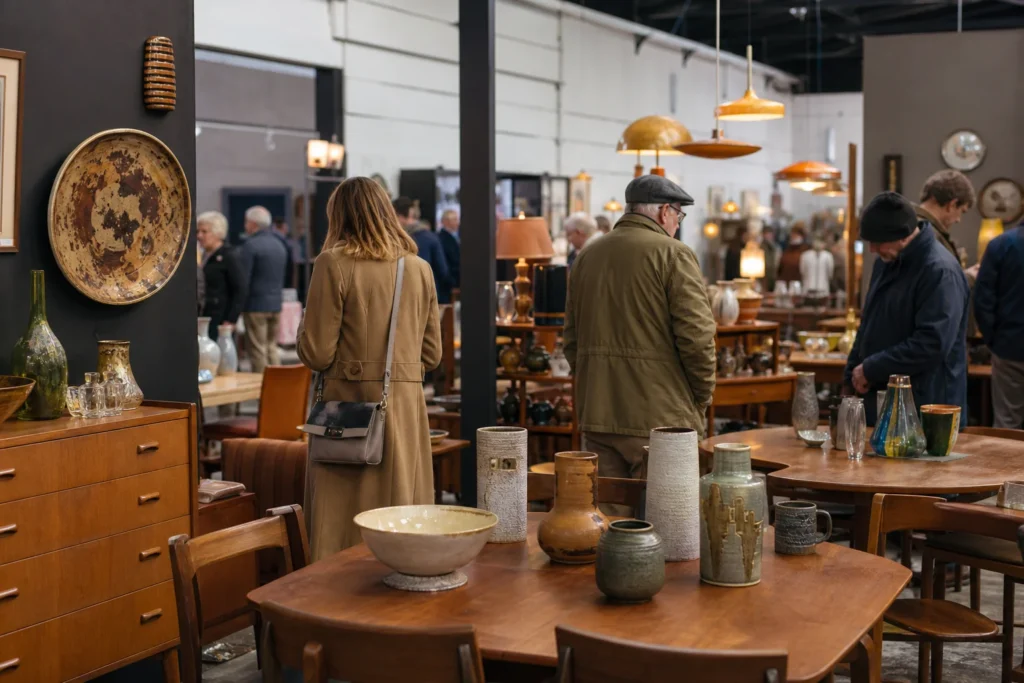
Walk into any room at the Vintage Home Show Midlands and the era announced itself immediately. The furniture sat low and purposeful. Lighting in organic forms caught the eye from across the floor. Ceramics in burnt orange and avocado green lined the trestle edges. This was not a general antiques fair with a loose postwar corner. It was a show built almost entirely around the decades between the Festival of Britain and the arrival of flatpack furniture — a tight, coherent slice of postwar British and European design.
The merchandise reflected that discipline across every stall. Furniture from the 1950s, 1960s and 1970s formed the backbone of the show. Teak sideboards, moulded chairs, and lounge suites in period upholstery gave collectors something to measure and consider. Lighting was a particular strength. Sculptural pendants, arc floor lamps and ceramic table bases appeared in quantities rarely seen outside specialist London fairs. These were pieces that needed space to display properly, and the Midlands venues gave dealers room to show them at their best.
The smaller objects offered a different kind of browsing entirely. Ceramics, glassware and textiles rewarded the patient visitor who worked the edges of each stall. Studio pottery, pressed glass and woven throws sat alongside kitchenware, decorative china and enamelware. Candelabras and framed graphic prints added further texture. Entry points varied widely, making the show accessible to buyers who arrived with modest budgets alongside those hunting significant furniture pieces.
What set the Vintage Home Show apart from a general antiques centre was the sensibility behind each stall. Dealers curated with a point of view. The stock tended to feel selected rather than accumulated. Mid-century furniture hunters valued this especially. The kind of characterful, well-made object that surfaced here rarely appeared in high-street charity shops or mainstream antiques markets. Ceramics buyers and textile collectors found the show comparably worthwhile for similar reasons.
The audience was as mixed as the merchandise was focused. Dedicated collectors arrived early and moved efficiently toward the furniture and lighting. Interior designers walked the show differently, picking up smaller objects and talking through ideas with dealers who genuinely engaged with styling questions. Home renovators on a room project found the show a practical source of period-appropriate pieces. Many visitors came without a fixed shopping list, drawn by the atmosphere as much as the stock.
The Vintage Home Show ran a touring circuit across England, reportedly including events in Manchester and Leeds alongside the Midlands dates. For Midlands visitors, the regional shows removed the need to travel to one of the larger northern city events. The organising team brought considerable experience to each staging, and it showed in the venue choices — rooms large enough for furniture to breathe, wide enough for proper browsing without bottlenecks.
The show ran through spring, summer and autumn, pausing during winter months. Early arrival consistently rewarded visitors. Furniture and lighting pieces moved fast once doors opened, and the first hour of trading had a particular energy: dealers greeting regulars, collectors comparing notes, the occasional negotiation reaching a quiet conclusion across a teak dining table.
The Vintage Home Show Midlands served a specific collector community with unusual consistency. It understood its era, respected its audience and gave mid-century design a well-organised regional platform. For the collectors, designers and enthusiasts who attended, it occupied a distinct and valued place in the English antiques fair calendar.
Frequently Asked Questions
Q: What kind of fair was the Vintage Home Show Midlands?
A: It was a specialist vintage fair with a tight focus on postwar British and European design — roughly the 1950s through to the 1970s. Rather than a general antiques market, the show brought together dealers whose stock reflected a coherent mid-century sensibility, with furniture, lighting, ceramics, textiles and glassware all selected around that era.
Q: What were the strongest categories for collectors and buyers?
A: Furniture and lighting were the backbone of the show. Teak sideboards, moulded chairs and sculptural pendant lights appeared in quantities rarely found outside specialist fairs. Ceramics, studio pottery, pressed glass and woven textiles rewarded patient browsing along the stall edges, with entry points ranging from modest decorative objects through to significant furniture pieces.
Q: Who typically attended — was it mainly serious collectors?
A: The audience was genuinely mixed. Dedicated mid-century collectors arrived early and moved quickly toward furniture and lighting. Interior designers picked up smaller objects and talked through ideas with dealers who engaged readily with styling questions. Home renovators came looking for period-appropriate pieces, and many visitors attended with no fixed list, drawn as much by the atmosphere as any specific hunt.
Q: Did the Vintage Home Show run elsewhere, or was the Midlands event standalone?
A: The show operated as part of a touring circuit across England, with events also reported in Manchester and Leeds. The Midlands dates gave regional buyers a practical alternative to travelling to one of the larger city events, and the touring format meant the organising team had experience placing the fair in venues with enough space to display larger furniture pieces properly.
Marketplace Highlights









Add a review