

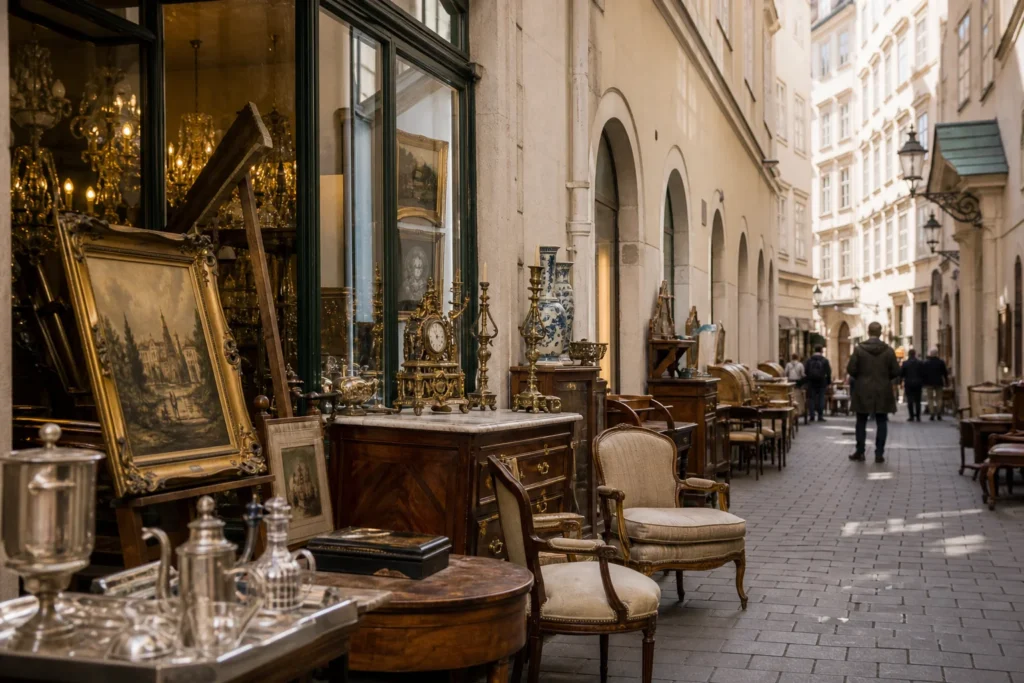

Most visitors rushing between Stephansplatz and the Staatsoper walk straight past them. The narrow lanes of the Kärntner Viertel — Stallburggasse, Spiegelgasse, Dorotheergasse, Bräunerstraße, Plankengasse — sit just off the tourist current, yet they hold some of the most serious antique trading in central Europe. The contrast is the point: cobblestones and shop fronts that look modest from outside, collections inside that would hold their own in any auction catalogue.
The Dorotheum on Dorotheergasse anchors the whole district. One of the world's oldest auction houses, it draws international collectors and gives the neighbourhood its professional weight. Around it, a cluster of specialist dealers works at a more intimate scale. Wissenschaftliches Kabinett on Spiegelgasse 23, Kunsthandel Kolhammer on Plankengasse 7, Patrick Kovacs Kunsthandel on Lobkowitzplatz, Kunsthandel Stephan Andréewitch in Stallburggasse, and Lilly's Contemporary Art & Exclusive Antiques each bring genuine curatorial character. These feel less like shops and more like edited private collections — the kind of place where a dealer can date a piece by the joinery, not the label.
The inventory spans centuries, but two periods dominate the conversation. Biedermeier work from roughly 1800 to 1850 turns up repeatedly — clean geometry, warm fruitwoods, a restraint that reads surprisingly well in contemporary interiors. Jugendstil and Vienna Secession pieces from around 1900 to 1910 fill the other end of the spectrum: fluid ornamentation, nature motifs, the design language of Hoffmann, Wagner and Loos made physical. Thonet bentwood chairs, Loetz glassware, Augarten and Meissen porcelain, Herend animal figurines, Riess enamelware, long-case clocks, gothic painted furniture and Baroque armories all appear across the district's shops. Smaller pieces — a porcelain cup, a Jugendstil vase, a silver brooch — give first-time buyers a realistic entry point without competing for the centrepiece lots.
Prices here reflect museum-quality provenance and professional expertise. This is not flea-market territory, and the dealers make no apology for it. Serious collectors will recognise the standard immediately; anyone else should treat that as useful calibration before browsing.
Most shops in the district open Monday through Friday from 10:00 to 18:00, and Saturday from 10:00 to 13:00. The district is generally quiet on Sundays, so plan accordingly. A Saturday morning visit before 13:00 suits those who want to move quickly; a weekday afternoon gives more time to ask questions and handle pieces properly.
The Kärntner Viertel suits dedicated collectors, Biedermeier and Jugendstil specialists, high-end gift buyers and anyone making a purposeful antique crawl rather than a casual browse. What makes it worth choosing over a general city search is simple: the concentration of serious specialists within a handful of walkable alleys is rare at this level anywhere in Europe, let alone in a single postal district.
Getting here is straightforward. Stephansplatz station, approximately 300 metres away, serves subway lines U1 and U3 alongside bus lines 1A, 2A and 3A — it is the most practical arrival point for most visitors. Bus line 2A also stops at Plankengasse, roughly 80 metres from the heart of the dealer cluster. Oper, Karlsplatz offers further options about 350 metres away, with tram lines 1, 2, 71 and D, light rail line WLB, and a broad range of bus connections including night routes.
Frequently Asked Questions
Q: What kinds of antiques and collectibles will I find in Vienna's Antique District?
A: The district has real depth across several periods. Biedermeier furniture (c.1800–1850) with its clean lines and warm fruitwoods appears regularly, as does Jugendstil and Vienna Secession work from around 1900–1910. Specific pieces to look for include Thonet bentwood chairs, Loetz glassware, Augarten and Meissen porcelain, Herend animal figurines, Riess enamelware, long-case clocks, gothic painted furniture and Baroque armories. Smaller objects — a Jugendstil vase, a silver brooch, a porcelain cup — give first-time buyers a realistic entry point.
Q: Is this a good destination for casual browsers, or is it aimed at serious collectors?
A: Serious collectors will feel at home immediately; prices reflect museum-quality provenance and professional expertise. That said, the district rewards curious browsers too, especially those with a genuine interest in decorative arts or period design. Treat the price level as useful calibration before you walk in — this is not flea-market territory, and the dealers don't position it that way.
Q: What are the general opening hours for the district's shops?
A: Most shops open Monday through Friday from 10:00 to 18:00 and Saturday from 10:00 to 13:00. The district is generally quiet on Sundays. A weekday afternoon gives the most time to ask questions and handle pieces properly; a Saturday morning visit works if you want to move through quickly before the half-day close. Confirm individual shop hours directly before making a dedicated trip.
Q: Which streets and landmarks should I use to navigate the district?
A: The core runs through a cluster of narrow lanes just off the main tourist flow between Stephansplatz and the Staatsoper: Stallburggasse, Spiegelgasse, Dorotheergasse, Bräunerstraße and Plankengasse. The Dorotheum auction house on Dorotheergasse is the natural anchor and starting point. Named specialist dealers are spread across these streets and nearby Lobkowitzplatz, so a slow walking loop covers the whole district without backtracking far.
Marketplace Highlights








Add a review