

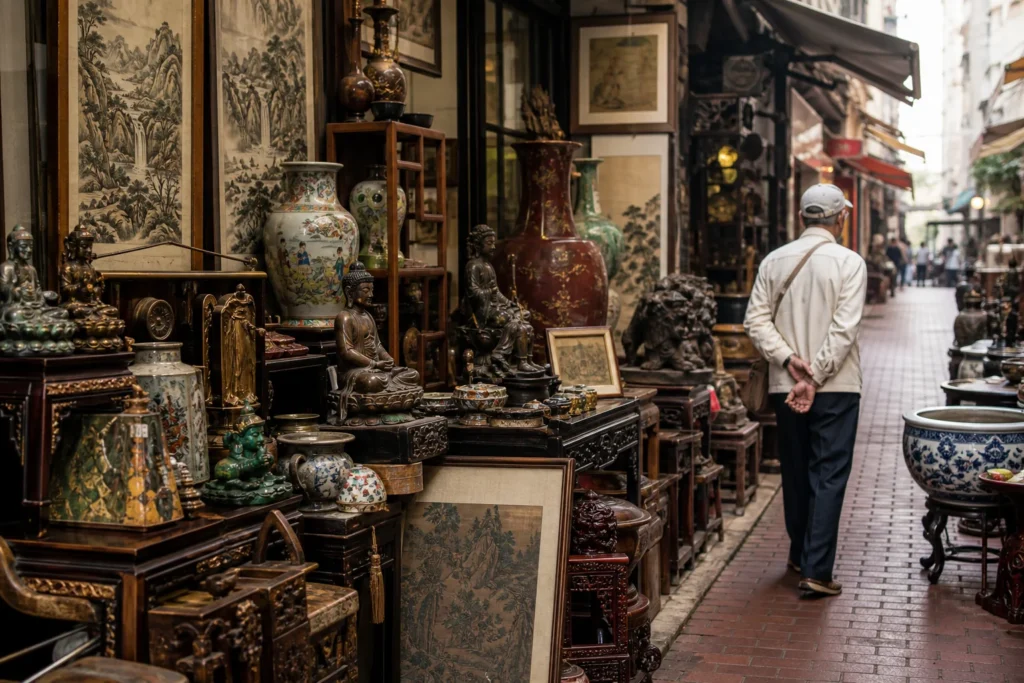

Hollywood Road has been a trading street since 1844. Built in the early years of British Hong Kong, its original position near the old shoreline made it a natural corridor for merchants dealing in goods from mainland China. That commercial instinct never faded. Nearly two centuries later, the road remains one of Asia's most concentrated antique markets — not a curated space, but a working street where dealers, collectors and first-time browsers all move through the same dense stretch of shops.
The first thing visitors notice is the sheer variety on display. Carved jade pieces crowd shelves beside export porcelain and lacquerware. Further along, furniture dealers fill deep, low-lit showrooms with heavy Ming and Qing dynasty cabinets, tables and screens — the kind of pieces that anchor a serious collection. Elsewhere, the register shifts toward 20th-century material: Mao-era memorabilia, propaganda posters and classical Chinese paintings share window space in a way that feels genuinely eclectic rather than curated.
The street runs at a gentle but sustained incline from the Central end up toward the Man Mo Temple, so comfortable footwear is worth thinking about before you set off. Antique shops sit shoulder to shoulder for much of the length, broken up by a scattering of contemporary art galleries. That mix gives Hollywood Road a dual character — part antique market, part emerging-art corridor. Browsing here feels closer to moving through a sprawling museum than walking a typical shopping street, with the key difference that everything on display carries a price tag.
Not every shop targets serious collectors. Souvenir stores are spread throughout, stocking smaller pieces and decorative goods at prices well below the main tourist shopping districts. The quality is more variable, but the atmosphere is far more interesting than anything found in a mall.
Bargaining is expected and welcomed along Hollywood Road. Most dealers respond well to a clear opening offer and an unhurried negotiation. Knowing roughly what you are willing to pay before you enter a shop makes the process much smoother.
Hollywood Road also connects directly to Cat Street, officially Upper Lascar Row, which runs nearby on a parallel line. Cat Street trades at a lower price point, specialising in smaller curios, trinkets and secondhand goods. Combining both streets in a single visit gives a fuller picture of Hong Kong's antique and secondhand scene. Most shops along the stretch keep hours roughly from 11:00 to 18:00, Monday through Saturday, with Sunday typically a rest day — though individual dealers may vary.
Getting here is straightforward. Sheung Wan MTR station on the Island Line sits approximately 300 metres away and makes the easiest arrival point for most visitors. For those travelling by bus, the Hollywood Terrace stop is almost directly outside, served by a large number of routes including buses 3A, 4, 4X, 7, 10, 26 and several others. The Hillier Street tram stop is also within roughly 300 metres, offering a slower but scenic approach from the east.
Frequently Asked Questions
Q: What kinds of antiques and collectibles can you find along Hollywood Road?
A: The range is unusually broad for a single street. Carved jade, export porcelain and lacquerware sit alongside Ming and Qing dynasty furniture in deep showroom spaces. Elsewhere the stock shifts toward Mao-era memorabilia, propaganda posters and classical Chinese paintings. Collectors focused on Chinese and Southeast Asian antiques will find it hard to leave quickly, and casual browsers will find souvenir-grade shops mixed in throughout.
Q: Is bargaining expected, or are prices fixed?
A: Bargaining is standard and welcomed by most dealers on Hollywood Road. Coming in with a clear sense of what you are willing to pay and opening with a direct offer makes negotiations smoother. Most vendors engage readily with an unhurried approach.
Q: What is Cat Street, and is it worth visiting alongside Hollywood Road?
A: Cat Street — officially Upper Lascar Row — runs parallel nearby and trades at a lower price point, specialising in smaller curios, trinkets and secondhand goods. The two streets complement each other well, and combining both in a single visit gives a fuller picture of Hong Kong's antique and secondhand scene.
Q: When are the shops open, and how do I get there?
A: Most shops keep hours roughly from 11:00 to 18:00, Monday through Saturday, with Sunday typically a rest day, though individual dealers vary. Sheung Wan MTR station on the Island Line is the easiest arrival point, sitting approximately 300 metres from the street. Check individual shop hours before a dedicated visit, as schedules can differ across dealers.
Marketplace Highlights








Add a review