

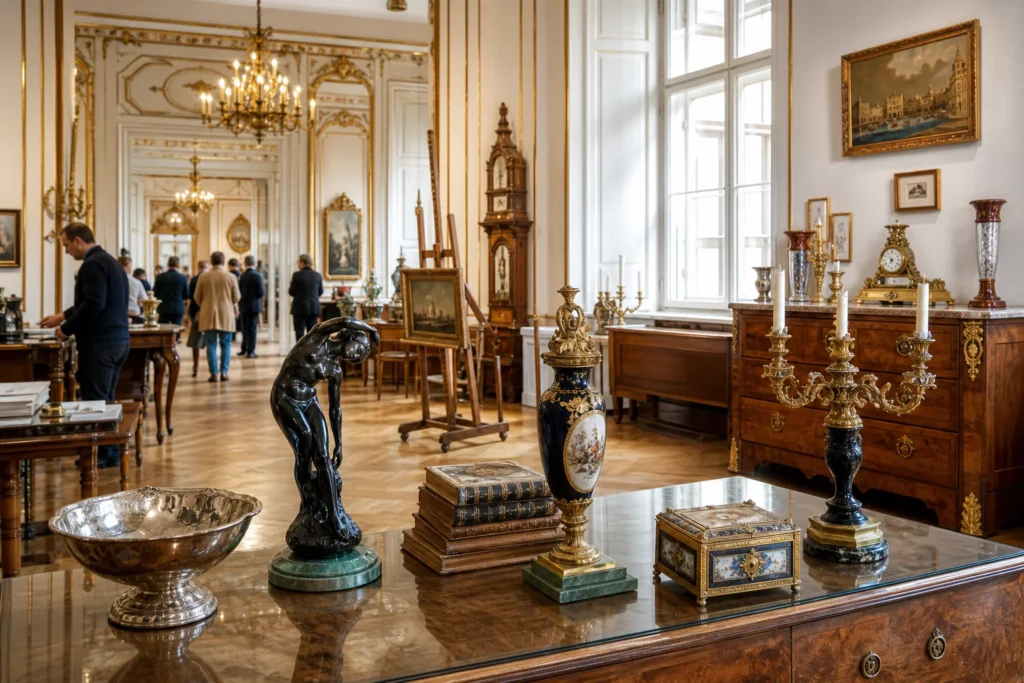

Palais Kinsky sits on Freyung in Vienna's 1st district, its baroque façade giving little away. Step inside, and the scale of what happens here becomes clear. Auktionshaus im Kinsky is one of Austria's most significant auction houses, and it has occupied this 18th-century palace since its founding in 1993. The combination of historic setting and serious dealing gives every visit a particular weight.
The catalogues run across meaningful clusters rather than arbitrary categories. Fine art spans Old Masters, 19th-century paintings, Modern and Contemporary works. Decorative arts draw in Art Nouveau, Wiener Werkstätte pieces, antique furniture, silver and bronze objects. Jewellery rounds out the offer. Im Kinsky holds approximately three major auction cycles per year, and each catalogue is substantial enough to reward proper study before the sale date.
The house made international headlines in 2024 when it sold a newly rediscovered Gustav Klimt portrait — Portrait of Fräulein Lieser — for around €30 million at hammer price. That result confirmed what regular buyers already understood: im Kinsky surfaces genuinely important works. It takes curatorial risks and backs them.
Bidding is available in person, by phone, and online, so the room is never the only route in. After each auction, unsold lots move into a post-auction sale at fixed prices, typically available for a period afterward. That window suits buyers who prefer quiet negotiation over live competition. Prices can be more approachable, though the objects are no less serious. The house also handles private sales and art consulting, and a small expert team means interaction stays personal rather than institutional.
Non-auction visits are worth making. Exhibition previews before each sale open the lots to close inspection, and the rooms feel genuinely lived-in rather than museum-cool. The house opens Monday to Friday from 10:00 to 18:00 and stays closed at weekends. Freyung itself is a calm square by Viennese standards, easy to combine with a walk through the surrounding Innere Stadt.
Getting here is straightforward from several directions. Herrengasse station is approximately 175 metres away and serves U3 subway trains as well as bus lines 1A and 2A. Bus line 1A also stops at Teinfaltstraße, roughly 70 metres from the address — the closest public transport point to the door. Trams 1, 71 and D stop at Rathausplatz/Burgtheater, around 250 metres away, along with night buses N25, N38, N60 and N66 for later evenings.
Im Kinsky rewards patience and preparation. Browse the forthcoming catalogue, visit during the exhibition preview, and decide whether to bid live or follow the sale remotely. For decorators sourcing a Wiener Werkstätte desk or collectors tracking a specific period, the depth of stock justifies the attention. And when the gavel falls short of its reserve, the post-auction window is there — a second chance at objects that still deserve a good home.
Frequently Asked Questions
Q: Do I need to be a serious collector to engage with Auktionshaus im Kinsky, or is it accessible to first-time buyers?
A: First-time buyers are welcome. The post-auction sale — where unsold lots are available at fixed prices after each auction — is a particularly low-pressure entry point, removing the live bidding dynamic entirely. Exhibition previews before each sale are open for inspection, so you can examine pieces closely before deciding whether to bid or wait.
Q: What kinds of objects come up at im Kinsky, and is it useful for decorators sourcing specific periods or styles?
A: The catalogue runs broad and deep. Fine art spans Old Masters through to Contemporary; decorative arts cover Art Nouveau, Wiener Werkstätte pieces, antique furniture, silver and bronze objects; jewellery appears regularly too. For decorators tracking a specific period — a Wiener Werkstätte desk, an Art Nouveau lamp — the catalogues are worth studying well ahead of the sale date, as the depth rewards preparation.
Q: Can I bid without being in the room on auction day?
A: Yes. Bidding is available in person, by phone, or online, so attending the Vienna sale room is not a requirement. If you're following a specific lot remotely, reviewing the catalogue thoroughly and visiting the exhibition preview in advance — if possible — will give you the best read on condition and scale before committing.
Q: How do I get to Palais Kinsky on Freyung using public transport?
A: The closest stop is Teinfaltstraße, served by bus line 1A, approximately 70 metres from the entrance. Herrengasse station (U3 subway, plus bus lines 1A and 2A) is around 175 metres away. Trams 1, 71 and D stop at Rathausplatz/Burgtheater, roughly 250 metres distant. Night buses N25, N38, N60 and N66 also serve the area for later-evening visits.
Q: When is im Kinsky open for non-auction visits, and what's worth timing a trip around?
A: The house opens Monday to Friday, 10:00 to 18:00, and is closed at weekends. Exhibition previews held before each auction cycle are the most rewarding visits — lots are displayed for close inspection in the Palais rooms, which feel lived-in rather than museum-formal. Check the house's official website for preview dates tied to upcoming sales.
Marketplace Highlights








Add a review