


Region
The Austin Antique Mall is permanently closed. The venue is retained as an editorial archive of the venue and its distinctive character.
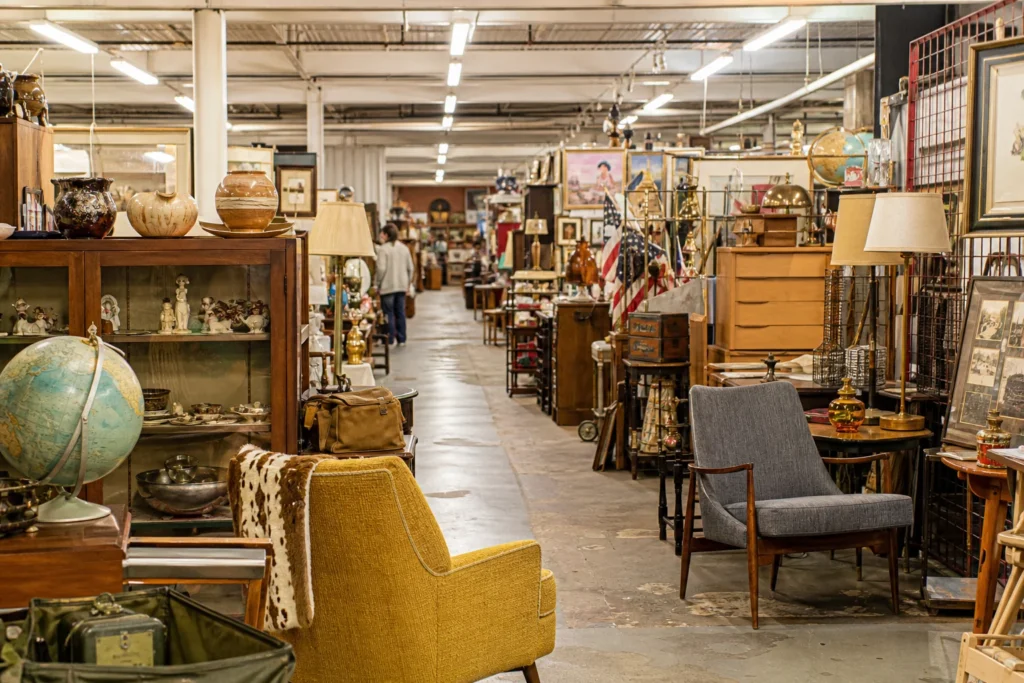
Stepping inside a space reported to span 30,000 square feet, a visitor to the Austin Antique Mall encountered something closer to a compressed neighbourhood than a conventional shop floor. Booth after booth extended in every direction, each one holding a different collecting world. Some aisles opened wide and invited easy movement. Others narrowed between stacked furniture and crates of vinyl, requiring a careful sideways step. That physical variation was part of the character — the place felt genuinely overstuffed, in the way a serious antiques destination should.
More than 100 dealers reportedly filled the mall at its height, and the range they brought was one of its defining qualities. Furniture and decorative objects anchored many booths: mid-century pieces, ornate candlesticks, clocks and lamps that demanded attention as you passed. Other aisles shifted into a different register entirely — militaria, cameras, stamps, comics and assorted paper ephemera drew collectors who knew exactly what they were hunting. Elsewhere, vintage clothing hung alongside jewellery cases, silverware sets and china. The categories did not always stay tidy, and that messiness was part of the appeal.
Dealers at the mall were not passive presences behind their merchandise. Many kept additional stock off the floor and welcomed direct conversation about their specialities. For a collector with a specific gap to fill, this made the Austin Antique Mall considerably more useful than a straight browse of visible inventory suggested. Knowing which vendors to seek out, and building that knowledge across visits, became its own reward.
Stock turnover gave the place a rhythm that suited repeat visitors. Dealers refreshed their booths consistently, which meant a return trip a few weeks later rarely looked like the same experience. Regular visitors understood this pattern and planned accordingly — some returned across multiple trips just to cover the floor properly. A single visit that felt thorough often revealed something overlooked on a second pass.
The mall suited collectors with a precise focus and curious browsers with none at all. Furniture hunters, militaria enthusiasts and vintage clothing seekers all found genuine reasons to linger. First-time visitors often described a moment of mild overwhelm at the scale, followed fairly quickly by the specific pleasure of not knowing what the next booth would hold. That combination — initial density giving way to discovery — shaped the experience in a way that kept people returning.
The Austin Antique Mall occupied an unusually substantial place in Central Texas antiques culture. Its scale, its reported longevity dating back to 1984, and the breadth of its dealer community gave it a weight that smaller markets rarely achieved. For collectors and secondhand enthusiasts in the Austin area, it functioned as a serious point of reference — a place measured not in a single visit but in accumulated familiarity over time.
Frequently Asked Questions
Q: Is the Austin Antique Mall still open?
A: No. The Austin Antique Mall is permanently closed. The venue is preserved here as an editorial archive of its history and character.
Q: What kinds of antiques and collectibles did the Austin Antique Mall carry?
A: The mall was exceptionally broad in its range. More than 100 dealers filled around 30,000 square feet with mid-century furniture, decorative objects, militaria, vintage clothing, jewellery, silverware, cameras, stamps, comics, vinyl records, clocks, lamps, and china, among much else. Each booth reflected a different collecting focus, so the inventory shifted noticeably as you moved through the space.
Q: Was it worth talking directly to dealers rather than just browsing?
A: Very much so. Many dealers held additional stock off the floor and welcomed conversation about their specialities. For collectors with a specific piece or category in mind, a direct conversation often opened up inventory that a straight browse of visible goods would never have revealed.
Q: How long did a proper visit typically take?
A: Most visitors who planned a quick hour found themselves still there two or three hours later. A thorough pass through the full floor took the better part of a day, and regular visitors often returned across multiple trips to cover it properly.








Add a review