

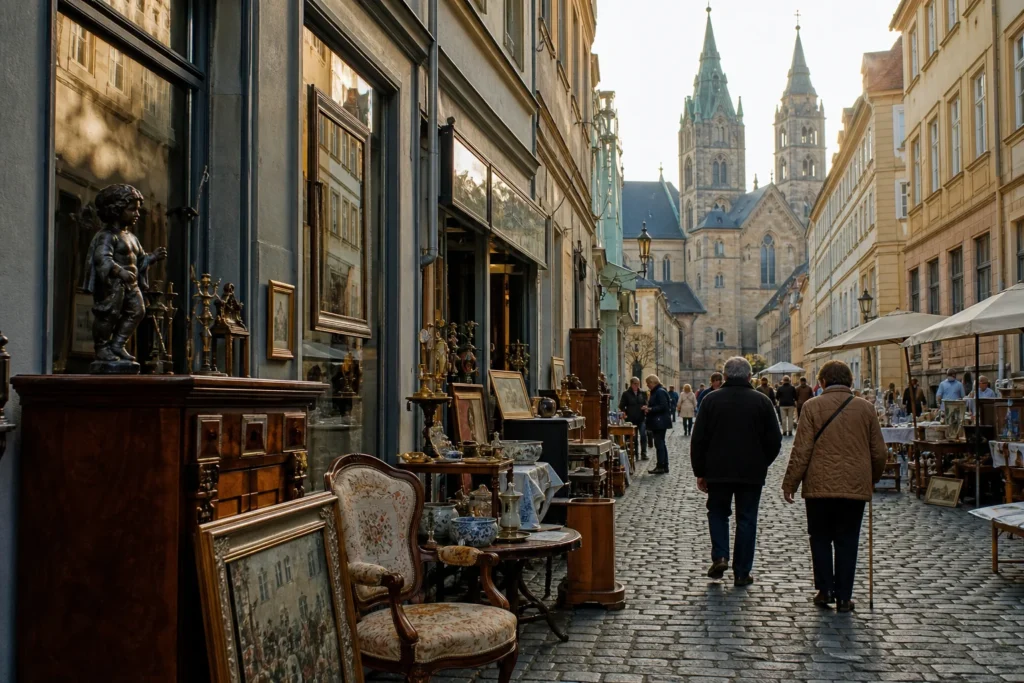

Few antique districts in Bavaria carry the weight of place quite like this one. The shops along Karolinenstraße, Herrenstraße and Dominikanerstraße sit in buildings that survived the Second World War largely unscathed. Bamberg Cathedral rises just above, and its shadow falls across the same cobblestones that dealers have worked for decades. The architecture and the merchandise feel like chapters in a continuous story — and that continuity is exactly what draws serious collectors here.
Antiquariat Lorang anchors the bibliophile end of the district. Open since 1989, the shop holds more than 50,000 antique books and suits anyone who wants depth rather than a casual browse. Clear an afternoon. Senger Kunsthandel occupies a position between the cathedral and the old town hall, and its focus spans Gothic sculpture, paintings from the 15th to the 20th century, and selected furniture from the 18th and 19th centuries. The gallery rewards collectors with broad visual tastes and a specific interest in older German and European work. Hauptmann Antiquitäten and Silber Kontor Heiss extend the range further, each with its own specialist focus. Together, these names offer genuine variety within a very short walk.
That compactness matters more than it might first appear. Dealers here have built reputations on specialist knowledge rather than volume. Serious buyers often arrive already knowing the names. The short distances between shops make it easy to return and reconsider a piece without losing momentum — comparison shopping in this district is straightforward, not exhausting. The overall pace feels unhurried, which suits the kind of buying that requires thought.
Once a year, the district amplifies into the Bamberger Kunst- und Antiquitätenwoche, an art and antiques week held in July. During this period, hours extend across the district: Monday to Friday from 10:00 to 18:00, Saturday from 10:00 to 16:00, and Sunday from 13:00 to 17:00. Additional dealers from across Germany and beyond join the permanent residents. Listed buildings open for exhibitions, and outdoor stalls fill the public spaces between the shops. The event does not replace what the district is the rest of the year — it amplifies it, giving the streets a festival energy while keeping the specialist character intact.
Getting to the district by public transport is straightforward. Bamberg station, approximately 1.5 km away, serves intercity trains including IC 61 and ICE 28, alongside a wide range of regional RE and RB services. For the final stretch into the heart of the quarter, the Historisches Rathaus bus stop is approximately 50 metres from the district, served by the local Bambergbus line.
The Bamberg Art and Antique District suits collectors who value concentration and expertise over scale. Bibliophiles, buyers of Gothic and early modern art, and anyone with a focused interest in German antiques will find more here than a first glance suggests. The permanent district and the annual summer event together make Bamberg a stronger specialist destination than many larger but less cohesive antique venues elsewhere in the region.
Frequently Asked Questions
Q: What kinds of antiques and collectibles can I expect to find in the Bamberg Art and Antique District?
A: The district covers a broad range. Antiquariat Lorang holds more than 50,000 antique books and suits serious bibliophiles. Senger Kunsthandel focuses on Gothic sculpture, European paintings from the 15th to the 20th century, and selected furniture from the 18th and 19th centuries. Hauptmann Antiquitäten and Silber Kontor Heiss each bring their own specialist focus, so the overall range — across a very short walk — is wider than the district's compact size might suggest.
Q: Is there a time of year when the district is particularly worth visiting?
A: Once a year, the district hosts the Bamberger Kunst- und Antiquitätenwoche, an art and antiques week held in summer. During this period, participating dealers are joined by additional vendors from across Germany and beyond, listed buildings open for exhibitions, and outdoor stalls fill the public spaces between the shops. Hours extend across the district for the duration. Check the organizers' official channels for the current year's dates before you plan around it.
Q: How easy is the district to get around on foot?
A: Very easy. The quarter runs along three streets — Karolinenstraße, Herrenstraße and Dominikanerstraße — and the distances between shops are short enough that doubling back to reconsider a piece takes minutes rather than effort. Serious collectors find the compact layout a practical advantage: comparison shopping here is straightforward without the fatigue of a sprawling fair.
Q: How do I reach the district by public transport?
A: Bamberg station, around 1.5 km away, is served by intercity and regional rail including IC and ICE services. From the station, the Historisches Rathaus bus stop — served by local Bambergbus routes — is approximately 50 metres from the heart of the district.
Q: Is this district suited to casual visitors, or is it primarily for trade buyers?
A: Both find it worthwhile, though the atmosphere skews toward the serious collector. Dealers here built their reputations on specialist knowledge rather than volume, and many buyers arrive already knowing specific names. That said, the unhurried pace and walkable layout make it equally rewarding for a first-time visitor who arrives without a fixed agenda and simply wants to browse with depth.
Marketplace Highlights








Add a review