

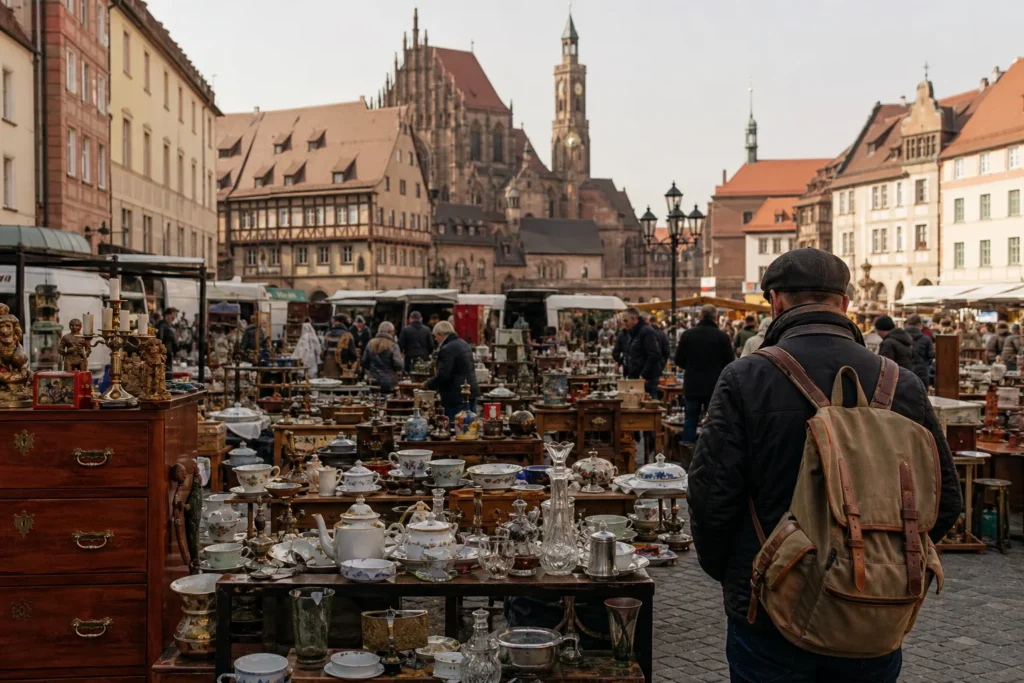

Twice a year, Nuremberg's medieval Altstadt becomes the setting for one of Germany's largest and most atmospheric flea markets. The Trempelmarkt spreads through the historic Old Town streets in May and September, filling cobbled lanes and squares with hundreds of stalls and drawing crowds from across the country and beyond. The scale alone is extraordinary. What keeps visitors coming back, though, is the character the setting lends to everything on sale.
The Friday opening is the event's defining session. Stalls open at 16:00 and trade until midnight, lit largely by candlelight rather than harsh electric light. Silverware catches the flame. Old porcelain and glassware glow in a way no daytime market can produce. The atmosphere is genuinely different from anything you will find at a conventional weekend fair, and experienced visitors often rate Friday evening as the best few hours of the entire event. Saturday runs from 07:00 to 20:00, giving serious browsers a full day to cover what Friday left unfinished.
The seller mix gives the Trempelmarkt much of its appeal. Professional antique traders set up alongside private sellers clearing inherited stock, and the contrast runs through the whole market. A curated dealer's display of silver and decorative porcelain might sit next to a table of family attic finds. That unpredictability rewards patience and makes returning to streets you have already walked worthwhile.
Merchandise clusters naturally around a few themes. Tableware and decorative objects dominate much of the market — crockery, china, silverware, jewellery and vintage glass appear in volume. Books, printed ephemera and vintage clothing surface regularly throughout the stalls. Larger pieces, including antique furniture, mix with smaller curiosities: gramophones, vintage toys, teddy bears and collectors' items of every description. Serious collectors of German antiques and Mitteleuropa decorative arts tend to find the range genuinely productive.
Bargaining is expected and welcomed here. When you find something you want, asking the seller for their Schmerzgrenze — their lowest acceptable price — signals immediately that you understand how the market works. Most vendors respond well to the question. A few words of German help everywhere, though most professional traders manage English well enough to negotiate.
The event draws very large crowds across the two days. Move slowly, double back on lanes you have already passed, and plan the full Friday-to-Saturday run rather than a single session. Comfortable shoes and a bag with room to grow are the only essential equipment.
Getting to the Trempelmarkt is straightforward. Lorenzkirche station on subway line U1 sits approximately 80 metres from the market site on Königstraße, making it the most direct public transport option. Tram line 8 stops at Marientor roughly 350 metres away. Visitors arriving by long-distance rail will find Nürnberg Hauptbahnhof approximately 600 metres from the market, with IC and ICE services connecting the city to much of Germany.
Frequently Asked Questions
Q: When does the Trempelmarkt take place each year?
A: The market runs twice a year, typically in May and September, centred on a Friday and Saturday in Nuremberg's historic Altstadt. Check the organizer's official page before you go to confirm the exact dates for the edition you plan to attend.
Q: What makes the Friday evening session worth attending?
A: Stalls open at 16:00 on Friday and trade until midnight, lit largely by candlelight. The effect is genuinely different from daytime browsing — silverware and old porcelain catch the flame in a way harsh electric lighting never produces. Experienced visitors often rate Friday evening the strongest session of the entire event.
Q: What kind of goods can I expect to find?
A: Tableware and decorative objects dominate much of the market — crockery, china, silverware, jewellery and vintage glass appear in volume. Books, printed ephemera and vintage clothing surface throughout, alongside antique furniture, gramophones, vintage toys, teddy bears and assorted collectors' curiosities. Professional antique dealers set up alongside private sellers clearing inherited stock, so the range and quality vary stall to stall.
Q: Is bargaining acceptable at the Trempelmarkt?
A: Bargaining is expected and welcomed. Asking a seller for their Schmerzgrenze — their lowest acceptable price — signals immediately that you understand how the market works, and most vendors respond well to it. A few words of German help, though most professional traders can negotiate in English.
Q: How do I get there, and how should I plan my visit?
A: Lorenzkirche station on subway line U1 sits roughly 80 metres from the market on Königstraße, making it the most direct public transport option. The event draws very large crowds, so plan for the full Friday-to-Saturday run rather than a single session, move slowly, and double back on streets you have already walked. Comfortable shoes and a bag with room to grow are the only real essentials.
Marketplace Highlights








Add a review