

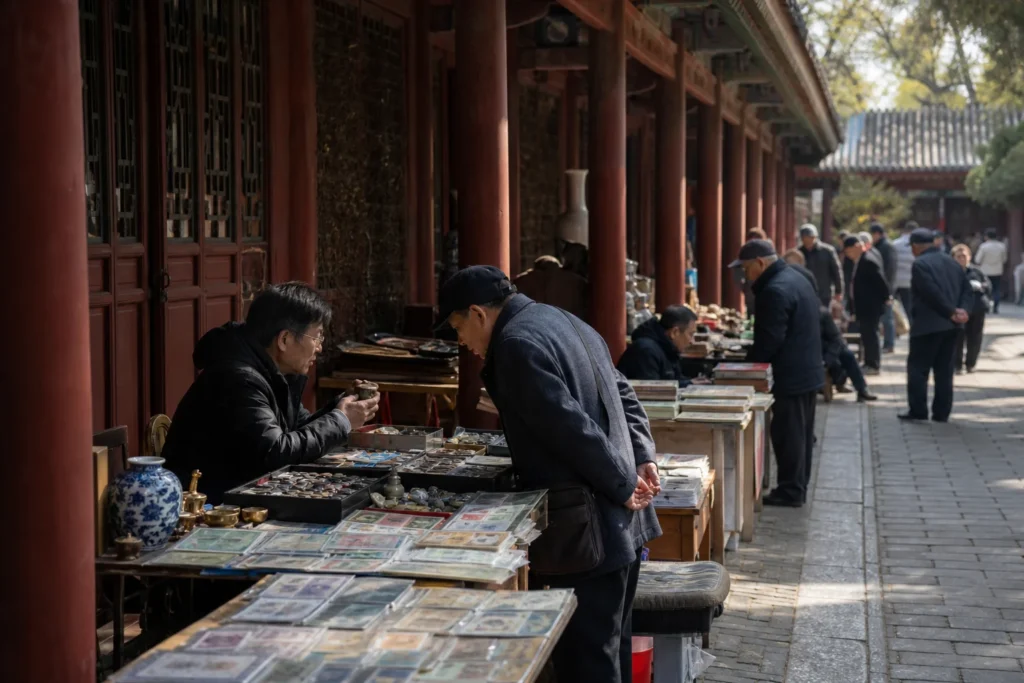

Baoguo Temple has been drawing traders and collectors to this corner of Beijing for well over a thousand years. The temple traces its origins to the Liao Dynasty in the 900s and was rebuilt into its present walled form in 1466. It has functioned as a commercial gathering place for most of the centuries since — antique bazaars and exchange fairs far outlasting any formal religious use. Walking through its gate today, that long mercantile tradition still feels entirely intact.
What sets this market apart from almost anything else in Beijing is its tight specialist focus. Vendors here concentrate on old Chinese coins and foreign currency, antique paper money, historic newspapers and vintage books. These are not decorative antiques or general curios — the inventory clusters around printed and minted history, and the best stalls carry material of genuine numismatic or bibliographic interest. That same specificity has a flip side: fakes and reproductions move freely through the market, and a practised eye matters considerably more here than at most of the capital's antique destinations.
The crowd reflects the inventory with unusual precision. Most visitors arrive with a list and a purpose — numismatists, paper money enthusiasts, rare-book hunters and dealers who know exactly what they want. Tourist foot traffic stays low, which keeps the pace calm and the atmosphere genuinely unhurried. Conversations between collectors run long here. Regulars treat the space as much as a networking venue as a buying ground, and those exchanges often prove as useful as the stalls themselves.
Weekend visits shift the dynamic noticeably. More mobile sellers spread across the courtyard on Saturdays and Sundays, filling gaps between the permanent stalls and widening the range of material on offer. The temple also hosts national collectors' events across the year, and during those gatherings the inventory quality rises and the crowd thickens considerably. If you time a visit to coincide with one, expect a broader and more competitive selection than on an ordinary weekday.
The market opens daily from 9am to 4pm. A small entry fee applies at the temple gate, and the exhibition halls inside add a layer of cultural interest worth the modest cost on their own. Street vendors outside the temple sell snacks and drinks, making it straightforward to extend a visit without rushing back out.
Getting here is easy from central Beijing. Xuanwumen station, served by subway lines 2 and 4, sits approximately 500 metres away and works well as the primary arrival point for most visitors. The 校场口 bus stop is roughly 330 metres from the market entrance and connects routes 83, 144 and the night bus 夜4. Changchunjie station on subway line 2 offers an alternative, approximately 700 metres away.
Baoguo Temple Antique Market earns its reputation on depth and specificity, not breadth. For collectors focused on Chinese coins, currency history or early printed matter, it delivers a quality of specialist material rarely concentrated in one place. The historic setting simply adds to the case for making the trip.
Frequently Asked Questions
Q: What does this market specialise in — is it a general antique market?
A: No. Baoguo Temple is a tight specialist market. Vendors concentrate almost exclusively on old Chinese coins, foreign currency, antique paper money, historic newspapers and vintage books. If you are after furniture, ceramics or decorative curios, you will find very little here.
Q: Is it worth visiting as a casual browser, or do you need specialist knowledge?
A: Casual browsers are welcome, but the market rewards preparation. Fakes and reproductions circulate freely alongside genuine material, so a trained eye matters considerably. That said, the unhurried pace and long collector conversations make it an absorbing visit even if you leave empty-handed.
Q: Does the day or time of week affect what is on offer?
A: Yes, noticeably. Weekends bring more mobile sellers into the courtyard, widening the range of material available. The temple also hosts national collectors' events across the year, and during those gatherings inventory quality rises and the selection broadens — worth timing a visit around if you can.
Q: How do I get here by public transport?
A: Xuanwumen station (subway lines 2 and 4) is approximately 500 metres away and is the most convenient arrival point for most visitors. The 校场口 bus stop, around 330 metres from the entrance, is served by routes 83, 144 and night bus 夜4. Changchunjie station on line 2 is an alternative at roughly 700 metres.
Q: Is there an entry fee, and are there other reasons to linger beyond the stalls?
A: A small entry fee applies at the temple gate. The exhibition halls inside add genuine cultural interest and are worth time on their own. Street vendors outside sell snacks and drinks, so there is no need to rush away once you have finished with the stalls.
Marketplace Highlights








Add a review