

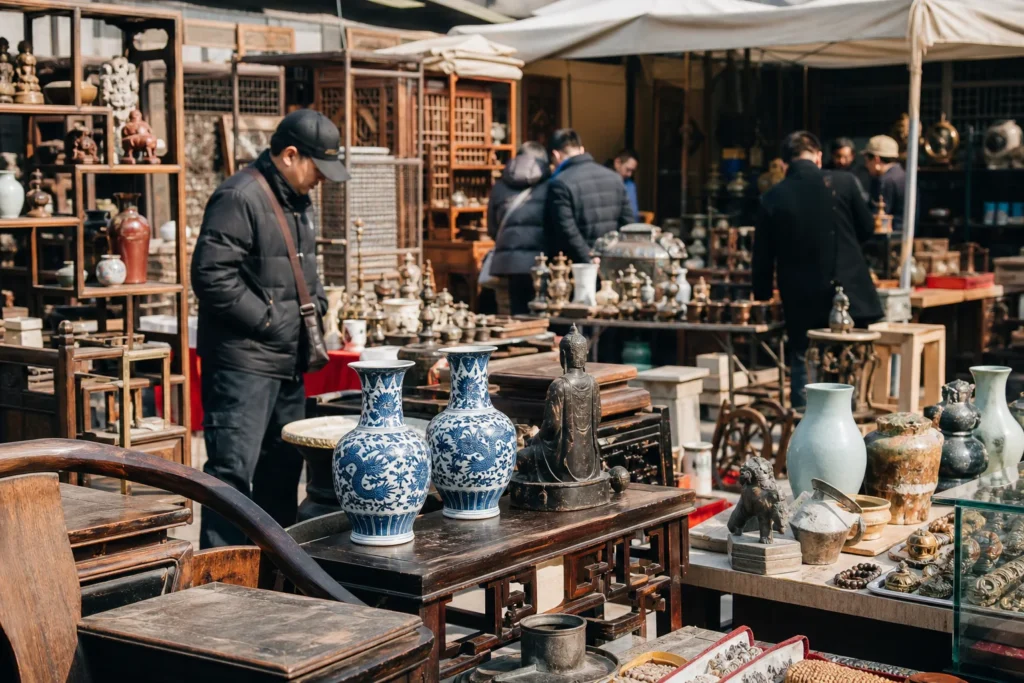

Beijing's most famous flea market earned its old nickname the hard way. Locals once called Panjiayuan "the dirt market" because traders would arrive having literally dug goods from the ground the day before, hoping to sell whatever the earth offered up. The digging is largely history now, but the raw, unpredictable energy it produced never left. Panjiayuan remains one of the most exhilarating market experiences in China.
The market occupies a large site in Beijing's Chaoyang district. It combines open-air stalls with covered sections, so there is always ground to cover regardless of the weather. Dealer numbers run into the thousands on a busy day, and the weekend crowds swell to match. Weekday hours run from 08:30 to 18:00, and the market does open Monday through Friday. Weekends draw the bigger spectacle, with stalls opening as early as 04:30 and trading through to 18:00. Early arrivals get slightly more breathing room before the crowds reach their peak.
What fills those stalls resists easy categorisation. Cigarette advertisement posters lean against folding tables next to seated Buddhas. Strings of prayer beads share space with delicate miniature teapots. Calligraphy scrolls hang beside Qing dynasty-style furniture. The honest truth is that most of it is replica, reproduction or general curiosity. Genuine antiques do exist, but finding them takes sharp expertise or a well-placed contact. Panjiayuan rewards the knowledgeable and quietly humbles the overconfident.
Bargaining is not optional here. Every seller expects negotiation, and some expect a degree of theatre. Come in with a clear price in mind, stay calm, and be willing to walk away. That last move carries real power in a market this size. If you want time to think before committing, note your stall location carefully. The crowds make it genuinely easy to lose your bearings, and finding a specific vendor again without a reference point can test your patience.
First-time visitors should allow at least a few hours. The scale surprises most people expecting a manageable browse. Panjiayuan is not a market you dart through quickly. It is one you get absorbed by, pleasantly or otherwise, depending on your tolerance for noise, press of bodies and the low-grade thrill of not knowing what the next table holds.
The market suits curious travellers, dedicated collectors and anyone drawn to the archaeology of secondhand culture. It is less suited to those who prefer calm, curated retail environments.
Getting here is straightforward. Panjiayuan subway station on metro line 10 sits roughly 300 metres away, making the market easy to reach from central Beijing. For bus travel, the 潘家园桥东 stop serves bus lines 34 and 63 approximately 150 metres from the site. Bus lines 28, 638 and 687, as well as the 夜30 night routes, stop at 潘家园桥 about 300 metres away.
Leave with something. Given the sheer variety spread across this market, it is, as more than one visitor has quietly discovered, essentially impossible not to.
Frequently Asked Questions
Q: When is the best time to arrive at Panjiayuan?
A: Weekend mornings are when the market is at its most alive, with stalls opening as early as 04:30. Serious collectors and experienced dealers arrive in those early hours. Weekday visits are quieter and some stalls don't open at all, so if you want the full scale of the market, a Saturday or Sunday is the better choice.
Q: Are the antiques at Panjiayuan genuine?
A: Most stock is replica, reproduction or general curiosity. Genuine antiques do exist within the market, but identifying them reliably takes either sharp expertise or a trusted contact on the ground. Come with realistic expectations and treat anything claimed as authentic with healthy scepticism unless you can verify provenance yourself.
Q: Do I need to bargain, and how should I approach it?
A: Bargaining is expected by every seller and some expect a degree of theatre along with it. Come in with a clear price in mind, stay calm, and be genuinely prepared to walk away — in a market this size, that move carries real weight. Before you wander off to think, note your stall location carefully; the crowds make re-finding a specific vendor surprisingly difficult.
Q: How do I get to Panjiayuan by public transport?
A: Panjiayuan subway station on metro line 10 is approximately 300 metres from the market, making it easy to reach from central Beijing. Several bus lines also serve stops within 150 to 200 metres of the site. Check current route information before travel, as service details can change.
Q: How long should I set aside for a visit?
A: Allow at least a few hours. The scale consistently surprises first-time visitors expecting a manageable browse. The combination of open-air stalls and covered sections means there is always more ground to cover, and getting absorbed — pleasantly or otherwise — is part of the experience.
Marketplace Highlights








Add a review