

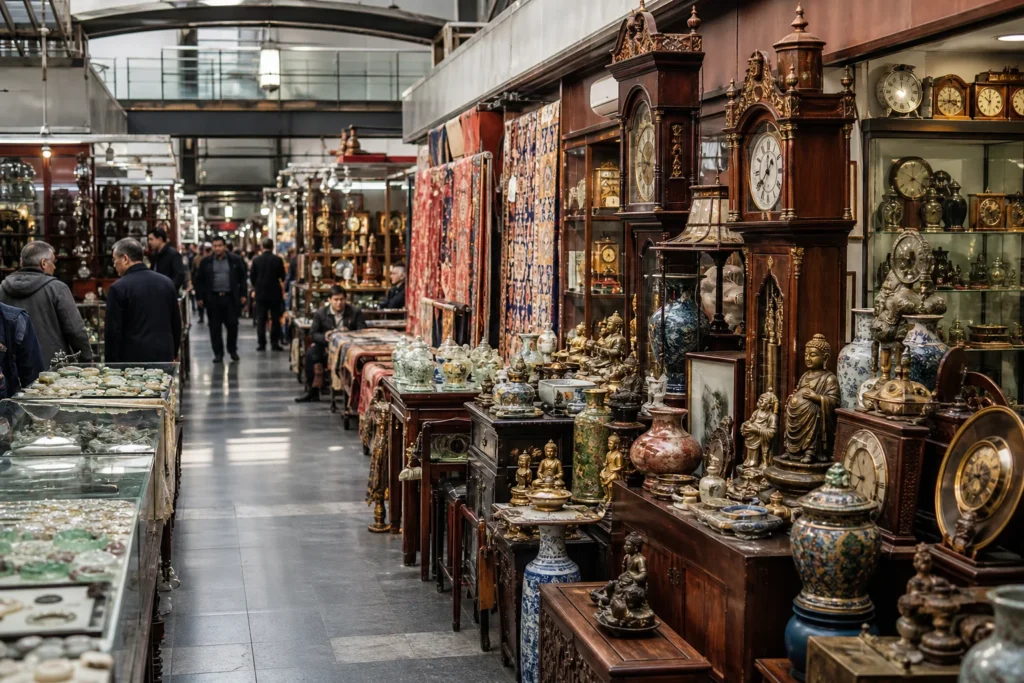

Beijing Curio City offers something rare in a city full of sprawling antique markets: a permanent, all-weather indoor complex open every day from 09:30 to 18:30. Spread across roughly 23,000 square metres in Chaoyang District, the building brings together more than 500 stores under one roof. Rain, heat or holiday crowds make no difference here. Serious collectors and casual browsers can spend an entire morning — or a full day — without stepping outside.
The ground floor centres on jade. Vendors display carved pendants, bangles and sculptural pieces across glass cases, covering a wide spectrum of grades from pale celadon nephrite to vivid imperial green. Sellers here are generally knowledgeable and willing to explain the differences. Buyers without a baseline understanding of the stone, however, will benefit from arriving with some research done or a trusted guide in tow.
The second and third floors open into a denser, more varied world. Bronze vessels with ink-rubbed patinas, lacquered boxes and silk-pile rugs dominate many stalls. Wander further and the range shifts to calligraphy scrolls, painted porcelain, ancient coins, pearl and gemstone jewellery, and substantial pieces of vintage furniture. The density of adjacent stalls makes proper browsing easy. It is entirely possible to spend an hour simply looking before committing to a single purchase — which is arguably the best approach.
The fourth floor rewards the most specialised visitors. Dealers in antique clocks and pocket watches line their cases with precision. Brass carriage clocks sit alongside Qing-era timepieces, and the vendors here discuss provenance with a fluency that is harder to find at outdoor markets. For clock collectors in particular, this floor gives the building a specialist credential well above a general curio complex.
One practical note applies across all four floors: not everything here is what it first appears to be. Convincing reproductions share shelf space with genuine period pieces, and the two are not always easy to separate. Decorative replicas suit many shoppers perfectly well. Those pursuing authenticated antiques should examine closely, ask direct questions about age and source, and pay attention when answers feel rehearsed.
Bargaining is standard practice throughout the building. Vendors price with negotiation built in. Arriving when the doors open at 09:30 gives the widest choice and the most relaxed atmosphere for a measured back-and-forth. The best pieces tend to move early in the day.
Beijing Curio City suits collectors with a defined focus — jade, clocks, textiles, ceramics — as well as first-time visitors to Beijing's antique trade who want a structured starting point rather than an open-air scramble. Interior hunters looking for carpets, furniture or decorative porcelain will also find genuine depth here. The combination of daily hours, permanent fixed stalls and specialist floor-by-floor organisation makes it a more reliable base than many alternatives in the city.
Getting here is straightforward from central Chaoyang. Tuanjiehu Station on Metro Line 10 sits approximately 575 metres away and serves as the most practical transit option for visitors coming from across the city. Two bus stops — 团结湖路, served by bus 专5, and 团结湖路北口, served by buses 31 and 95 — are both within approximately 235 metres of the complex and offer useful connections for those already in the neighbourhood.
Frequently Asked Questions
Q: When is Beijing Curio City open, and do I need to plan around a weekly market day?
A: Unlike many of Beijing's open-air antique markets, Beijing Curio City is open every day of the week from 09:30 to 18:30 inside a permanent indoor building. There is no single market day to plan around — you can visit on a Tuesday morning as comfortably as a weekend.
Q: What should I expect on each floor in terms of what's being sold?
A: The ground floor concentrates heavily on jade — pendants, bangles and sculptural pieces across a wide range of grades. The second and third floors cover antiques and carpets, including bronze vessels, lacquered boxes, silk-pile rugs, porcelain, calligraphy scrolls, coins and vintage furniture. The fourth floor is home to specialist dealers in antique clocks and pocket watches, including Qing-era timepieces, and is worth the trip up on its own for serious collectors.
Q: How do I know if something is a genuine antique or a reproduction?
A: Both sit on the same shelves throughout the building, sometimes side by side. Ask vendors direct questions about age and provenance, examine pieces carefully, and pay attention if answers feel rehearsed or vague. Decorative replicas are perfectly suitable for many shoppers; those pursuing authenticated period pieces should arrive with knowledge or a trusted guide and take their time.
Q: Is bargaining expected, and is there a better time of day to get good pieces?
A: Bargaining is standard practice across all floors — vendors price with negotiation built in. Arriving at opening time (09:30) gives you the widest selection and the most relaxed atmosphere for a measured back-and-forth. The best pieces tend to go early in the day.
Q: Is this a practical choice for a first-time visitor to Beijing's antique trade?
A: Yes. The all-weather indoor setting, fixed hours and concentration of 500-plus stores under one roof make it a more structured starting point than open-air scrambles like Panjiayuan on a crowded weekend morning. Collectors with a specific focus — jade, clocks, carpets, ceramics — will find enough depth to spend several hours on a single category.
Marketplace Highlights








Add a review