


Catrinette is permanently closed. This listing is retained as an editorial archive of the venue and its distinctive character.
Katharina Marchgraber brought an unusual combination of credentials to the vintage trade. Trained at Christie's Education in Paris and raised in the orbit of her father's established dealership, Antiquitäten Erwin Marchgraber, she had absorbed the disciplines of connoisseurship long before opening her own space. Catrinette, which she founded around 2012, was the natural expression of that formation — less a shop than a sustained collector's argument rendered in objects.
The sourcing reflected exactly that outlook. Katharina travelled personally to cities dense with design history — Paris, New York, Copenhagen, Berlin and Vienna — selecting each piece herself. The stock moved through roughly eight decades, from early-twentieth-century interiors to pieces from the 1980s, with a particular pull toward the mid-century decades of the 1950s and 1960s. Nothing arrived by accident.
Lamps were a defining category. Katharina's eye for lighting gave the store one of its clearest editorial signatures, and her selections ran from atmospheric postwar forms to bold 1970s terracotta shades capable of reframing an entire room. It was the kind of category strength that comes from genuine collecting instinct rather than commercial calculation.
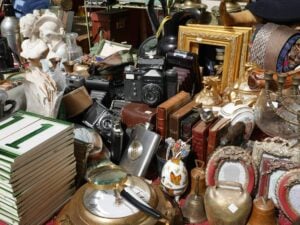
The rest of the stock ranged with similar purpose. A mahogany nightstand might sit near a geometric silver vase; a carefully chosen jewellery selection — weighted toward mid-century pieces — occupied its own considered place. Across roughly 100 square metres of retail space, the range felt broad in era but narrow in standard. Every object had been chosen to carry its own character and history into a new domestic context.
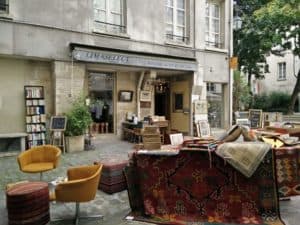
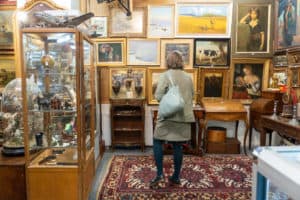
What separated Catrinette from Vienna's wider vintage landscape was the display philosophy. Pieces were arranged with breathing room, more in the manner of a gallery than a market stall. The uncluttered presentation was not accidental tidiness — it reflected the Christie's-educated instinct that an object properly seen sells itself. Browsers could read each piece individually rather than excavating it from a crowd.
That combination — family lineage in the Austrian antiques trade, formal art-historical training, personal international sourcing and a gallery sensibility in presentation — gave Catrinette a coherence that was genuinely difficult to replicate. It occupied a specific and well-reasoned position in Vienna's vintage design scene, one shaped entirely by its founder's expertise and personal taste.
Frequently Asked Questions
Q: What kind of vintage objects was Catrinette known for?
A: Lamps were a signature category — from atmospheric postwar forms to bold 1970s terracotta shades. The broader stock included furniture, decorative objects such as a mahogany nightstand and a geometric silver vase, and a considered jewellery selection weighted toward mid-century pieces. Everything spanned roughly the 1900s to the 1980s, with the 1950s and 1960s as the core focus.
Q: Where did Katharina Marchgraber source her stock?
A: She sourced personally from cities with strong design histories — Paris, New York, Copenhagen, Berlin and Vienna — selecting each piece herself rather than buying through agents or bulk channels.
Q: How was Catrinette different from a typical vintage or thrift shop?
A: The display philosophy set it apart. Pieces were given breathing room in the manner of a gallery, allowing each object to be read individually. That approach reflected Katharina Marchgraber's Christie's Education background and her family lineage in the Viennese antiques trade — the curation was editorial in intent, not opportunistic.
Q: Is Catrinette still open?
A: No. Catrinette is permanently closed. This listing is retained as an editorial archive of the venue and its character.
Marketplace Highlights








Add a review