

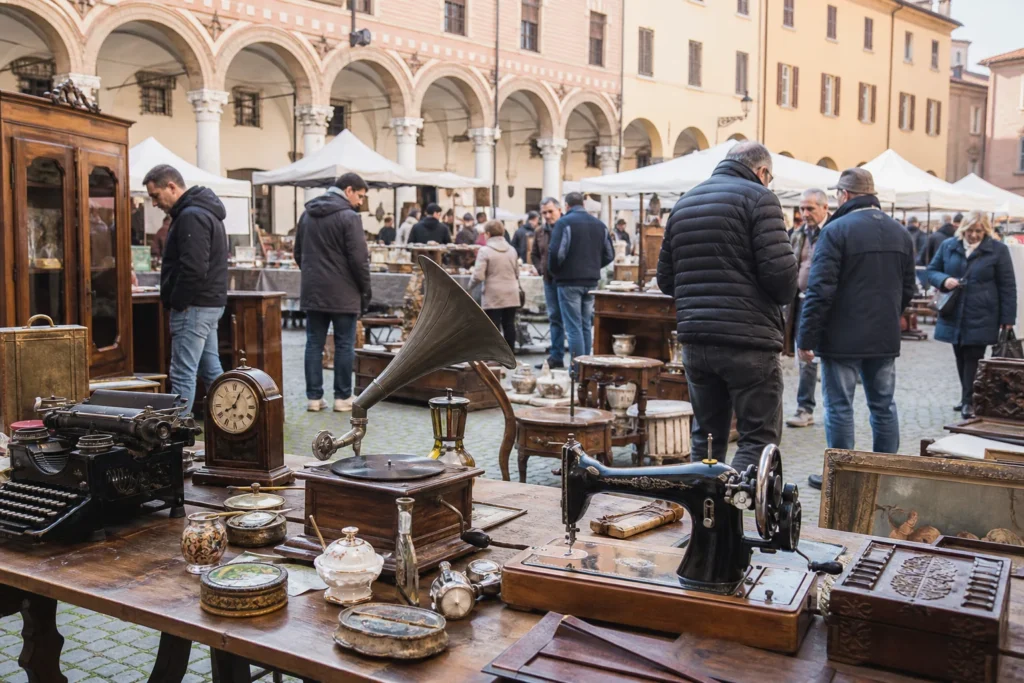

Cortemaggiore sits quietly in the flat Piacenza plain, its Renaissance grid barely altered since Gian Ludovico Pallavicino founded it in 1479. Arcaded streets lead into stone piazzas, and on most days the pace here is unhurried. On the first Sunday of most months, however, the town shifts entirely. Stalls fill Piazza Patrioti, Via Roma and Via Cavour, and dealers, collectors and curious visitors arrive from across Italy and beyond.
The market takes its name from an Italian phrase meaning "Things from Other Times," and the description is precise. Cose d'Altri Tempi has operated since 1988, and its longevity reflects a clear identity. Only certified professionals and merchants who comply with Italian trade law earn a place here. That rigorous selection process gives buyers something increasingly rare at antique fairs: genuine confidence in what they handle. Over 300 dealers reportedly attend on market days, making the event one of the more substantial on the northern Italian circuit.
The merchandise spans several centuries and several collecting tastes. Furniture hunters will find ornate cabinets and worn country pieces alongside decorative objects in various states of restoration. Collectors drawn to mechanical curiosities tend to seek out antique clocks, gramophones and vintage sewing machines. Printed ephemera — old maps, bound volumes, trade catalogues — draws a quieter crowd that works methodically through the stalls. Prices reflect the certified nature of the merchandise. Expect fair market value rather than improvised-fair bargains, though patient searching across 300-plus exhibitors does reward itself.
Bargaining is a normal part of trading here. Dealers are accustomed to international visitors, and a good negotiation rarely needs much shared language. That said, a few words of Italian go a long way in setting a collegial tone. Arriving early is strongly advisable; the best pieces move quickly, and the full extent of the stalls rewards a long, unhurried morning.
The schedule follows the seasons. The market opens at 08:00 throughout the year, but closing times shift: from October through March the event runs until 16:30, while April through September it extends to 18:00. January is the one month with no market at all. Nearby trattorias and local food stalls provide a natural break mid-morning, and Cortemaggiore is compact enough to explore entirely on foot — the town's main church and Renaissance piazza make a rewarding accompaniment to the market visit.
For visitors arriving by public transport, a bus stop — Cortemaggiore Via Roma 1 — sits approximately 80 metres from the market on Via Roma, one of the main market streets. No confirmed route-line numbers are available for this stop; travellers relying on buses should verify current services locally before the visit. Most attendees arrive by car, and the surrounding plain makes road access straightforward from Piacenza and the wider Po Valley.
What sets Cose d'Altri Tempi apart from convention-hall antique fairs is difficult to replicate. The arcaded streets and Renaissance stonework give the objects a coherence that an indoor venue cannot provide. A seventeenth-century cabinet looks different standing in a piazza that predates it only marginally. Serious collectors who want professional certification standards and genuine architectural context in a single visit will find few comparable combinations on the Italian antique calendar.
Frequently Asked Questions
Q: When does Cose d'Altri Tempi take place, and are there any months when it doesn't run?
A: The market is held on the first Sunday of most months, opening at 08:00. January is the exception — there is no market that month. Closing times shift with the seasons: October through March the event ends at 16:30, while April through September it runs until 18:00.
Q: What kinds of things do dealers bring, and is it geared towards serious collectors or casual browsers?
A: The mix spans antique clocks, gramophones, leather-bound books, printed maps and trade catalogues, ornate furniture, vintage sewing machines and decorative household objects from several centuries. The certified dealer environment attracts serious buyers, but curious visitors who enjoy handling objects with a history tend to find plenty to explore across 300-plus stalls.
Q: Can I negotiate on price, and do I need Italian to get by?
A: Bargaining is a normal part of trading here. Dealers are accustomed to international visitors, and a good negotiation rarely requires much shared language — though a few words of Italian help establish a friendly tone. Prices reflect the certified nature of the merchandise, so expect fair market value rather than informal-fair bargains.
Q: Is it worth arriving early?
A: Yes — the best pieces move quickly, and the full extent of the stalls across Piazza Patrioti, Via Roma and Via Cavour rewards a long, unhurried morning. Early arrival gives you the widest selection before the most sought-after items go.
Q: How do I get to Cortemaggiore by public transport?
A: A bus stop at Cortemaggiore Via Roma 1 sits roughly 80 metres from the market on Via Roma, one of the main market streets. Specific route numbers should be verified with current timetables before you travel, as services can change.
Marketplace Highlights








Add a review