



Featured
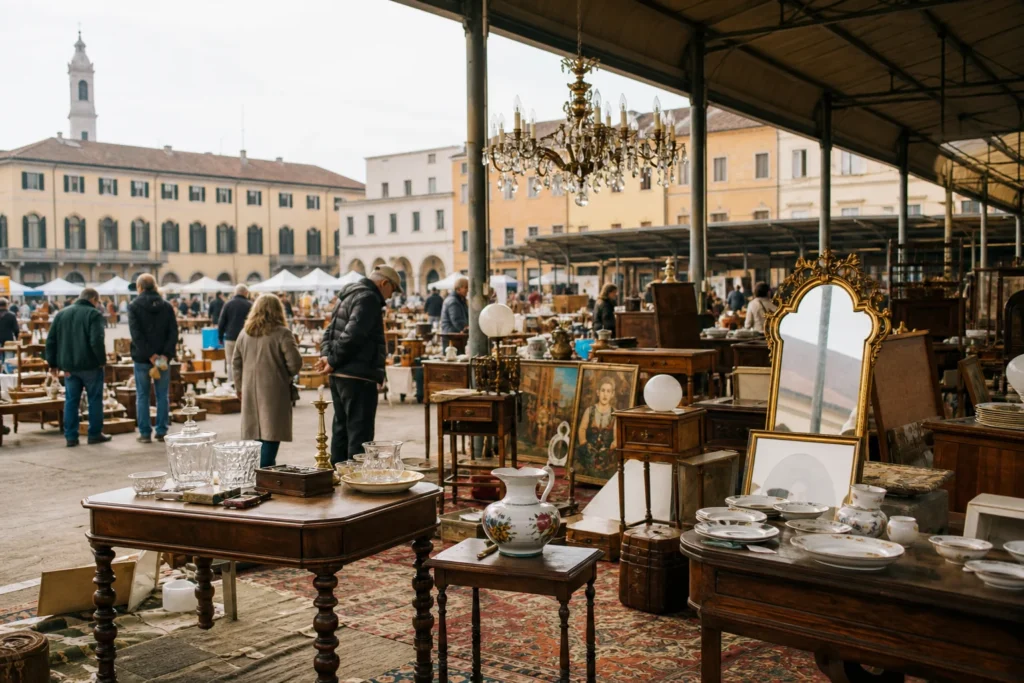
The name translates as "once upon a time," and C'era una volta Gonzaga earns it — not through nostalgia-kitsch, but through the kind of density and seriousness that only a long-established specialist market achieves. The setting is Piazza Matteotti in Gonzaga, a town in the province of Mantua in northern Italy's Po Valley. Over 400 vendors spread across roughly 8,000 square metres of covered pavilions and open-air stalls, giving the event genuine scale without losing the feel of a proper town-square occasion.
Organisation falls to the Numismatic Philatelic and Hobby Club of Gonzaga, working with the local Fair Authority. That pairing matters. A specialist club with a coins-and-stamps backbone sets a different selection logic than a municipal brocante. Expect knowledgeable dealers who know what they have, alongside the broader generalist vendors who make up the market's considerable range. The market runs once or twice a month, opening at 09:00 and running through to 17:00 — long enough to reward a full morning of unhurried browsing rather than a rushed circuit.
The merchandise categories reflect that specialist DNA without being narrow. Coins, paper ephemera and stamps attract dedicated collectors, but furniture, period objects, paintings and sculpture fill the stalls alongside them. Ceramics, porcelain and silverware draw buyers who prefer decorative arts. Vintage clothing and accessories pull a younger crowd, and dealers sourcing stock for resale will find the vendor numbers worth the trip. The variety means each visit can feel genuinely different from the last.
One named zone stands apart from the general layout: the Millennium Market. This curated section focuses on works of art spanning antiquity through to the twentieth century, functioning as a more focused browsing environment inside the larger event. For anyone researching a specific period or comparing quality across eras, that dedicated structure is useful in a way that a dispersed open market rarely can be. It lifts the event above the general category of antique fair.
The covered-pavilion and open-air combination keeps the market running through the cooler months. Northern Italy's autumn and winter bring serious collectors out more reliably than summer heat, and the practical layout supports that. The Piazza Matteotti setting — central, urban, stone-paved — gives the whole thing a sense of place that fairground-style venues can't replicate.
By train, the closest station is Gonzaga-Reggiolo, served by regional train line R202 and approximately 1.8 km from the piazza. Visitors arriving from Mantua or from further along the regional network may find Suzzara more practical. Suzzara station, roughly 6.7 km away, connects to train lines R18, R23 and R202. The gap between both stations and the market means most visitors will want to arrange local transport or a taxi for the final stretch — worth factoring into the plan.
C'era una volta Gonzaga suits dealers sourcing specialist stock, collectors building a focused collection, and culturally curious visitors pairing the market with the wider Gonzaga ducal heritage of the surrounding area. The Millennium Market zone, the specialist club organisation and consistent scale at every edition give this market a standing that earns it a firm place on any northern Italy antique circuit.
Frequently Asked Questions
Q: What kind of market is C'era una volta Gonzaga, and who organises it?
A: It is a well-established antique and collectors' market held in Piazza Matteotti in Gonzaga, province of Mantua. The Numismatic Philatelic and Hobby Club of Gonzaga organises it in partnership with the local Fair Authority, which gives the event a specialist backbone — particularly strong in coins, stamps and paper ephemera — alongside a broad generalist offer from more than 400 vendors across roughly 8,000 square metres.
Q: What can buyers expect to find across the stalls?
A: The range spans two broad currents. The core antiquarian offer covers furniture, period objects, ceramics, porcelain, paintings, sculptures and silverware. Running alongside it are the specialist and collecting-adjacent categories — coins, stamps, paper ephemera, vintage clothing and accessories — that reflect the organising club's roots and attract both dedicated collectors and younger browsers. Dealers sourcing stock will find the vendor depth and category mix worth the trip.
Q: What is the Millennium Market zone?
A: The Millennium Market is a curated section within the larger event, focused specifically on works of art spanning antiquity through to the twentieth century. It functions as a more concentrated browsing environment, useful for anyone researching a particular period or comparing quality and condition across eras — something a dispersed open market rarely makes easy.
Q: How do visitors reach Piazza Matteotti by public transport?
A: The closest station is Gonzaga-Reggiolo, served by regional train line R202 and approximately 1.8 km from the piazza. Visitors travelling from Mantua or along a broader regional route may find Suzzara more convenient — it sits roughly 6.7 km away and connects to lines R18, R23 and R202. Confirm current timetables before travelling, as regional schedules vary seasonally.
Q: How often does the market run, and what are the hours?
A: The market runs once or twice a month, opening at 09:00 and closing at 17:00. The covered-pavilion and open-air combination keeps it running through the cooler months, when serious collectors tend to turn out most reliably. Check the organiser's official channels before you go to confirm the next market date.
Marketplace Highlights

Flea Market Trip Planner
Visiting C’era una volta Gonzaga? Build your full flea market itinerary
Plan your route by date, distance and market type






Add a review