


Region
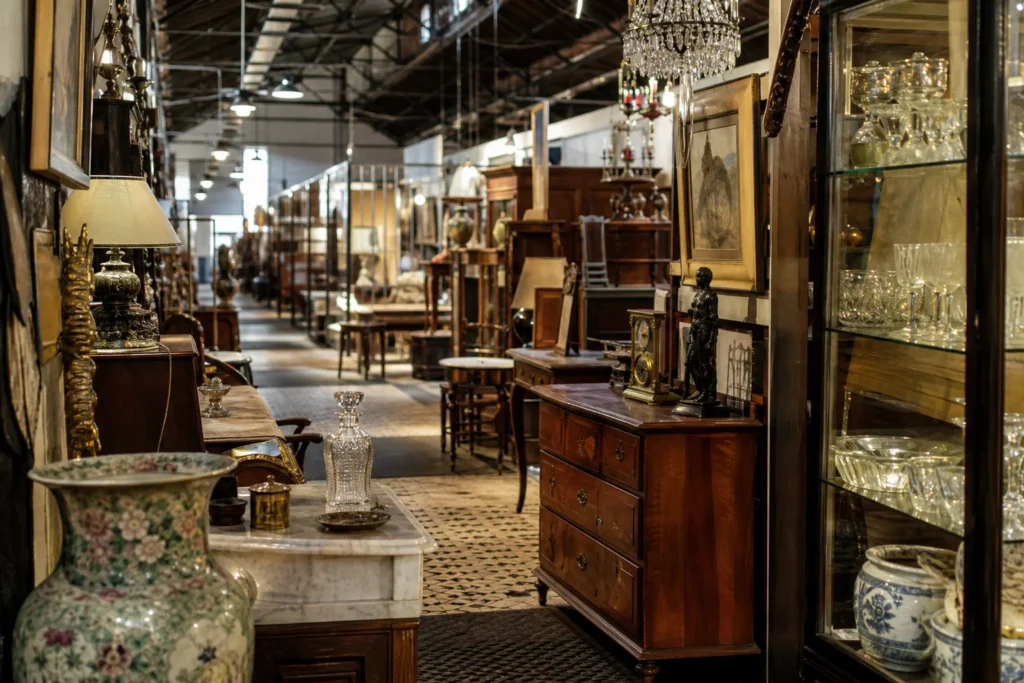
El Mercado de las Pulgas Dorrego spreads across roughly 13,400 square metres on Avenida Dorrego, right on the boundary where Palermo meets Colegiales. More than 140 specialist dealers fill the space, making this one of the most concentrated indoor antique markets in Buenos Aires. The layout is organised and navigable — a deliberate shift from the market's chaotic earlier identity — and the sheer density of specialist stock rewards visitors who arrive with a clear idea of what they want.
The furniture section is particularly strong. Hector Diseño, trading from booth 13, focuses on Scandinavian and North American pieces, while The Peruvian at booth 136 specialises in French chairs, predominantly Louis XV. Both are worth a look for anyone sourcing period or design-conscious furniture in the city.
Decorative objects and glassware account for much of the remaining floor space. Om Crystal at booth 86 carries twentieth-century glassware — cups, pitchers, vases, cheese plates and candy bowls — with a collector-oriented eye for quality mid-century pieces. Rincón Azul at booth 70 covers a different decorative register: fittings, vintage posters and bronze pieces. For tableware and crockery, Suam at booth 98 holds a broad collection spanning European, Asian and Argentinian origins.
One practical note worth keeping in mind: some dealers offer decorative reproductions alongside originals. The quality gap between the two is usually visible on close inspection, and the originals are generally the better find. A methodical browse pays off here more than a rushed one.
The market opens Tuesday through Sunday, from 11:00 to 19:00, and stays closed on Mondays. That Tuesday-to-Sunday schedule makes it more accessible than weekend-only markets, and the afternoon hours suit a post-lunch wander as well as a focused morning visit.
Several bus lines stop almost directly outside. The Mercado de Pulgas stop, approximately 72 metres from the entrance, is served by bus lines 108, 140, 151B21, 151C, 168 and 168C. A secondary stop at Niceto Vega y Arévalo, around 132 metres away, is served by lines 151B21, 151C, 168 and 168C. Palermo is well connected across the wider Buenos Aires bus network, making the market straightforward to reach from most central neighbourhoods.
El Mercado de las Pulgas Dorrego suits collectors, decorators and design-conscious buyers more than casual browsers. The organised stall layout and specialist focus mean it functions more like a curated trade floor than a rummage market — which, depending on what you are looking for, is precisely its strength.
Frequently Asked Questions
Q: When is El Mercado de las Pulgas Dorrego open, and is it open on weekends?
A: The market opens Tuesday through Sunday, 11:00 to 19:00, and is closed on Mondays. That six-day schedule makes it more flexible than weekend-only markets, and the afternoon hours work well for a post-lunch visit.
Q: How do I get there by public transport?
A: Several bus lines stop close to the entrance. The Mercado de Pulgas stop, around 72 metres away, is served by lines 108, 140, 151B21, 151C, 168 and 168C. A second stop at Niceto Vega y Arévalo, about 132 metres away, is covered by lines 151B21, 151C, 168 and 168C. Palermo is well connected across the Buenos Aires bus network from most central neighbourhoods.
Q: What kinds of antiques and collectibles can I find here?
A: The market concentrates on furniture, decorative objects, glassware, and crockery. Standout specialisations include twentieth-century glassware, Scandinavian and North American furniture, French Louis XV chairs, bronze pieces, vintage posters, and European, Asian and Argentinian tableware. With over 140 specialist dealers across 13,400 square metres, the depth of stock rewards focused browsing.
Q: Is this market good for finding genuine antiques, or are there reproductions?
A: Both originals and decorative reproductions are present among the dealers. The quality difference is usually apparent on close inspection, and originals are generally the stronger find. A slow, methodical browse pays off here more than a rushed one.
Q: Is this suitable for a casual browse or better for serious collectors?
A: The organised stall layout and specialist dealer focus make it function more like a curated trade floor than a rummage market. Collectors, decorators and design-conscious buyers tend to get the most from it, though the named booth specialisations give any visitor a useful starting point.








Add a review