

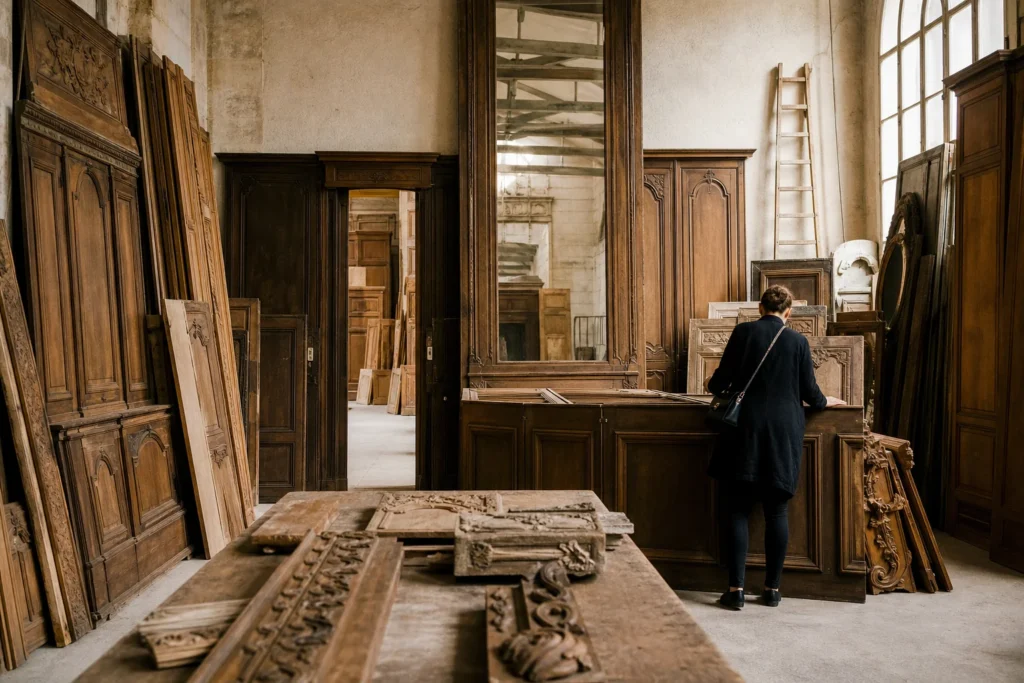

Few places in Paris reward a specialist visitor quite like the atelier at 9 Rue Laugier. Féau Boiseries has operated from the 17th arrondissement since 1875, when founder C. Fournier began working with leading architects on grand private commissions. The early projects set an exacting standard. The Palais Rose in Paris and the Villa Ephrussi de Rothschild at Saint-Jean-Cap-Ferrat both required carved woodwork of a kind that defines the French interior tradition at its most ambitious.
That founding standard has held across successive generations. From 1919 the atelier continued under R. Greloux, working in the pure French eighteenth-century idiom that remains central to the studio's identity. The twentieth century expanded the range. Féau contributed to the 1939 New York World's Fair and played an early role in the first major Parisian expressions of Art Deco — a dual command of period authenticity and modernist ornament that still shapes everything the studio produces.
Walking into the showroom makes the scale of the holding immediately apparent. More than 120 complete room panelings fill the space, spanning French interior design from the seventeenth century through to Art Deco. Oak-leaf wreaths and musical instrument carvings appear alongside geometric woodwork associated with designers including Jacques-Émile Ruhlmann, Eugène Printz, and Emilio Terry. Seeing those pieces together gives a serious collector or decorator something no auction catalogue can replicate: a compressed, physical overview of three centuries of French interior evolution in a single building.
For clients who want something new rather than antique, the studio's archive of several thousand documents lets craftsmen recreate or adapt period designs with precision. Extensive pattern books allow customers to select a style from any period and commission custom panels built to exact room dimensions. The team handles everything from a single replacement panel to a complete interior scheme — a range that suits private collectors and major institutions alike.
The institutional dimension matters. Museum collaborations with the Metropolitan Museum of Art in New York and the Getty reflect the trust Féau commands internationally. The atelier also participates in significant decorative arts events in Maastricht, Palm Beach, and Moscow, as well as the Biennale des Antiquaires et des Décorateurs in Paris. These are not decorative credentials — they signal the level at which the studio consistently operates.
The showroom opens Monday to Thursday from 09:30 to 18:30 and on Fridays from 09:30 to 17:30. It closes on Saturdays and Sundays, so planning a weekday visit is essential.
Ternes metro station on line 2 sits approximately 220 metres from the atelier and serves as the most direct approach. The Ternes bus stop, roughly 150 metres away, connects buses 30, 31, 43, 93 and 341 from multiple directions across the city. Visitors arriving by train can use Pereire–Levallois station on RER C, approximately 630 metres away, as an alternative entry point into the neighbourhood.
Frequently Asked Questions
Q: When is the Féau Boiseries showroom open?
A: The showroom is open Monday to Thursday from 09:30 to 18:30 and Friday from 09:30 to 17:30. It is closed on Saturdays and Sundays, so a weekday visit is essential to plan around.
Q: What is the closest metro station to the atelier at 9 Rue Laugier?
A: Ternes station on Line 2 is approximately 220 metres away and is the most convenient public transport option.
Q: Can visitors commission custom boiseries rather than buying from the existing stock?
A: Yes. The studio holds an archive of several thousand documents alongside extensive pattern books, allowing craftsmen to recreate or adapt period designs to fit a specific room. The team handles commissions ranging from a single replacement panel to a complete interior scheme.
Q: What periods and styles are represented in the showroom's holdings?
A: More than 120 complete room panelings span French interior design from the seventeenth century through to Art Deco, including woodwork associated with designers such as Jacques-Émile Ruhlmann, Eugène Printz, and Emilio Terry, alongside carved pieces featuring oak-leaf wreaths, musical instrument motifs, and geometric ornament.
Q: Does Féau Boiseries work with private collectors, or is it primarily an institutional supplier?
A: The atelier works with both. Private collectors and decorators commission custom panels and purchase from the showroom stock, while the studio's institutional projects include collaborations with the Metropolitan Museum of Art and the Getty, as well as participation in major decorative arts events in Paris, Maastricht, and Palm Beach.
Marketplace Highlights








Add a review