

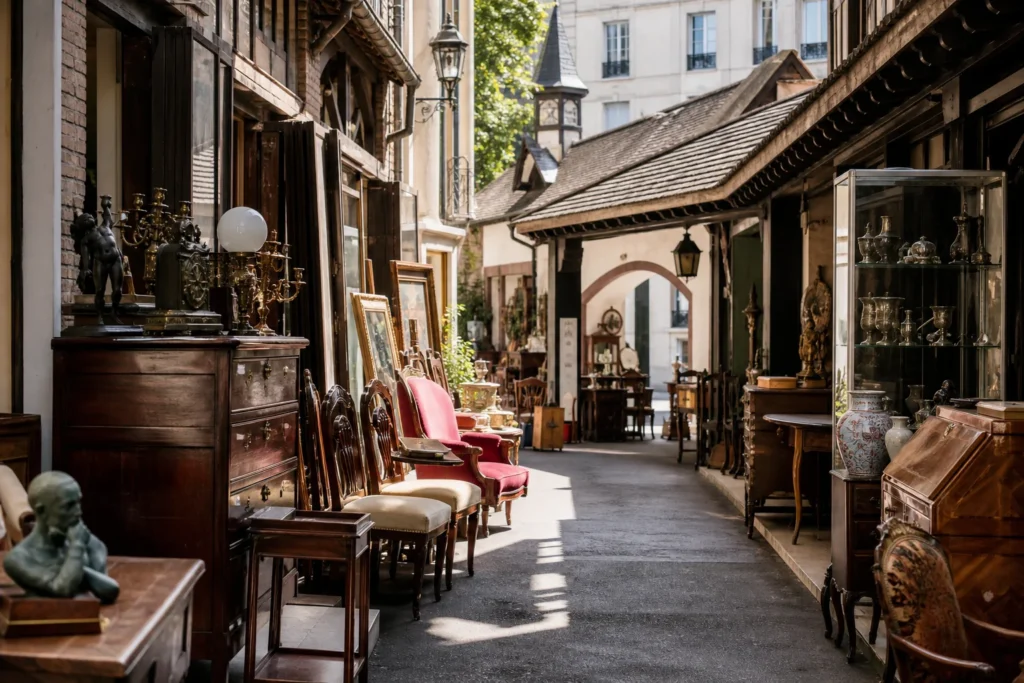

Most antique markets in Paris send you to the city's edges. Le Village Suisse does the opposite — it sits squarely in the 15th arrondissement, a short walk from the Champ de Mars, offering serious antiques without the half-day expedition.
The site has an unusual origin. Charles Henneberg and Jules Allemand built a replica Swiss Alpine village here for the 1900 World's Fair, nestling it at the base of a large Ferris wheel. When the wheel came down, informal traders moved in and repurposed the dismantled gondolas as market stalls. Those early rag-pickers gradually gave way to dealers of a different calibre. Proximity to the wealthy western arrondissements shaped the trade, and the merchandise climbed steadily upmarket over the following decades.
Today the village spans roughly 21,000 square feet of covered and open passages. More than 150 dealers occupy the space, and the mix skews firmly toward specialists rather than generalist stall-holders. Gallery owners, gunsmiths, jewellers, watchmakers and decorators share the arcade alongside dealers in antique furniture, paintings and decorative objects. Primitive art sits a few stalls away from mid-century design. The range is genuinely broad, but the tone throughout is knowledgeable and curated.
Prices reflect that expertise. Le Village Suisse is not a bargain-hunting destination in the Saint-Ouen sense. What it offers instead is a museum-quality browse in an outdoor architectural setting. Dealers tend to know their stock in depth and are often happy to discuss provenance and context at length. Even visitors who arrive with no intention of buying usually leave having learned something.
The market opens Thursday through Monday, from 11:00 to 19:00. It closes on Tuesdays and Wednesdays. Those hours suit a relaxed weekday visit — unhurried, well-lit, without weekend crowds. The Avenue de Suffren address in the 15th puts it within easy reach of central Paris.
Getting here by public transport is straightforward. La Motte-Picquet – Grenelle metro station serves lines 6, 8 and 10 and sits approximately 200 metres away — a natural arrival point. Bus lines 80 and 82 stop at Général de Bollardière, less than 50 metres from the market entrance. The Cambronne metro station on line 6 offers another option roughly 350 metres out, also served by buses 80, N12 and N61 for late-evening return journeys.
Le Village Suisse suits the collector, the design-literate traveller and the culturally curious visitor who wants specialist stock in a central, walkable setting. The combination of a remarkable architectural history, a dense concentration of expert dealers and civilised opening hours makes it one of the more rewarding ways to spend a weekday afternoon in Paris.
Frequently Asked Questions
Q: When is Le Village Suisse open?
A: The market opens Thursday through Monday, 11:00 to 19:00. It is closed on Tuesdays and Wednesdays. A weekday visit tends to be quieter and unhurried.
Q: How do I get there by public transport?
A: La Motte-Picquet – Grenelle metro station (lines 6, 8 and 10) is around 200 metres away and is the most convenient option. Bus lines 80 and 82 stop less than 50 metres from the entrance at Général de Bollardière. Cambronne station on line 6 is also walkable at roughly 350 metres, with night buses N12 and N61 available for a late return.
Q: What kind of dealers trade here, and what can I expect to find?
A: Over 150 specialist dealers occupy the covered and open passages, including gallery owners, watchmakers, jewellers, gunsmiths and antique furniture dealers. Stock ranges from primitive art and old master paintings to mid-century design and decorative objects — the mix is broad but consistently curated.
Q: Is this a good place to hunt for bargains?
A: Not in the way Saint-Ouen is. Prices reflect specialist expertise, and much of the stock is at collector or decorator level. The real value here is a museum-quality browse where dealers are typically willing to discuss provenance at length — worthwhile even if you are not buying.
Q: Is the market indoors or outdoors?
A: Le Village Suisse combines covered passages and open arcades across a roughly 21,000-square-foot site built as a replica Swiss Alpine village for the 1900 World's Fair. The layout feels like a pedestrian neighbourhood rather than a warehouse fair, and the architectural setting is part of the appeal.
Marketplace Highlights








Add a review