


Region
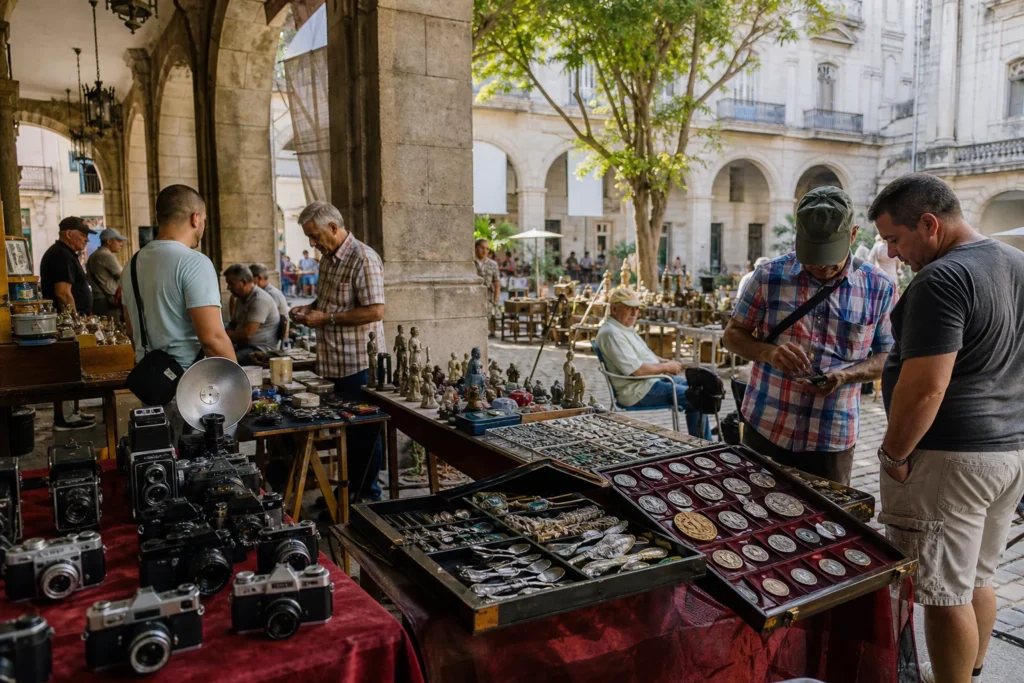
On the corner of calle Baratillo and calle Justiz, tucked into the Antigua Casa de Justiz y Santa Ana, a market runs that feels genuinely apart from the souvenir circuit of Old Havana. Almond trees shade the stalls. A faint sea breeze drifts between the tables, which are spread with objects that took real effort to find and bring here. The Feria de Publicaciones y Curiosidades is the kind of place that slows you down without you quite deciding to stop.
Around sixty vendors work the market, and roughly half of them rotate on alternating days. That mechanic is worth knowing before you plan your visit. A single morning gives you a partial view of what the market holds. Two consecutive visits show you something closer to the full range — and the range is genuinely broad enough to reward the return.
The strongest category here is Cold War-era material. Soviet cameras, military pins, Russian collectibles and revolutionary propaganda posters from the 1960s turn up with real regularity. These are not reproductions arranged for tourists. They are objects that passed through Cuban households, and the vendors behind the tables usually know their provenance.
Pre-revolution Cuba fills the other half of the offer. Antique coins, pocket watches, silverware and gramophones sit beside 1950s costume jewellery and pre-revolution memorabilia. The stock shifts day to day, but the categories stay consistent. Collectors focused on Latin American ephemera or mid-century Cuban material will find this unusually well-stocked for a street market.
Sellers here tend to be engaged rather than passive. It is not unusual to see a vendor quietly repairing a hand-wind watch mid-conversation, or adjusting the mechanism of a vintage camera between sales. Many speak enough English to negotiate comfortably. Haggling is standard practice and the atmosphere is relaxed enough that negotiating feels natural. Buying more than one item tends to open things up. Specific price figures from older sources are dated, so treat any prior references as rough orientation rather than current expectation.
The market runs daily, Monday through Sunday, roughly 10:00 to 17:00 Havana time. Its position near Plaza de Armas makes it easy to fold into a walking morning in Old Havana without much detour. Plaza San Francisco public transport stop sits approximately 100 metres away, making it straightforward to reach from other parts of the city. The Casablanca train station, served by line 8 and approximately 600 metres distant, offers another option for those coming from across the harbour. The Havana Cruise Ship Terminal is also close by, around 200 metres away, which puts the market within easy reach for visitors arriving by sea.
This is not a market for browsing in a hurry. The objects here ask to be handled and questioned. Collectors of Cold War-era material, pre-revolution antiques and Cuban political ephemera will find it more substantive than most open-air options in the region. Plan for two visits if your schedule allows, and give yourself time to talk to the vendors.
Frequently Asked Questions
Q: Does it matter which day I visit the Feria de Publicaciones y Curiosidades?
A: It matters more than you might expect. Roughly half of the sixty or so vendors rotate on alternating days, so a single visit gives you only a partial picture of what the market holds. If your schedule allows, two consecutive mornings will show you considerably more stock across both the pre-revolution antiques and the Cold War material.
Q: What kinds of objects actually turn up here?
A: The market divides roughly into two consistent clusters. On the pre-revolution side: antique coins, pocket watches, silverware, gramophones and 1950s costume jewellery. On the Cold War and revolutionary side: Soviet-era cameras, military pins, Russian collectibles and propaganda posters and books from the 1960s. The daily stock shifts, but these categories stay reliable.
Q: Is haggling expected, or is it better to accept the asking price?
A: Haggling is standard practice here and vendors are generally open to it. The atmosphere is relaxed enough that negotiating feels natural rather than awkward. Buying more than one item tends to open things up further. Engage with the seller, ask questions about the piece, and don't feel obliged to accept the first number offered.
Q: How easy is the market to reach without a taxi?
A: Quite straightforward. The Plaza San Francisco public transport stop is around 100 metres away, making it the most convenient option for most visitors. The Casablanca train station, served by line 8, is approximately 600 metres away across the harbour. The Havana Cruise Ship Terminal is around 200 metres away, putting the market within easy walking distance if you're arriving by sea.
Q: What are the opening hours?
A: The market runs daily, Monday through Sunday, roughly 10:00 to 17:00 Havana time. Confirm current hours locally before you go, as conditions in Old Havana can shift.
Marketplace Highlights












Add a review