

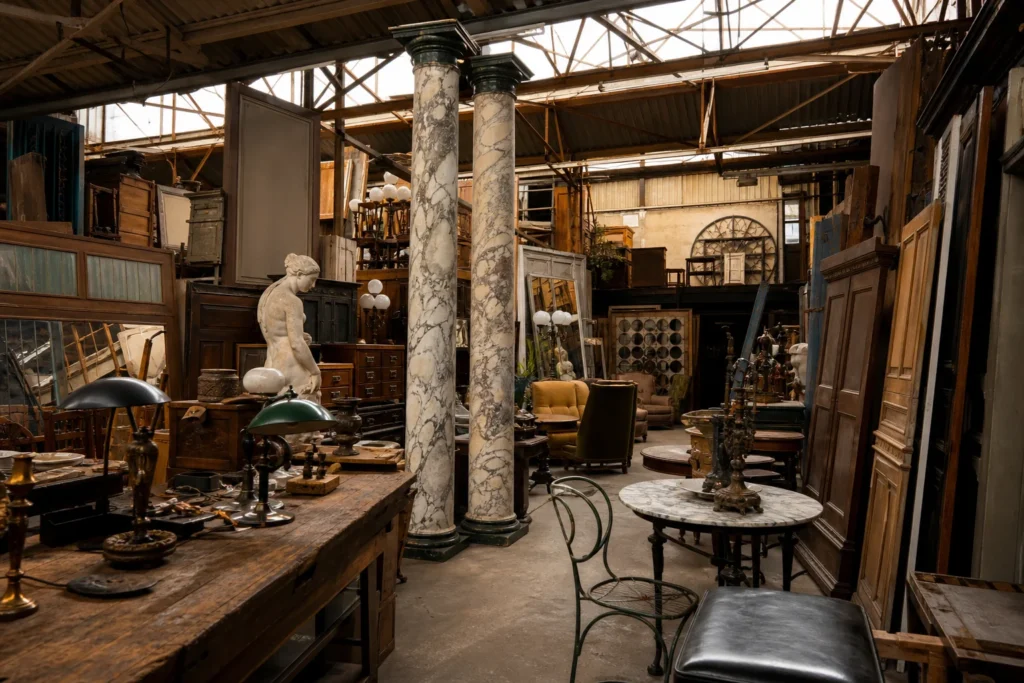
Most secondhand destinations deal in objects without histories. La Ressourcerie du Cinéma in Montreuil deals in objects whose histories are the whole point. Housed in an 800-square-metre warehouse inside the Mozinor business park, it stores the physical leftovers of French and international film productions — recovered, catalogued and offered back to the world at a fraction of their original cost.
The scale of the space takes a moment to absorb. Architectural fragments fill the floor: staircase sections, fake chimneys, Haussmann-style window frames and oversize wine barrels. Mezzanines built by volunteers rise overhead, stacked with sofas, school chairs and column bases painted to suggest marble. Near the entrance, light fittings cluster beside a bicycle. An antique frame holds a portrait of Pope John Paul II. A painted polystyrene boulder, shaped and blackened to pass for stone, sits convincingly in one corner as though it wandered off a fantasy production. Nearby, a cluster of tombstones dressed a Paris location shoot for the fourth John Wick film. Every aisle prompts the same half-formed question: which set, which scene, which actor?
That question has a serious origin. La Ressourcerie grew from the Éco-Déco Ciné collective, a group of set designers frustrated by industrial waste. Prop maker Jean-Roch Bonnin and recycling specialist Karine d'Orlan de Polignac lead the project. Their argument draws on film history. French studios once reused set materials as a matter of course, much as Cinecittà in Rome continues to do. From the 1950s into the mid-1970s, little left the lot without purpose. Rising land costs, cheaper timber and a throwaway production culture ended that habit. By the time the collective formed in 2020, entire sets were skipped because rebuilding cost less than storing. La Ressourcerie set out to reverse that logic.
The practical model is straightforward. Recovered materials are photographed, catalogued and sold or rented out. Prices reportedly run around 40 to 50 percent below market rate. Roughly 80 percent of stock arrives in near-new or unused condition, and decorative panels and frame sheets make up the bulk of the inventory, actively channelled toward architects, associations and reuse-sector craftspeople.
The buyer mix reflects the breadth of the stock. Escape room designers hunt for atmosphere. Architects source unusual cladding and flooring. Film professionals restock directly for new productions, taking fake walls, scenic canvas and set sheets that slot straight into the next shoot. Private buyers arrive for a lamp post, a decorative panel or a run of parquet that would take months to find elsewhere.
The warehouse opens Monday to Friday, 09:00 to 13:00 and 14:00 to 18:00, and visits are ideally made by appointment. It is closed at weekends. Stock turns over continuously, so checking the Ressourcerie's social media or catalogue before the trip is genuinely worthwhile.
The closest public transport stop is Édouard Branly, approximately 137 metres from the site, served by bus lines 102, 121 and the night bus N34. Visitors coming from central Paris by Metro can take line 11 to Montreuil–Hôpital, roughly 1.1 km away, or to La Dhuys at a similar distance on the same line. Both stations put the warehouse within easy reach on foot.
La Ressourcerie du Cinéma suits anyone drawn to objects with a documented creative past, and it rewards a deliberate visit far more than a casual browse. The stock is specific, the pricing is competitive, and the warehouse atmosphere — part archive, part curiosity shop, part working salvage operation — is unlike anything else on the Paris-area vintage circuit.
Frequently Asked Questions
Q: Who typically shops at La Ressourcerie du Cinéma, and is it open to the general public?
A: Yes, private buyers are welcome alongside trade visitors. The buyer mix is broad: escape room designers hunting atmosphere, architects sourcing unusual cladding or flooring, film professionals restocking for new productions, and individuals after a specific lamp post, decorative panel or run of parquet. The warehouse is open Monday to Friday, 09:00–13:00 and 14:00–18:00, and visits are ideally made by appointment.
Q: What kind of stock does La Ressourcerie du Cinéma carry?
A: The warehouse holds recovered set pieces, props and construction materials from French and international film productions. Architectural elements dominate — Haussmann-style window frames, staircase sections, fake chimneys, oversize wine barrels and decorative panel frames — alongside furnishings, scenic canvas, flooring, lighting and smaller curiosities. Roughly 80 percent of stock reportedly arrives in near-new or unused condition.
Q: How are items priced compared with standard secondhand or architectural salvage sources?
A: Prices reportedly run around 40 to 50 percent below market rate. Items can be purchased outright or rented depending on the piece, which makes the warehouse useful for productions or events with limited budgets as well as for permanent buyers.
Q: Do items come with any provenance information about which productions they appeared in?
A: Materials are catalogued and photographed when they arrive, so specific production origins are often traceable. The tombstones from the Paris shoot for the fourth John Wick film are a well-known example. For buyers to whom provenance matters, it is worth asking directly when you visit or make contact before your appointment.
Q: Where exactly is the warehouse, and is it easy to reach without a car?
A: La Ressourcerie du Cinéma is inside the Mozinor business park in Montreuil, just east of Paris. Given the industrial park setting and the practicalities of transporting larger pieces, checking transport options and confirming the exact access point with the team before your visit is worthwhile.
Marketplace Highlights









Add a review