

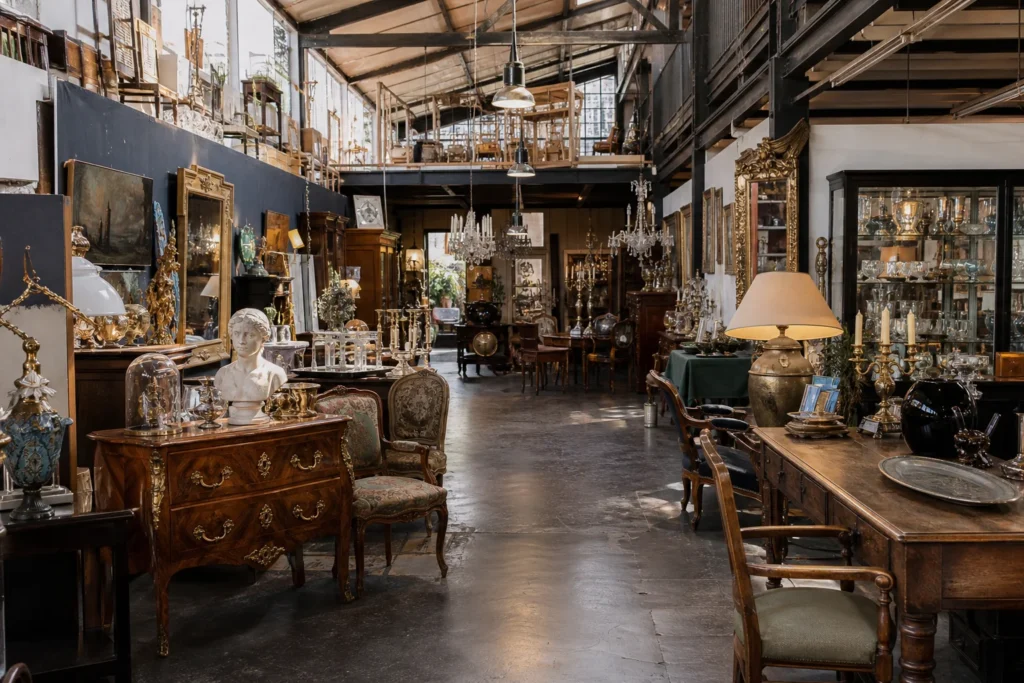

Tucked into Bordeaux's Chartrons district, inside a converted nineteenth-century printing house on Rue Notre-Dame, Le Village Notre Dame is one of Aquitaine's most established permanent antique galleries. The former press floor opened as an antique centre in 1982. More than four decades later, roughly twenty specialist dealers occupy around 1,000 square metres of calm, well-ordered exhibition space.
The merchandise divides naturally into distinct worlds. Precision objects — antique jewellery, silverware and clocks — sit alongside displays of ornamental porcelain, hand-painted vases and decorative glassware. Heavier pieces fill the deeper corners: vintage furniture, carved chests and marble busts. At the margins, vintage photography, framed artwork and an assortment of genuine curiosities reward the visitor who takes time to browse past the obvious centrepieces.
What distinguishes the dealers here is depth rather than volume. Each specialist tends to know their category thoroughly — periods, provenance, condition — and most are willing to walk a first-time buyer through a piece without sales pressure. That approachability matters. For anyone put off by the noise and unpredictability of a large open-air flea market, Le Village Notre Dame offers a quieter way into serious collecting.
One service sets this gallery well apart from anything else in the region. Le Village Notre Dame runs a wedding gift registry, allowing couples to list specific antique pieces in place of the usual household catalogue. Registering a nineteenth-century carriage clock or a pair of hand-painted dessert plates in a specialist gallery is a different proposition entirely from ticking boxes in a department store. The idea travels well beyond Bordeaux, and it draws buyers who might never otherwise have walked into a permanent antiques centre.
The gallery follows a classic French gallery rhythm: open Monday to Saturday, 10:00 to 12:30 and again from 14:00 to 19:00, with Sunday closed. Arriving before 12:30 or after 14:00 makes the most of the dealers' availability and avoids the short midday window.
The Chartrons context matters for planning a visit. The neighbourhood built its reputation on the Bordeaux wine trade, and the grand merchant townhouses that followed brought the antique culture that still defines the streets today. The Église Saint-Louis des Chartrons and the Halle des Chartrons both sit close by. Several more antique dealers, small galleries and vintage boutiques line the surrounding streets, making a wider Chartrons circuit a natural half-day itinerary alongside a visit here.
Getting to the gallery is straightforward. Place Paul Doumer — served by tram lines C and E and bus lines 5 and 15 — sits approximately 170 metres away, making it the most convenient local stop. Visitors arriving by train from outside Bordeaux will come in via Bordeaux-Saint-Jean, roughly 3.2 kilometres distant, and should plan onward travel into Chartrons from there. The Les Hangars ferry stop on the Garonne, about 760 metres away, is served by ferry line 2 and adds a pleasant riverside approach for those crossing from the Right Bank.
Le Village Notre Dame suits returning collectors hunting a specific object, couples building a thoughtful registry, and first-time buyers who want expert guidance without the pressure of an auction house. The converted press hall gives the space an industrial calm that feels genuinely different from any open-air market. It is one of the more serious antique destinations in southwest France, and it earns that reputation consistently.
Frequently Asked Questions
Q: What kinds of antiques will I find at Le Village Notre Dame?
A: The gallery's roughly twenty specialist dealers cover a wide range across around 1,000 square metres. Precision objects — jewellery, silverware and clocks — sit alongside decorative porcelain, hand-painted vases and glassware. Deeper into the space you'll find vintage furniture, carved chests and marble busts. Photography, framed artwork and assorted curiosities reward slower browsing at the margins.
Q: Is Le Village Notre Dame a good choice for first-time antique buyers?
A: It works well for newcomers. The dealers tend to specialise deeply and are generally willing to walk a first-time buyer through a piece without pressure. The calm, well-ordered layout of the former printing house is considerably less overwhelming than a large open-air flea market.
Q: When is the gallery open?
A: Le Village Notre Dame opens Monday to Saturday, 10:00 to 12:30 and again from 14:00 to 19:00. It is closed on Sundays. Plan your arrival before 12:30 or after 14:00 to make the most of dealer availability and avoid the midday closure.
Q: Does Le Village Notre Dame offer anything beyond standard antique sales?
A: Yes — the gallery runs a wedding gift registry service, allowing couples to list specific antique pieces rather than a conventional household catalogue. Registering a nineteenth-century carriage clock or a set of hand-painted porcelain in a specialist gallery is a notably different proposition from a department-store list.
Q: Is it worth combining a visit with the wider Chartrons neighbourhood?
A: Easily. The Chartrons district holds several more antique dealers, small galleries and vintage boutiques within walking distance of Le Village Notre Dame, and the Halle des Chartrons is close by. A wider Chartrons circuit makes a natural half-day itinerary without retracing steps.









Add a review