

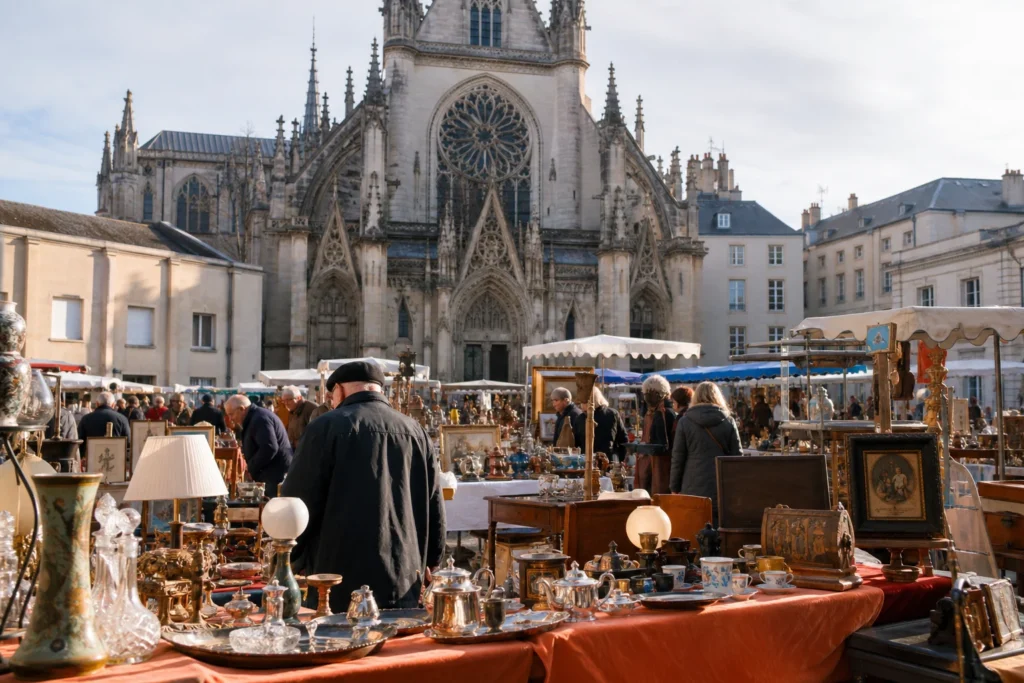

Once a month, Nancy's old town becomes the setting for one of the most atmospheric flea markets in the Grand Est region. The Marché aux Puces de la Vieille Ville takes place on the second Sunday of each month, running from 07:00 until 18:00. It spreads through the streets below the Basilica of Saint Epvre, a towering Gothic structure whose ornate facade gives the market a backdrop that most brocantes can only dream of.
Somewhere between 40 and 50 vendors set up on a typical market day. Sunny mornings reliably pull out more stalls and larger crowds, while overcast weather tends to trim both — checking the forecast is simple visitor intelligence rather than a deterrent. The long opening window suits almost any pace: dedicated hunters arrive at seven, while unhurried browsers can still find genuine interest well into the afternoon.
The stock ranges widely, and grouping it mentally helps. One cluster covers the domestic and decorative: silverware, cutlery sets, china, glassware, carved ornaments and small decorative objects. A second runs through paper and print — vintage books, framed photographs and prints in various states of frame and condition. Furniture appears too, mostly at the smaller end: chairs, compact writing desks and occasional cabinets that actually fit in a car. Pricing has shifted over the years as more students and budget-conscious shoppers have made this a regular stop, and most vendors have followed. The result is an accessible market rather than a circuit for serious collectors only. A core of long-standing regular vendors keeps certain categories reliably stocked, while occasional new faces stop the overall feel from going stale.
Nancy carries its own weight for anyone interested in French design history. Jean Prouvé was born here, trained here, and founded his celebrated furniture workshop in the city. His pieces now command extraordinary sums at international auction, but the local connection occasionally filters down to more everyday settings — secondhand shops, Emmaüs stores, and reportedly even kerbside during bulky goods collection days. A confirmed Prouvé find remains unlikely, but the background awareness shapes how design-minded visitors think about the city as a destination.
On the same Sunday, Nancy also runs a concurrent general market alongside the flea market. That combination makes the day doubly worthwhile: visitors can move between fresh produce and everyday goods on one side and vintage silverware or old prints on the other, all within the same medieval neighbourhood.
The Marché aux Puces de la Vieille Ville suits visitors who combine a genuine interest in antiques or vintage goods with a desire to spend time in a city rather than a specialist fair. The Gothic setting, a calendar established since the 1980s, and pricing pitched for ordinary shoppers give this market a character that larger urban flea markets rarely sustain.
Getting here is straightforward. Nancy train station sits roughly 900 m from the market and serves multiple regional and intercity train lines, including routes 5516, 5537 and the C40 series. For those already in the city, the Citadine 1 bus stops at Musée Lorrain, approximately 40 m from the market, and at Saint-Epvre around 130 m away — both within a very short walk of the stalls.
Frequently Asked Questions
Q: When does the Marché aux Puces de la Vieille Ville take place?
A: The market runs on the second Sunday of each month, from 07:00 until 18:00, in Nancy's old town near the Basilica of Saint Epvre.
Q: What kinds of things can I expect to find at the stalls?
A: Stock typically covers silverware, cutlery sets, china and glassware alongside vintage books, framed prints and photographs. Smaller furniture pieces — chairs, compact writing desks, occasional cabinets — also appear regularly. The range varies from stall to stall, and long-standing regular vendors tend to keep certain categories reliably stocked.
Q: Is it worth arriving early, or can I browse at a relaxed pace later in the day?
A: Both approaches work. Dedicated hunters tend to arrive at seven when the market opens, but the long closing time means genuine finds are still in play well into the afternoon. Sunny Sundays bring out the most vendors and the largest crowds.
Q: Is this market accessible for everyday budgets, or aimed mainly at serious collectors?
A: Pricing has become notably accessible over the years, partly because students and budget-conscious shoppers have become regulars. It is not exclusively a circuit for deep-pocketed collectors, though the full range of merchandise means serious buyers also find it worthwhile.
Q: Is there anything else happening in Nancy on the same day?
A: A concurrent general market runs alongside the flea market on the same Sunday, covering fresh produce and everyday goods. Both markets sit within the same medieval neighbourhood, making it easy to move between the two during a single visit.








Add a review