


Mercadinho dos Clérigos is permanently closed. The market is retained as an editorial archive of the venue and its distinctive character.
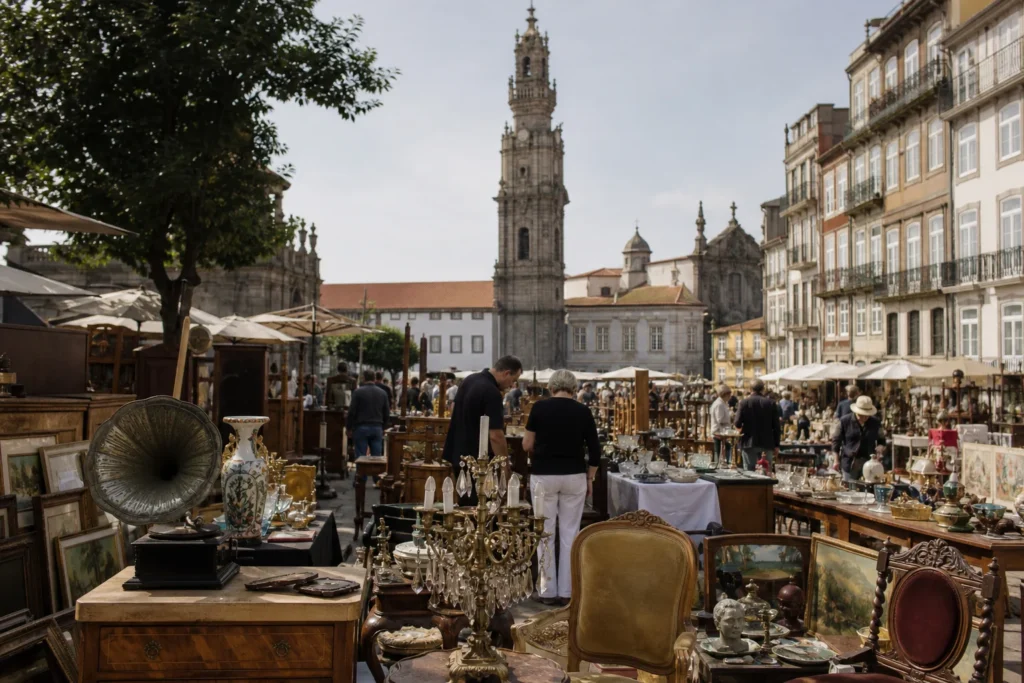
The Torre dos Clérigos rises above the rooftops of central Porto with the quiet authority of a landmark that no longer needs to prove itself. Mercadinho dos Clérigos gathered in its shadow, occupying one of the most visually arresting corners of the city's UNESCO World Heritage Zone. The setting gave the market an almost unfair head start — but what filled the stalls more than earned the address.
The stock leaned eclectic rather than purely antique, and that distinction mattered. Vintage clothing shared space with old chandeliers, glassware and ornamental objects whose origins were anybody's guess. Coin collections and comic books gave the market an unusually nerdy edge — the kind of detail that separated it from the linen-and-ceramics circuit. Local artists and craftspeople set up alongside the vintage dealers, so a single pass through the stalls could move from a 1970s chandelier pendant to a freshly painted canvas without any sense of incongruity. The result felt genuinely browsable rather than curated into predictability.
The market ran twice a month, which gave it a rhythm that regular visitors learned to work around. What kept it reliable through Porto's wet winters was the indoor fallback at Plano B on Cândido dos Reis Street. When rain arrived, the market moved inside without drama, which meant the twice-monthly dates held firm across seasons. For a city where outdoor events frequently surrender to the weather, that flexibility was a practical distinction.
The experience shifted depending on what time you arrived. Early in the day, serious collectors circulated before the crowd thickened, turning up coin rarities and vintage pieces before anyone else had a claim. By evening, the atmosphere loosened. Food and drink stalls made it easy to graze without stopping, and a second pass through the stalls after dinner in the neighbourhood felt unhurried and entirely natural. Porto's food culture ran through the market as much as any restaurant nearby, and the stalls that carried local produce and drink added something a purely object-focused market would have lacked.
The neighbourhood rewarded wandering in either direction. Rua das Carmelitas and its bookshops lay within easy reach. The Ribeira waterfront was a short walk downhill. Mercadinho dos Clérigos sat at a natural junction in any slow itinerary of the historic centre, easy to fold into an afternoon that was already moving between architecture, food and discovery.
What distinguished the market, finally, was not the setting alone — it was the combination of an eclectic seller mix, a forgiving all-weather format and a location that made even an empty-handed visit feel like time well spent in one of Europe's most characterful city centres.
Frequently Asked Questions
Q: What kind of stalls did Mercadinho dos Clérigos offer?
A: The market leaned eclectic rather than purely antique. Stalls carried vintage clothing, chandeliers, glassware, coin collections, comic books and old posters alongside work from local artists and craftspeople. Food and drink vendors were also part of the mix, making it easy to graze while browsing.
Q: How often did the market run, and what happened when it rained?
A: Mercadinho dos Clérigos ran twice a month. When rain arrived, it shifted indoors to Plano B on Cândido dos Reis Street, which meant the twice-monthly dates held firm across seasons — an unusual degree of reliability for an outdoor Porto market.
Q: Was there a best time of day to visit?
A: Early arrivals had the pick of genuinely collectible pieces before the crowd built — particularly useful for coin hunters and vintage hunters. By evening the atmosphere loosened considerably, and a second pass through the stalls after dinner in the neighbourhood felt relaxed and unhurried.
Q: Where was the market located, and what was nearby?
A: The market gathered in the shadow of the Torre dos Clérigos in Porto's UNESCO World Heritage Zone. Rua das Carmelitas and its bookshops were within easy reach, and the Ribeira waterfront was a short walk downhill — making the market a natural stop within a slow itinerary of the historic centre.
Marketplace Highlights








Add a review