


Mercatino dei Miracoli is permanently closed. This listing is retained as an editorial archive of the venue and its distinctive character.
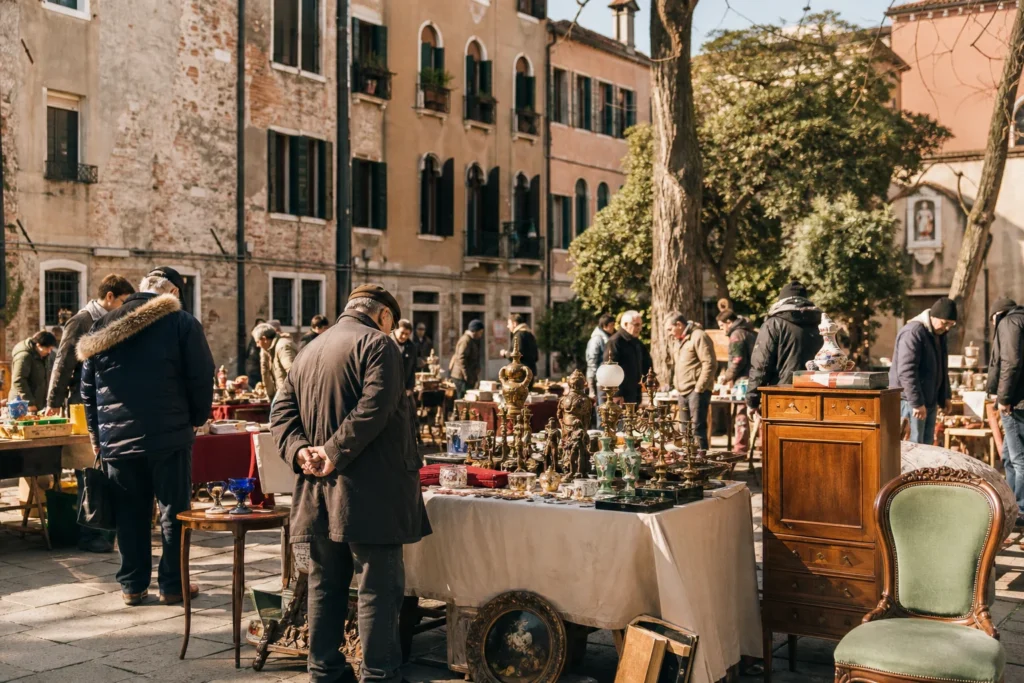
Campo Santa Maria Nova, tucked into Venice's quiet eastern reaches, once hosted one of the city's most quietly revered flea markets. Mercatino dei Miracoli occupied a rustic courtyard there, drawing antique collectors and vintage enthusiasts into a setting that felt genuinely removed from the tourist-heavy centre. The worn stonework and close-knit stalls gave the market a shabby-chic character that photographs well but felt even better in person.
What distinguished the market was its rarity. Running roughly ten days a year between spring and December, it arrived as an event rather than a routine fixture. That scarcity shaped the crowd. Casual browsers were outnumbered by committed collectors who planned around it, arriving with clear intentions and leaving with objects they had spent months tracking down.
The merchandise ranged widely and rewarded patience. Vendors offered vintage Italian jewellery alongside engraved silver cutlery, hand mirrors with ornate gold-plated frames, floral glass serving bowls, ukuleles, old issues of Italian Vogue, and decorative china. Italian pieces dominated the stalls, but European goods appeared regularly, and the occasional find from further afield gave the whole market an unpredictable, anything-is-possible quality that suited its name well.
The social dimension was as central as the shopping. Local vendors knew their stock deeply and welcomed the chance to talk about it. Collectors compared notes across stall divides. Travellers fell into long conversations with dealers about periods, provenance and personal obsessions. Nobody seemed to be in a hurry. The market's compact footprint encouraged that kind of lingering — you circled back, reconsidered, chatted again. It had the rhythm of a gathering rather than a transaction.
Venice's waterways made Campo Santa Maria Nova straightforward to reach by boat, and the courtyard location kept the atmosphere self-contained once visitors arrived. The small scale worked in the market's favour. There were no vast hangar-style crowds, no overwhelming rows of identical stalls. What it offered was curated by circumstance — whatever the vendors chose to bring, on the handful of dates the market actually ran.
For researchers piecing together Venice's vintage and antique market scene, Mercatino dei Miracoli stands as a reference point worth knowing. It demonstrated that a market need not run every weekend to build a loyal following. Rarity, a strong sense of place and a genuinely social atmosphere proved more than enough.
Frequently Asked Questions
Q: Is Mercatino dei Miracoli still running?
A: No. Mercatino dei Miracoli is permanently closed. This listing is kept as an editorial archive of the market and its character.
Q: Where was the market held?
A: It was held in a rustic courtyard at Campo Santa Maria Nova, in the quieter eastern part of Venice, easily reached by boat.
Q: What kind of goods did vendors typically sell?
A: Stock leaned heavily Italian and European, ranging from vintage jewellery, ornate gold-plated hand mirrors and engraved cutlery to decorative china, floral glass serving bowls, old Italian Vogue issues and the occasional instrument or curiosity.
Q: How often did the market take place?
A: It ran roughly ten days a year, between spring and December — an occasional, anticipated event rather than a regular fixture, which drew committed collectors rather than casual browsers.
Marketplace Highlights







Antonio La Greca
10th December 2017 at 22:27This flea market does not exist anymore
I was in Venice last May and the flea market was not there
I am in Venice now December 2017 and only 1 minute from Santa Maria Novella and the flea market was not there
I asked a store owner of a used book and print shop there and he said the flea market has not happened in a few years