

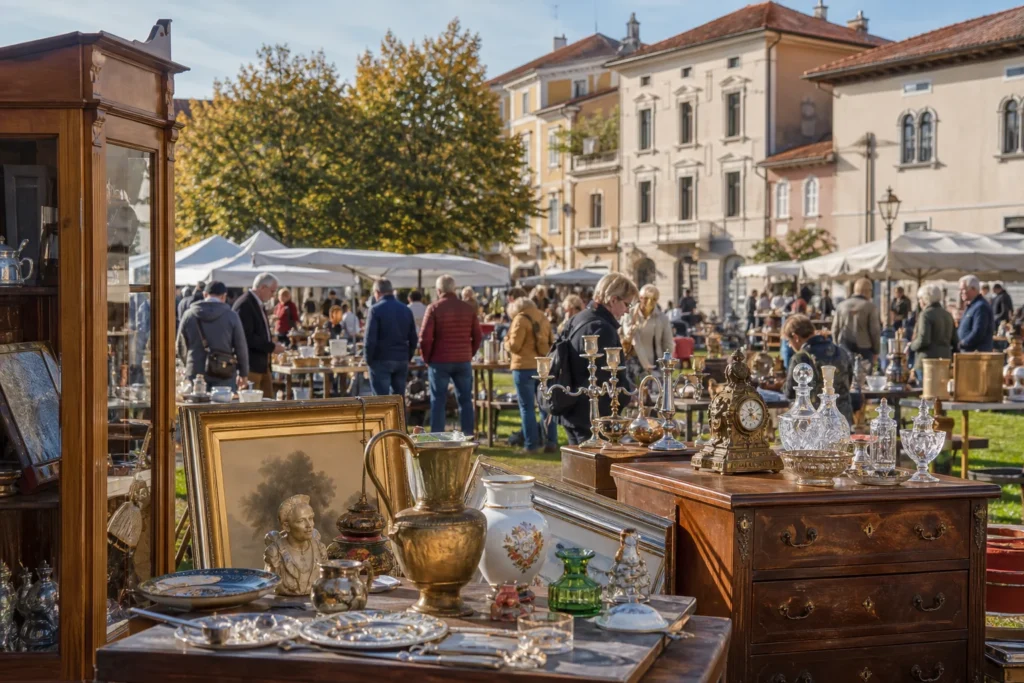

Piazza Unità d'Italia sits at the heart of Gradisca d'Isonzo, a compact Friulian town shaped by Venetian-era fortifications and the quiet pull of the Isonzo plain. On the third Sunday of each month, from 08:00 to 17:00, this square and the surrounding streets become the stage for one of northeastern Italy's most rewarding antique markets. Stalls spread across the Parco della Spianata and Viale Regina Margherita too, giving the event a generous, unhurried scale.
Around 200 exhibitors attend each edition of the Mercatino Mitteleuropeo dell'usato, and the geography of that name earns its place. Dealers travel not just from Friuli-Venezia Giulia but from Veneto, Emilia Romagna, Austria, Slovenia, Croatia, Poland and Hungary. That range shows directly in the merchandise. Objects that might have furnished a Viennese apartment sit alongside Italian provincial ceramics and pieces that arrived from Ljubljana or further east. The cross-border sourcing is the defining quality here — no single-region market produces quite the same mix.
Serious collectors find real depth in the antique offer. Porcelains, antique prints and silverware appear throughout the stalls. Decorative objects from earlier centuries turn up alongside antique candlesticks and jewellery. A separate current runs through the kitchen and domestic finds: old pulpers, cauldrons, wooden ladles and ironware that carry clear traces of rural Central European life. The market rewards patience, and it rewards arriving early. The 08:00 opening draws dedicated buyers who know the better pieces move before mid-morning.
The market also carries a handful of artisan stalls, but the tone stays firmly antiquarian rather than craft-fair. The inventory shifts meaningfully from month to month, partly because the exhibitor origins vary and partly because the Associazione Gradisca è — the local organisation behind the event — keeps the curation consistent and well-managed. Their long-running involvement gives the Mercatino Mitteleuropeo a reliability that many regional Italian markets struggle to maintain.
Gradisca d'Isonzo itself adds to the appeal. The town sits close to Gorizia and the Slovenian border, and its Venetian fortifications and riverside setting make the market feel genuinely embedded in its surroundings. Wandering between stalls here, it is easy to lose the whole morning without noticing. Visitors combining the market with Friuli's wine country — the Collio and Isonzo DOC zones are close by — find the timing fits a natural day-trip rhythm.
Most visitors arrive by car, but bus connections serve the town well. The stop at Viale Regina Elena (giardinetti) sits approximately 150 metres from the market and is served by bus lines G01, G22, G28 and G51. An alternative stop, Viale Trieste 121 (grattacielo), is around 500 metres away and runs the same four lines. Both stops connect Gradisca to surrounding Friulian communities, making a car-free visit practical from several nearby towns.
Frequently Asked Questions
Q: When does the Mercatino dell'Antiquariato a Gradisca d'Isonzo take place?
A: The market runs every third Sunday of the month, from 08:00 to 17:00. Arriving close to opening gives you the best chance of finding serious pieces before dedicated collectors move through the stalls.
Q: What makes this market "Mitteleuropeo" — is it genuinely different from other Italian antique markets?
A: Yes, noticeably so. Around 200 exhibitors travel not only from Friuli-Venezia Giulia and the Veneto but also from Austria, Slovenia, Croatia, Poland and Hungary. That cross-border sourcing is reflected directly in the stock — you'll find objects that might have furnished a Viennese apartment alongside Italian provincial ceramics and pieces that arrived from much further east.
Q: What categories of antiques and vintage goods appear regularly?
A: The market has real depth in porcelains, antique prints and silverware. Old kitchen and domestic tools — pulpers, cauldrons, wooden ladles and ironware — are a distinctive running thread, carrying a clear Central European rural character. Antique candlesticks, vintage toys, jewellery and decorative objects from earlier centuries also appear regularly across the stalls.
Q: How do I get there without a car?
A: Gradisca d'Isonzo is served by bus lines including G01, G22, G28 and G51. The stop at Viale Regina Elena (giardinetti) is approximately 150 metres from the market area. Check current timetables before travel, as service schedules can vary.
Q: Is this a craft fair as well as an antique market?
A: Primarily antique. A small number of artisan stalls appear alongside the dealers, but the tone stays firmly antiquarian. The Associazione Gradisca è, the local organisation behind the event, keeps the curation consistent — the focus on genuinely old objects is a deliberate and maintained characteristic of the market.
Marketplace Highlights








Add a review