

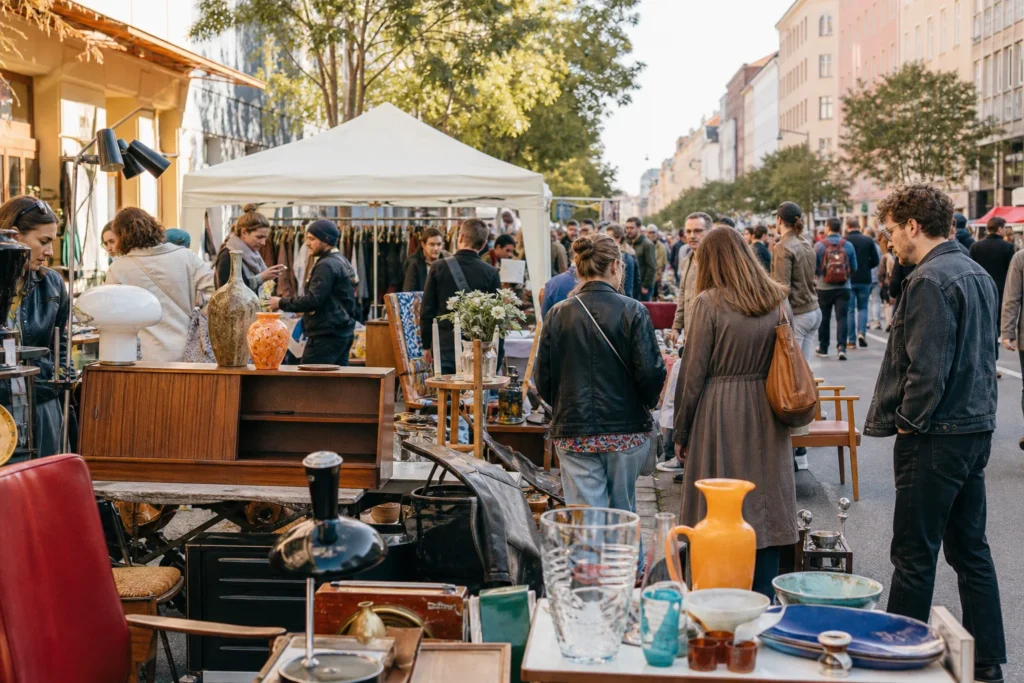

On a normal day, Neubaugasse moves at a particular Vienna pace — independent boutiques, coffee shops, a few galleries tucked between residential facades. Twice a year, that rhythm shifts completely. The street fills from Mariahilfer Straße all the way to Lerchenfelder Straße, roughly 1.2 kilometres of stalls, browsers and noise, as the Neubaugassen Flohmarkt takes over the seventh district for two full days each spring and autumn.
The merchandise here spans a wide range, and the browsing rewards patience. Collectors hunt for vinyl records, midcentury lamps and old prints. Ceramics and glassware appear in real depth, from elegant midcentury pieces to cheerful everyday oddities. Vintage fashion draws its own crowd, and wearables of every era surface reliably across the stalls. The miscellaneous layer is where things get interesting — a faded lithograph propped beside a ceramic figurine, costume jewellery next to a tray of hand tools, dog-eared paperbacks stacked near someone's grandmother's tea service. That unpredictable layering is part of what draws people back edition after edition.
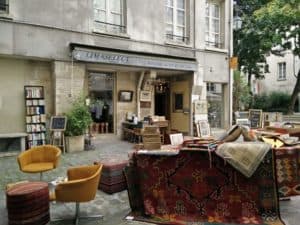
What genuinely sets this market apart from most Vienna flea markets is the boutique integration. The permanent shops lining Neubaugasse open their doors and extend their stock onto the pavement during market days. Visitors move without interruption between flea market stalls and the neighbourhood's independent retailers. The effect is less a pure secondhand market and more a full neighbourhood celebration — handmade ceramics from a local maker sitting a few steps from a vintage dealer's vinyl, all on the same stretch of cobblestones.
Programming adds further texture beyond the buying and selling. Pop-up concerts and dance performances appear along the route on both market days. A dedicated children's flea market gives younger visitors their own space to sell off toys and books. Street food vendors contribute to the sensory layering — Vienna sausages and Hungarian lángos are reliable presences, alongside café terraces spilling chairs onto the street. The market runs from early morning to early evening, giving enough time to cover the full stretch and still circle back.
A few practical habits help on the day. Arriving earlier in the morning gives first access to the best selection before crowds build and before the more sought-after pieces move on. Cash is useful, since not every vendor takes cards. The cobblestones are uneven along much of the route, so comfortable footwear matters. Both spring and autumn editions are worth noting: the autumn market draws a strong turnout from collectors returning after summer. Exact dates shift each year, so checking the current schedule before making travel plans is genuinely worthwhile.
Getting there is straightforward. Neubaugasse U3 station sits essentially at the market's edge — less than 50 metres from the street — and is served by subway line U3 as well as bus lines 13A, 14A and N71. Zieglergasse, also on the U3, lies approximately 300 metres away and works well as an alternative entry point from the opposite direction along the line. Visitors coming from the Ring or western districts can also use tram 49, which stops at Siebensterngasse around 350 metres from the market. Bus lines 13A and N49 serve Siebensterngasse as well.
Collectors and dedicated market-goers will find the depth of stock here genuinely competitive by Vienna standards. But the Neubaugassen Flohmarkt also suits visitors who want a market that feels rooted in a real neighbourhood rather than staged for tourism. The seventh district gives it a particular character — creative, local, unhurried — and the market reflects that accurately.
Frequently Asked Questions
Q: When does the Neubaugassen Flohmarkt take place?
A: The market runs twice a year, once in spring and once in autumn, across two full days each edition. Exact dates shift from year to year, so it's worth checking the current schedule before making travel plans.
Q: What kinds of things can you find at the market?
A: The range is genuinely broad. Collectors tend to focus on vinyl records, midcentury lamps, ceramics, glassware and old prints. Vintage fashion draws its own steady crowd. Then there's the miscellaneous layer — costume jewellery, hand tools, old paperbacks, ceramic figurines and the occasional faded lithograph — which is often where the most unexpected finds turn up.
Q: What makes this market different from other Vienna flea markets?
A: The permanent boutiques lining Neubaugasse open their doors and extend their stock onto the pavement during market days. Visitors move fluidly between secondhand stalls and independent local retailers along the same stretch of cobblestones, giving the whole event more of a neighbourhood-festival feel than a straight flea market.
Q: Is there anything beyond buying and selling?
A: Yes — pop-up concerts and dance performances appear along the route on both days, and there's a dedicated children's flea market where younger visitors can buy and sell toys and books. Street food vendors are well represented, with Vienna sausages and Hungarian lángos among the reliable presences alongside café terraces spilling onto the street.
Q: Any practical tips for visiting?
A: Arriving earlier in the morning gives you first access to the best selection before crowds build. Bring cash, as not every vendor has a card reader. The route runs along uneven cobblestones for over a kilometre, so comfortable footwear is genuinely worth thinking about. The U3 Neubaugasse station puts you essentially at the market's edge for a straightforward arrival.
Marketplace Highlights








Add a review