

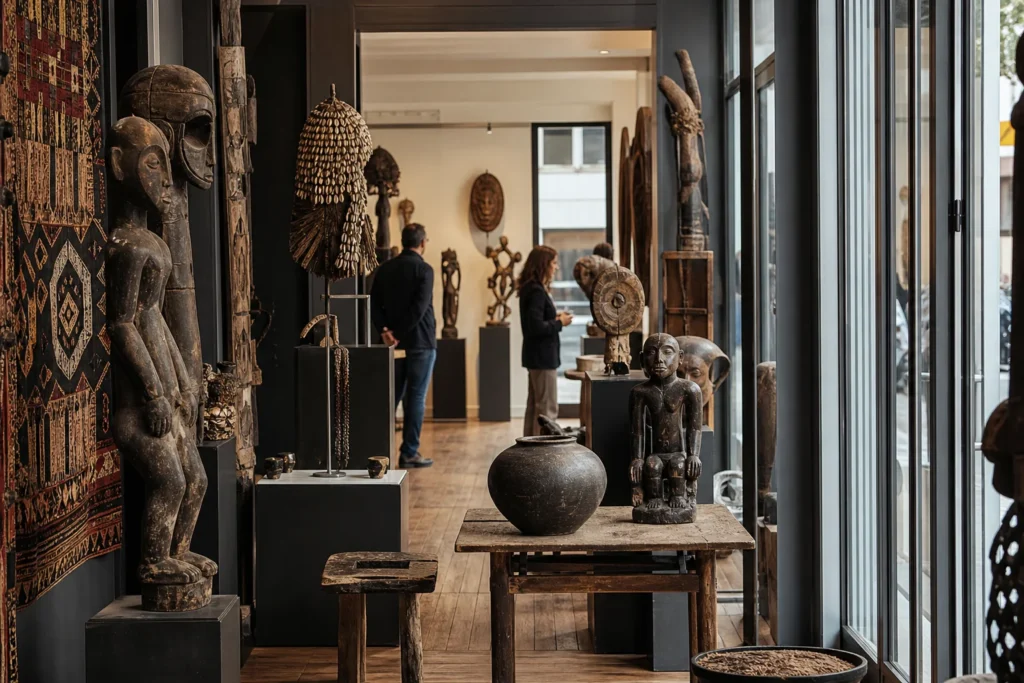

Parcours des Mondes turns Saint-Germain-des-Prés into something you have to walk to understand. Once a year, on the second weekend of September, a cluster of specialist galleries across this historic Paris quarter opens simultaneously for the fair, running each day from 11:00 to 18:00. Instead of a single convention hall filled with booths, the event unfolds across real gallery spaces — each with its own entrance, its own rooms, its own editorial argument.
The disciplinary range is one of the fair's genuine distinctions. African art, Oceanic objects, pre-Columbian and other American works, Asian pieces, and classical archaeology all appear across the participating galleries. These are not treated as unrelated categories dropped into adjacent booths. The galleries have built long specialist careers in these fields, and that depth shows in how the material is chosen and displayed.
Selection into Parcours des Mondes is competitive. Organisers apply vetting criteria to new applicants, and the gallery list reflects that standard. Each exhibiting dealer curates its own show independently, so visitors encounter a sequence of distinct points of view rather than one undifferentiated fair floor. Some rooms hold a handful of objects given generous space; others build a more layered case across a broader range.
The fair works across a genuine price spectrum. Ethnographic pieces accessible to newer collectors appear alongside museum-grade works that serious buyers have tracked for years. That breadth is one of the event's practical strengths. When you step into a gallery at Parcours des Mondes, you speak directly with a specialist who knows the material in front of you. That kind of conversation is hard to find on a conventional fair floor, and it makes the event navigable for someone still building knowledge as much as for an established collector.
Planning pays off here. The official map lets visitors filter participating galleries by discipline — tribal art, Asian art, archaeology — so you can sketch a route around your primary interest before you arrive. The second-weekend-of-September timing means the fair sits within Paris's broader autumn cultural calendar. Saint-Germain-des-Prés rewards unhurried walking in any case, and the gallery circuit gives that walking a sharp focus.
Getting there is straightforward. The Jacob bus stop is approximately 85 metres away and serves bus lines 39, 95, N12 and N13, making it the closest local option. Metro line 4 stops at Saint-Germain-des-Prés station, roughly 350 metres from the fair's heart — the most practical choice for visitors crossing the city. Those arriving from further afield or travelling by rail can reach the area from Musée d'Orsay station on RER train line C, approximately 700 metres away.
Parcours des Mondes suits anyone genuinely curious about non-Western and ancient art, whether they come as experienced collectors or complete newcomers. The neighbourhood has concentrated tribal art and antiquities dealers at a density rare in any other city. The fair makes that concentration briefly and explicitly visible — a useful way to spend a September afternoon in one of Paris's most seriously specialist quarters.
Frequently Asked Questions
Q: When does Parcours des Mondes take place and what are the opening hours?
A: The fair runs on the second weekend of September, with galleries open each day from 11:00 to 18:00. Check the organiser's official page before you go to confirm the exact dates for the year you plan to visit.
Q: What kinds of art and objects will I find at the fair?
A: Parcours des Mondes covers African art, Oceanic objects, pre-Columbian and other American works, Asian pieces, and classical archaeology. These are specialist fields rather than decorative categories, and the galleries exhibiting have long careers in them — so the depth of material tends to be genuine.
Q: Is the fair suitable for someone who is new to ethnographic and tribal art?
A: Yes. The price spectrum is broad, with pieces accessible to newer collectors alongside museum-grade works sought by serious buyers. Because you enter real gallery spaces rather than booth-lined aisles, you can speak directly with a specialist about what is in front of you — a far more useful conversation for someone still building knowledge than a crowded fair floor typically allows.
Q: How do I get to the Saint-Germain-des-Prés galleries?
A: Metro line 4 to Saint-Germain-des-Prés station is the most practical option for most visitors, roughly 350 metres from the fair's centre. The Jacob bus stop, around 85 metres away, serves lines 39, 95, N12 and N13 if you are already in the neighbourhood. Visitors arriving by rail have the option of RER line C to Musée d'Orsay, approximately 700 metres away.
Q: How should I plan my route around the fair?
A: The official map lets you filter participating galleries by discipline — tribal art, Asian art, archaeology — so it is worth sketching a route around your primary interest before you arrive. The galleries are spread across Saint-Germain-des-Prés and are visited on foot, so an unhurried pace works well; the neighbourhood itself repays that kind of walking.
Marketplace Highlights








Add a review