

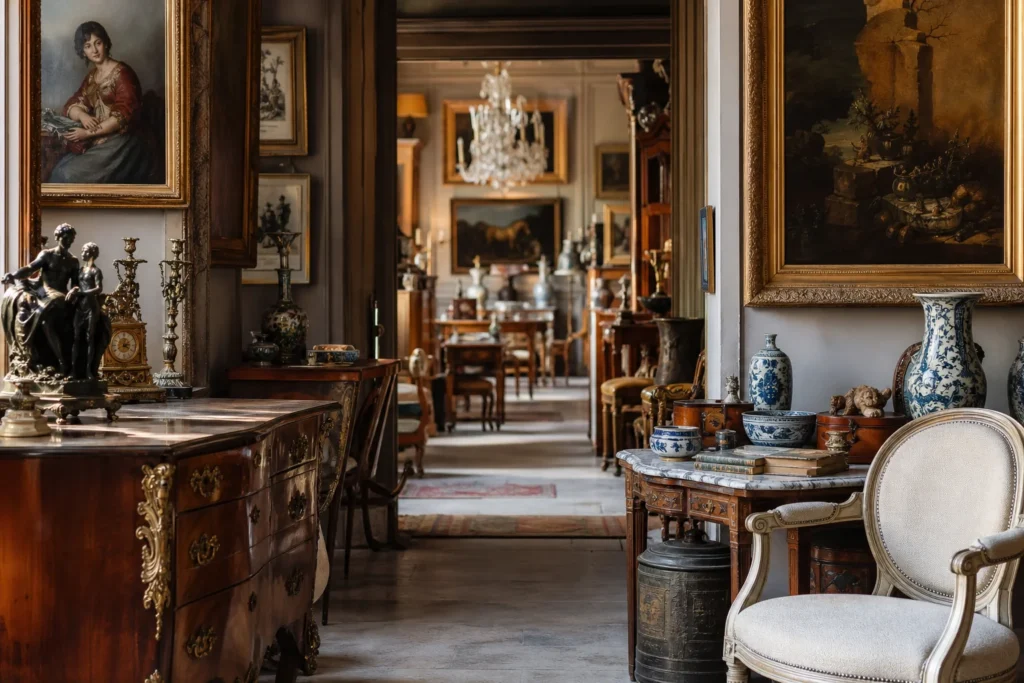

Small blue square banners mark the doorways along Rue des Saints-Pères, Quai Voltaire and Rue du Bac. They signal membership of Carré Rive Gauche — a formal association of antique and art dealers occupying a tight grid of streets across the 6th and 7th arrondissements of Paris. The Seine runs along its northern edge. The Musée d'Orsay sits a short walk to the east. Few antique districts anywhere announce themselves with quite this much architectural confidence.
The association brings together around 111 galleries within that compact area, bounded by Rue du Bac, Rue de l'Université, Rue des Saints-Pères and Quai Voltaire. Founded in 1977, it has spent nearly five decades building a reputation that reaches well beyond Paris. What distinguishes it from a general antique market is specialisation. Each gallery tends to focus on a defined period, style or category rather than offering a broad sweep of stock. That commitment to depth is what draws professional buyers.
The merchandise clusters into distinct fields. At one end of the spectrum sit furniture, old master paintings and sculpture — pieces with serious provenance and period credentials. At the other end, dealers concentrate on decorative arts, applied crafts and historical everyday objects: ceramics, silver, textiles, works on paper. Together, the association's members cover an extraordinary chronological range — association literature speaks of seven thousand years of art history, reflecting the span of objects across all 111 galleries rather than any single room.
That breadth attracts a particular type of visitor. Prominent collectors and museum curators have long used the Carré as a serious sourcing ground. The proximity of the Louvre, the Musée d'Orsay and the Musée des Arts Décoratifs is no accident — it places the association within the professional orbit of major French and international institutions. Dealers here are accustomed to conversations that go well beyond price.
Programming extends across the year. Member galleries host exhibitions throughout the calendar, and the association organises antique fairs in spring. The spring fair draws buyers and browsers alike, and represents one of the more rewarding times to visit if scheduling allows.
For anyone arriving by public transport, the Jacob bus stop on Rue Jacob sits approximately 100 metres from the heart of the district, served by bus lines 39, 95, N12 and N13. Métro line 4 stops at Saint-Germain-des-Prés station, roughly 400 metres away — a straightforward approach from much of central Paris. Those arriving by RER can use the Musée d'Orsay stop on line C, approximately 600 metres to the east along the river.
Carré Rive Gauche rewards the visitor who arrives with some knowledge and specific intent. The serious collector researching a period or style, the museum-adjacent buyer looking for specialist expertise, or the well-informed browser who prefers depth over variety — all will find the district worth the time. It is not a place for impulse purchases. It is a place where objects come with stories, and dealers who know them well.
Frequently Asked Questions
Q: How do I know which shops belong to the Carré Rive Gauche association?
A: Look for a small blue square banner displayed at the entrance. Dealers showing this sign are official members of the association.
Q: Is this a market or a district of individual galleries?
A: It is a district. Around 111 independent galleries are spread across a compact grid of streets — Rue du Bac, Rue de l'Université, Rue des Saints-Pères and Quai Voltaire — each operating its own premises and specialising in a defined period, style or category.
Q: What is the best time of year to visit if you are a serious buyer?
A: The association organises antique fairs in spring, which draw both professional buyers and collectors and represent one of the more rewarding times to visit. Member galleries also host exhibitions throughout the year. Check the association's official page for current dates before planning a trip.
Q: What is the easiest way to reach the district by public transport?
A: Métro line 4 stops at Saint-Germain-des-Prés, roughly 400 metres away. The Jacob stop on Rue Jacob — served by bus lines 39, 95, N12 and N13 — puts you approximately 100 metres from the heart of the district. RER line C at Musée d'Orsay is around 600 metres to the east along the river.
Q: Do you need specialist knowledge to visit, or is it worth going as a casual browser?
A: Both are welcome. Dealers are accustomed to in-depth conversations with professional buyers and curators, but the district is also worth exploring out of curiosity. Arriving with at least a rough sense of the period or category that interests you will help you navigate the 111 galleries more purposefully.
Marketplace Highlights









Add a review