

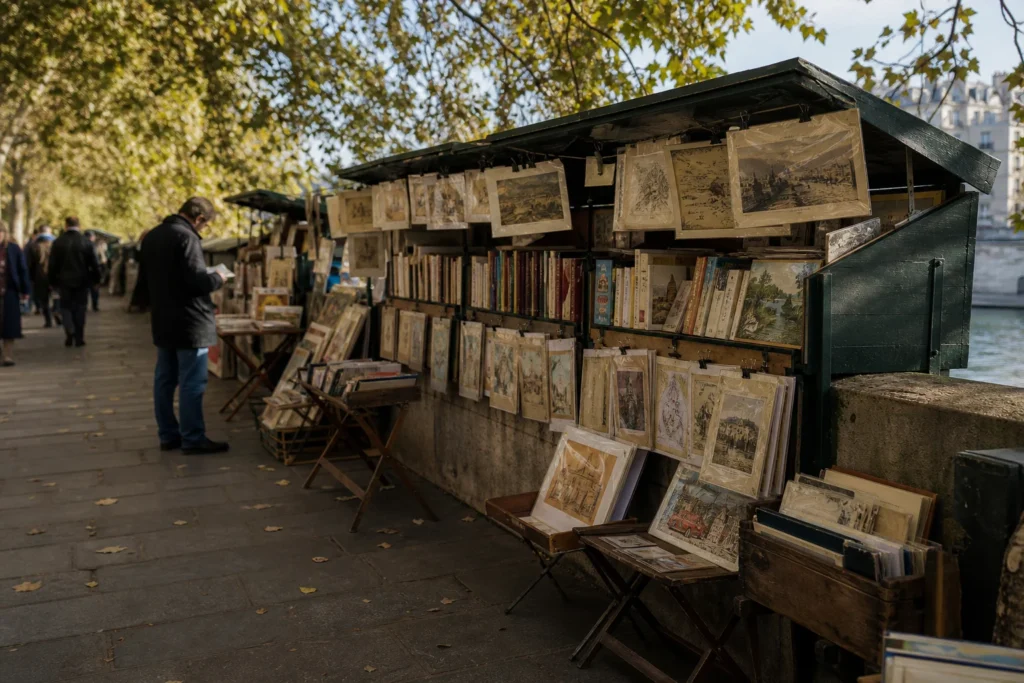

Fold back the hinged wooden lid of any one of the dark green boxes lining the Quai de la Mégisserie and you get an immediate sense of what Les Bouquinistes de Paris actually are: not a pop-up market, not a weekend event, but a permanent open-air institution that has occupied the banks of the Seine since the sixteenth century. The green boxes themselves have become as recognisable as the river behind them. Roughly 240 licensed dealers operate more than 900 of them, stretching across approximately two miles of both banks — left bank from Quai Voltaire to Quai de la Tournelle, right bank from Pont Marie to Quai du Louvre.
The sheer scale rewards a slower visit. Around 500,000 items fill those boxes at any one time, and the range runs well beyond books. Old periodicals, antique prints and engravings, vintage posters, postcards, stamps and trading cards share space with paperback novels and serious antiquarian volumes. The depth is genuine: a first edition from the seventeenth century might sit in the same stall as an affordable reprint of a Baudelaire collection. That combination of serious rarity and accessible everyday finds gives the bouquinistes much of their appeal for collectors and casual browsers alike.
French literature dominates, naturally. Hugo, Zola, Saint-Exupéry and Baudelaire appear regularly, in original editions and in later reprints. Art, history, philosophy, science, sociology and fine arts all have solid representation. Foreign-language stock is genuinely present too — English, German, Italian, Dutch, Russian and Spanish titles turn up with enough frequency to reward non-Francophone visitors who take the time to look. A collector hunting a specific eighteenth-century edition will need patience and likely several visits. A tourist after a readable French classic at a fair price will find options almost immediately.
Haggling is normal here, much as it is at any good flea market, and the informal negotiation is part of the experience. Prices vary widely by stall and by seller, and there is no fixed rule about what is negotiable. Bring patience rather than expectations.
Stalls open Monday through Friday from around 10:00 to 18:00. Weekend hours are shorter — generally 13:00 to 18:00 on Saturdays and Sundays. Individual dealers set their own pace, so not every box opens every day, and weekday mornings tend to be quieter than weekend afternoons, when the riverbank sees heavier foot traffic from both locals and visitors.
The right-bank stretch is most practical to reach via Châtelet, where metro lines 1, 4, 7, 11 and 14 stop approximately 160 metres from the Quai de la Mégisserie end of the market. A large cluster of bus lines also serves Châtelet — routes 21, 38, 47, 67, 72 and 76 among them — making the area reachable by bus from across central Paris. Visitors arriving by regional rail can use Châtelet–Les Halles, served by RER lines A, B and D, roughly 350 metres away.
Les Bouquinistes occupy a rare position in a city with no shortage of literary culture. They are neither museum nor marketplace in the conventional sense, but something in between — a living archive laid out in green boxes along one of the world's most walked riverbanks, open to anyone willing to stop and look.
Frequently Asked Questions
Q: What can you actually buy here beyond books?
A: Quite a lot. The green boxes hold old periodicals, antique prints and engravings, vintage posters, postcards, stamps and trading cards alongside second-hand paperbacks and serious antiquarian volumes. Decorative prints picked up for a few euros are as common as rare finds, so it rewards browsing even if you are not after literature.
Q: Is haggling acceptable, and how should you approach it?
A: Haggling is a normal part of the experience here, much as it is at any flea market. There is no fixed rule about what is negotiable, and it varies by seller. Bring patience and make a reasonable opening offer; pushback is not taken badly.
Q: Do the stalls open every day, and when is the best time to visit?
A: Individual dealers set their own pace and not every box opens every day. Weekday hours are generally around 10:00 to 18:00, with shorter weekend hours in the afternoon. Weekday mornings tend to be quieter; weekend afternoons bring heavier foot traffic from both locals and visitors. Check individual stalls if you are making a special trip.
Q: Is there worthwhile stock for non-French-speaking visitors?
A: Yes. English, German, Italian, Dutch, Russian and Spanish titles turn up with enough regularity to make a browse worthwhile. You may need to look across several stalls rather than finding everything in one place, but non-Francophone visitors do find material.
Q: How much of the two-mile stretch do you need to cover to get a proper sense of it?
A: The full stretch runs across both banks — left bank from Quai Voltaire to Quai de la Tournelle, right bank from Pont Marie to Quai du Louvre. If time is limited, picking one bank and walking it deliberately is more rewarding than crossing back and forth. The right-bank end near Quai du Louvre is closest to Châtelet, the most convenient metro access point.
Marketplace Highlights








Add a review