

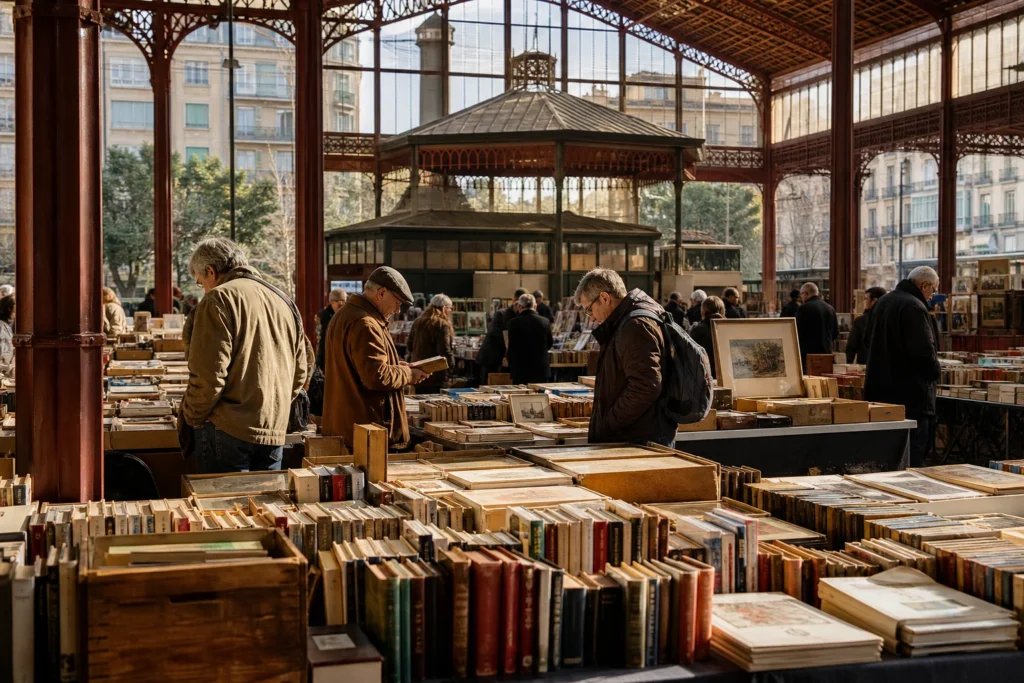

Every Sunday morning, the iron-and-brick Mercat de Sant Antoni anchors one of Barcelona's most distinctive rituals. By 08:30, more than 300 specialist vendors have already spread their stock across the market's perimeter stalls, and the browsers begin arriving in earnest soon after. The market traces its roots to at least 1936, with some accounts linking an even earlier predecessor to the Fira de Bellcaire print fair held near the port from 1882 — though that connection remains contested locally. Whatever its precise origins, the scale today is striking: upwards of 15,000 people pass through on a typical Sunday morning. The market bills itself as the largest antiquarian book market of its kind in the world, and while that superlative is difficult to verify globally, the sheer density of sellers and material gives it real credibility.
The stock divides naturally into a few meaningful clusters. For text-focused collectors, the tables carry antiquarian hardcovers, vintage paperbacks, regional newspapers, illustrated magazines and literary periodicals going back decades. Graphic and visual print enthusiasts find old comics, film posters, theatre programmes and trading cards alongside illustrated almanacs and vintage advertising material. A third category covers cartographic and documentary ephemera — old maps, postcards and printed documents that attract a quieter but dedicated crowd. Stock turns over consistently, and the vendors who know their material best tend to surface the best pieces early. Arriving close to the 08:30 opening rewards those with specific targets.
What separates Sant Antoni from a general flea market is the vendor community itself. Most stall holders have traded here for years and carry specialist knowledge of their inventory. They do not behave like generalists clearing a warehouse. Ask about a particular edition or a run of a certain comic and the vendor will either produce it or point you two stalls along to someone who might. The market functions as a loose outdoor federation of dealers, with informal referrals moving between tables throughout the morning.
That same expertise makes the market worthwhile for sellers as well as buyers. Vendors are accustomed to fielding valuation questions. Anyone who arrives with a box of old books or a folder of printed ephemera can approach stall holders directly and expect a practical, unpressured conversation about current market value.
The setting adds its own character. The Mercat de Sant Antoni building frames the stalls with handsome nineteenth-century architecture, and the surrounding Eixample streets fill with café-goers as the morning progresses toward the 14:00 close. The atmosphere shifts noticeably between 08:30 and mid-morning, so collectors chasing specific material tend to arrive first and linger longest.
Getting here is straightforward from most parts of Barcelona. Sant Antoni metro station on line L2 sits approximately 100 metres from the market entrance, making it the most direct public transport option. Urgell station on metro line L1 is roughly 450 metres away and adds a second underground route. The bus stop at Ronda Sant Antoni – Comte d'Urgell, approximately 80 metres from the market, serves several lines including buses 55, 120 and 141 among others, connecting the neighbourhood to broader parts of the city.
Sant Antoni suits dedicated bibliophiles hunting a specific edition, print collectors working through a defined category, and anyone genuinely curious about what old books and ephemera are worth. The specialist depth here, not just the size, is what makes a Sunday morning visit worthwhile.
Frequently Asked Questions
Q: What time should I arrive to find the best material?
A: Vendors are set up and trading from 08:30, and the most focused collectors arrive close to opening. Stock is fresh and the atmosphere is quieter early on. By mid-morning the crowds build significantly, so if you have specific targets — a particular edition, a comic run, a map from a certain period — earlier is consistently better. The market runs until 14:00.
Q: What kinds of printed material can I expect to find?
A: The stalls divide broadly into three areas: text-focused stock such as antiquarian hardcovers, vintage paperbacks, literary periodicals and regional newspapers; graphic and visual print including old comics, film posters, theatre programmes and trading cards; and cartographic and documentary ephemera such as old maps, postcards and printed documents. Stock turns over regularly, which is why many regulars visit most Sundays.
Q: Is this a general flea market or something more specialist?
A: It is considerably more specialist than a typical flea market. Most of the 300-plus vendors have traded at Sant Antoni for years and know their inventory in depth. If a stall holder cannot help with a specific request, they will usually direct you to a colleague nearby. The market functions more like an outdoor network of dealers than a jumble sale.
Q: Can I bring books or printed ephemera to get an informal valuation?
A: Yes, and vendors here are well used to it. Anyone curious about the value of an old book, a collection of comics or a folder of printed ephemera can approach stall holders directly. The environment is practical and low-pressure, with no obligation to sell.
Q: How do I get to the Mercat de Sant Antoni by public transport?
A: The Sant Antoni metro station (L2) is the closest option, roughly 100 metres from the market building in the Eixample district. Urgell (L1) is a reasonable alternative at around 450 metres. Check current service information before travelling.
Marketplace Highlights









Add a review