


Region
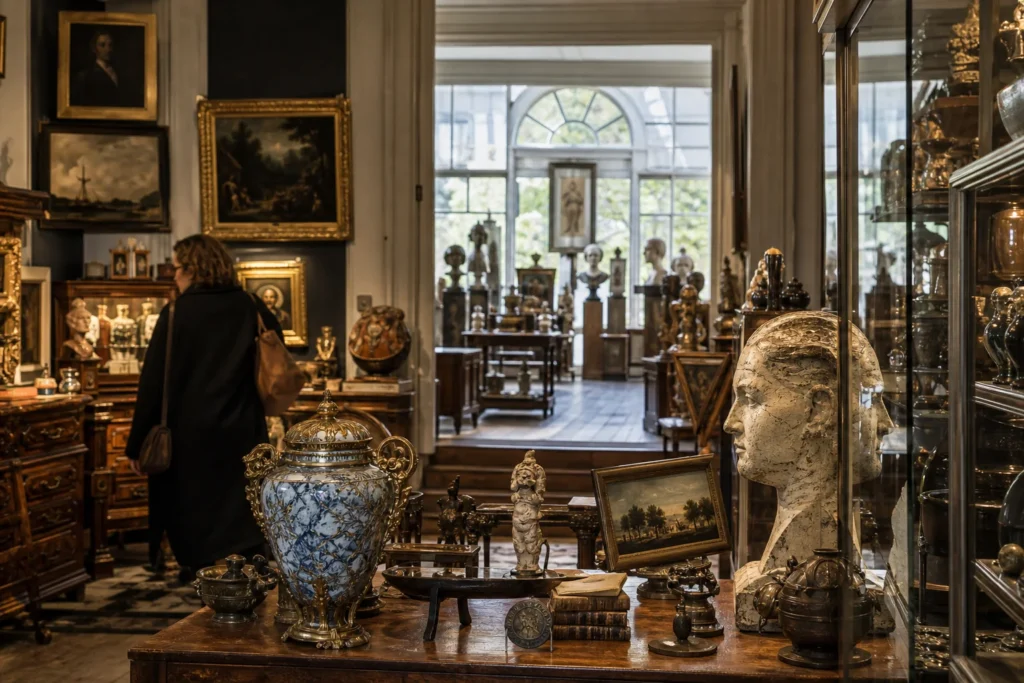
Along the Spiegelgracht, one of Amsterdam's quieter canal streets, a row of 17th and 18th-century gabled townhouses holds something unusual. Behind their leaded windows sit not boutique hotels or trendy restaurants, but specialist art and antiques dealers — over a hundred of them, concentrated into a few walkable blocks. This is the Spiegelkwartier, the Mirror Quarter, and it is one of Europe's most serious permanent antique districts. Its location directly beside the Rijksmuseum is no accident. The museum draws visitors already primed for Dutch Golden Age art, and the quarter quietly offers them a chance to take a piece of that history home.
The range here goes well beyond Dutch material, though Dutch collecting is genuinely strong. Dealers stock 17th-century furniture, Delft tiles and Golden Age paintings alongside Roman coins, tribal artefacts, Art Nouveau glass and Art Deco sculpture. The mix signals that this is an internationally sourced trade, not a local curio market. Window displays shift with the seasons, giving the street a different character in October than in April. Even a slow walk down the Spiegelgracht rewards a visit purely for the displays.
Two galleries give a sense of the district's specialist depth. Tóth Ikonen is Amsterdam's oldest gallery dedicated to religious iconography, with a rare collection of antique Russian icons that reportedly span several centuries. Nearby, Archea Ancient Art focuses on museum-quality pieces from ancient Greece, Rome, Egypt and the Near East, each accompanied by provenance documentation and scholarly context. Both represent the kind of specialist knowledge that distinguishes the quarter from a general antiques fair — these are dealers who have spent careers in narrow, serious fields.
That depth of knowledge is a consistent feature across the quarter. Many dealers are prepared to discuss provenance, history and attribution at length, and there is no pressure to buy. Serious collectors will find exactly the kind of conversation they are looking for. Curious visitors can browse just as freely. Galleries open across the district generally from 10:00 to 18:00 daily, though individual shops set their own hours. Some double as intimate venues for vernissages and artist talks, adding a live cultural layer to what might otherwise feel like a purely commercial neighbourhood.
Between visits, the quarter supports an unhurried pace. Canal-side cafés serve espresso and homemade cake, and a traditional Dutch pancake lunch is easy to find nearby. The Spiegelkwartier suits collectors hunting provenance-documented pieces, architectural enthusiasts drawn to the preserved townhouse streetscape, and anyone looking for a quieter alternative to Amsterdam's busier cultural circuit. It is a permanent neighbourhood where the trade has genuine depth and continuity — not a weekend market, but a living part of the city's art world.
Getting here is straightforward. The Rijksmuseum tram stop, served by trams 1, 7 and 19, sits approximately 100 metres from the Spiegelgracht address — the most practical option for visitors already heading to or from the museum. Vijzelgracht station on metro line 52 lies approximately 280 metres away and connects the quarter to Amsterdam's broader metro network. Both options place the district within easy reach from the city centre without the need for a taxi or bicycle.
Frequently Asked Questions
Q: What kinds of antiques and art can you find in the Spiegelkwartier?
A: The range is genuinely broad. Dutch-specific material — Golden Age paintings, Delft tiles, 17th-century furniture — sits alongside Roman coins, tribal artefacts, Art Nouveau glass and Art Deco sculpture. The quarter is internationally sourced, so expect specialist depth rather than a general jumble.
Q: Is it worth visiting even if you're not planning to buy?
A: Yes. Browsing is unhurried, there's no pressure to buy, and many dealers will talk through provenance and history at length. Window displays change seasonally, so the street itself rewards a slow walk. Canal-side cafés make it easy to pace the visit.
Q: Are there any standout specialist galleries to look for?
A: Two worth noting: Tóth Ikonen focuses exclusively on antique Russian icons and is Amsterdam's oldest gallery dedicated to religious iconography. Archea Ancient Art handles museum-quality pieces from ancient Greece, Rome, Egypt and the Near East, each with provenance documentation and scholarly context.
Q: When are the galleries open?
A: Most galleries open roughly 10:00 to 18:00 daily, but individual dealers set their own hours. Check before making a dedicated trip, especially for specific galleries.
Q: Where is the Spiegelkwartier relative to the Rijksmuseum?
A: It sits directly beside the Rijksmuseum along the Spiegelgracht, making it a natural extension of a museum visit — walkable in a few minutes from the main entrance.
Marketplace Highlights








Angie Mckenzie
9th August 2015 at 18:16Spiegelkwartier offers a range of antique shops and art galleries, I really enjoyed the passion the retailers have for their antiques and the wide range of prices.