

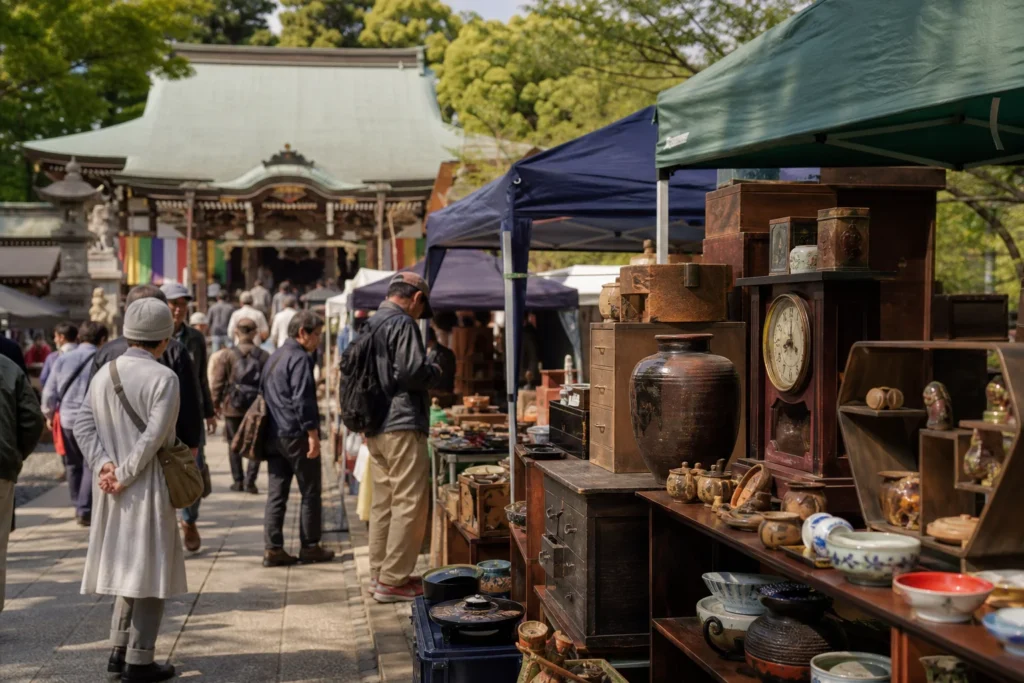

On the third Sunday of each month, the stone-stepped approach to Takahata Fudoson Temple in Hino City becomes one of western Tokyo's most atmospheric antique markets. Stalls line the main path leading to the temple gate, spill behind buildings and wind down quiet side streets. Some vendors keep things beautifully simple — small bowls arranged on mats laid across the steps, ceramic pieces catching whatever morning light filters through the trees. The market opens at 07:00 and runs through to 15:00, so arriving early rewards browsers who prefer first pick.
This is the Gozare Market, or ござれ市 — a name that gestures broadly at a celebration of old things. Around 120 dealers gather here each month, drawing from Tokyo and the surrounding cities. The scale feels substantial without feeling overwhelming, and the stock leans consistently toward traditional Japanese material rather than the mixed general goods you'd find at a typical swap meet.
It's worth knowing that Takahata Fudoson hosts two distinct monthly events. The second Sunday brings a broader swap meet, with a general mix of second-hand goods. The third Sunday — the Gozare Market — is the dedicated antique day. If your interest runs to serious Japanese antiques and vintage decorative objects, the third Sunday is your visit.
The merchandise at the Gozare Market clusters naturally into a few distinct areas. Textiles attract strong attention: vintage kimonos, accessories and fabric pieces appear across multiple stalls. Decorative objects and folk art form their own rewarding section — ceramics, porcelain, kokeshi dolls, netsuke, and scrolls all show up regularly. Furniture from the Shōwa era, old clocks, and 1940s household pieces round out the larger items. Some objects are so specific in their original purpose that even experienced local visitors stop to speculate. That depth of specialist stock is itself a signal that this is not a tourist-oriented market.
The setting is the factor that makes this fair genuinely different. Takahata Fudoson Temple belongs to the Shingon sect of Japanese Buddhism and ranks among the notable temples in the Kanto region dedicated to Fudo Myoo, known in Sanskrit as Acala Vidyaraja. Its five-story pagoda houses a statue of Kobo Daishi, the founder of the Shingon sect, alongside 1,000 jizo statues — the sentai jizoo. Several of the temple's cultural artifacts carry Important Cultural Asset designation. The temple remains active and architecturally distinguished, and that presence shapes the mood of everything around it.
Collectors focused on traditional Japanese decorative arts will find the Gozare Market well worth the detour westward from central Tokyo. The combination of serious specialist dealers and a living Buddhist temple creates a browsing experience that feels embedded in local life rather than arranged for visitors. The fair sits geographically further from Tokyo's central flea market circuit, but that distance contributes to its quieter, more local character.
For access, Takahatafudo Station on the KO train line sits approximately 300 metres from the market — a short walk from the temple grounds. Bus line 立65 also serves the area, with the Minamidaira stop roughly 200 metres away. Both options make the market straightforward to reach from central Tokyo without needing to drive.
Frequently Asked Questions
Q: What is the difference between the two monthly markets at Takahata Fudoson Temple?
A: There are two separate events. The second Sunday of each month is a general swap meet with mixed second-hand goods. The third Sunday is the Gozare Market (ござれ市), dedicated specifically to antiques and vintage Japanese objects — the event to target if traditional antiques are your interest.
Q: What kind of items does the Gozare Market typically stock?
A: The fair leans heavily toward traditional Japanese material: vintage kimonos and textiles, ceramics, porcelain, kokeshi dolls, netsuke, scrolls, Shōwa-era furniture, and old clocks. Around 120 dealers attend each month, and the depth of specialist stock means some items are unfamiliar even to experienced local visitors.
Q: When does the Gozare Market run, and is there an advantage to arriving early?
A: The market opens at 07:00 and runs until 15:00. Early arrival gives you first access to the full spread of stalls before popular pieces move on.
Q: How do I get to Takahata Fudoson Temple from central Tokyo?
A: The temple is a five-minute walk from Takahata Fudo Station on the Keio Line, making it straightforward to reach despite sitting on the western edge of the Tokyo Metropolis.
Q: Is the temple itself worth visiting on market day?
A: Yes. Takahata Fudoson is an active Shingon Buddhist temple with significant architecture, a five-story pagoda, and cultural artifacts carrying Important Cultural Asset designation. The temple grounds are the backdrop for the entire market, and the atmosphere shapes the experience in a way that a conventional fairground setting cannot.
Marketplace Highlights









Add a review