

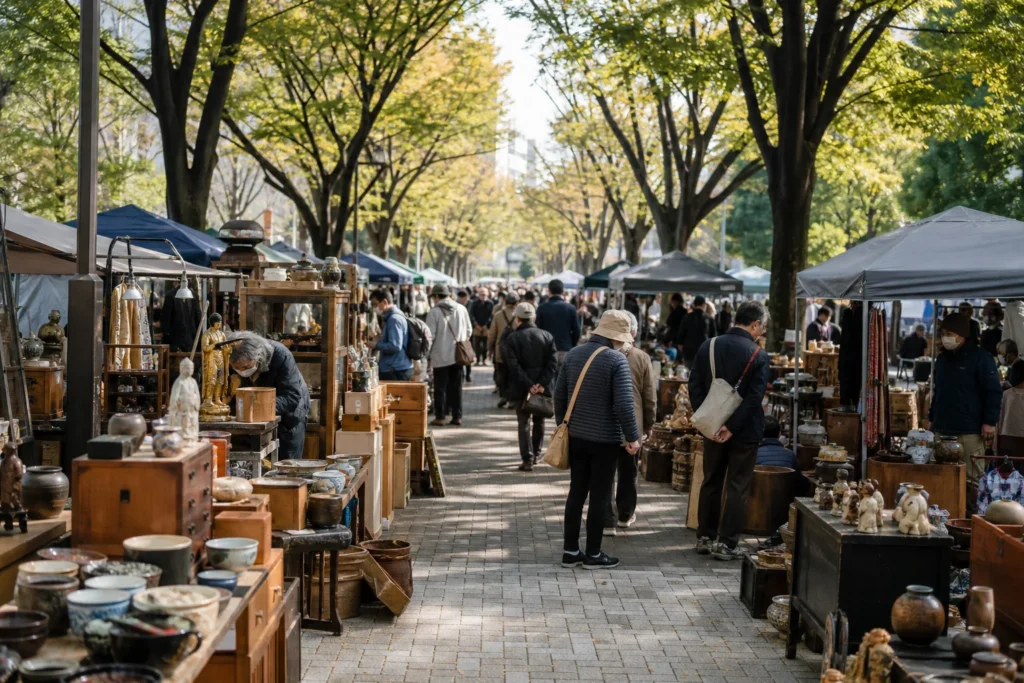

Tucked into the commercial heart of Yamato City in Kanagawa Prefecture, the Yamato Antique Fair draws collectors, dealers and curious visitors from across the greater Tokyo and Yokohama region. Known formally as やまとプロムナード古民具骨董市, this monthly market has grown into one of the largest antique fairs in the Kanto area, regularly hosting more than 200 vendors along the city's central promenade.
The fair traces its roots to 1998, when local organisers launched it to energise Yamato's commercial district. The Yamato City government and the local Chamber of Commerce have backed the initiative ever since, giving it an institutional stability that many open-air markets lack. That long-term support shows in the quality and consistency of the traders who return month after month.
Merchandise here spans centuries of Japanese material culture. Dealers set out traditional kimonos in careful stacks alongside netsuke toggles, vintage kokeshi dolls and painted go tables. Look further and you'll find samurai helmets, intricately carved wooden dragon masks, woodblock prints and rows of aged sake bottles. Old hand tools, wooden furniture and folk statues fill out the stalls, each piece carrying the quiet weight of Japan's rural and urban past.
The atmosphere is unhurried and genuinely communal. Vendors tend to know their stock well and engage browsers with the kind of context that turns a casual look into an informed purchase. Shoppers frequently leave with more than they planned to buy — a familiar outcome at a market where unexpected objects surface around every stall. For anyone moving heavier finds, traders can point visitors toward local delivery services, which removes one practical barrier for serious buyers.
The Yamato Antique Fair suits seasoned collectors hunting specific pieces as naturally as it suits first-time visitors simply curious about Japanese antiques and handcraft traditions. The breadth of stock — from delicate accessories and handmade clothing to substantial furniture — means there is genuine ground to cover whatever your interest or budget.
The market runs on the third Saturday of each month, opening at 06:00 and closing at 16:00 (Japan Standard Time). Early arrivals tend to find the widest selection, particularly among the smaller decorative pieces that move quickly. Yamato Station, served by the OE, SO and Enoshima limited-express train lines, sits approximately 350 metres from the promenade and makes the fair straightforward to reach from central Yokohama or Shinjuku without a car. The 南部ルート community bus stops at 大和警察署前, roughly 100 metres away, adding a useful local connection for those arriving from nearby districts.
Frequently Asked Questions
Q: When does the Yamato Antique Fair take place, and what are the opening hours?
A: The fair runs on the third Saturday of each month, from 06:00 to 16:00 Japan Standard Time. Arriving early gives you the best pick of smaller decorative pieces, which tend to move quickly.
Q: How do I get there by public transport?
A: Yamato Station — served by the Odakyu Enoshima and Sotetsu lines — is around 350 metres from the promenade, making it straightforward to reach from Shinjuku or central Yokohama without a car. The 南部ルート community bus stops at 大和警察署前, roughly 100 metres from the market, for those arriving from nearby districts.
Q: What kinds of items can I expect to find?
A: Stock spans a wide range of Japanese material culture — woodblock prints, netsuke, traditional kimonos, kokeshi dolls, go tables and pottery sit alongside samurai helmets, wooden dragon masks, old tools, folk statues and vintage sake bottles. With more than 200 vendors, there is genuine ground to cover across both specialist and vernacular antiques.
Q: Can I buy large items if I have no way to transport them?
A: Yes. Vendors can point you toward local delivery services, which removes the usual practical barrier for heavier furniture, wooden statues or bulkier finds.
Q: Is this market suitable for first-time buyers of Japanese antiques, or mainly for experienced collectors?
A: Both find it worthwhile. Dealers tend to know their stock well and are generally willing to engage browsers with context about what they're selling, which makes the fair genuinely useful if you're still learning. The breadth of stock means there is something interesting across a wide range of budgets and interests.
Marketplace Highlights










Add a review