

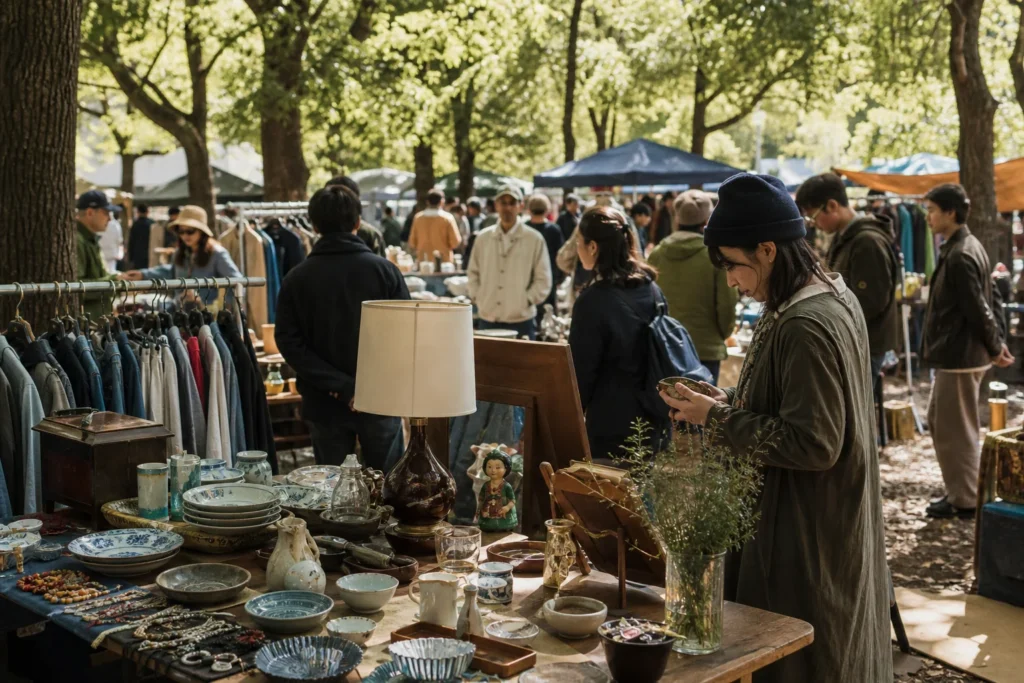

Yoyogi Flea Market has been running since 1981, and by its own claim it holds the title of Tokyo's first modern flea market. Decades on, it still draws crowds every time it opens in Yoyogi Park, tucked between the fashionable pull of Harajuku and the energy of Shibuya. The setting alone makes it unlike almost any other market in the city.
Part of the wider Oedo Antique Market community alongside the Tokyo International Forum venue, Yoyogi operates with a clear philosophy: only recycled and used goods change hands here. No professional dealers are admitted. The result feels less like a curated antique fair and more like a very stylish neighbourhood garage sale, where the boundary between seller and street icon quietly dissolves.
Vendor costs stay low — reportedly under the equivalent of around USD $40 a pitch — which keeps the market accessible to younger sellers. That affordability shapes the crowd on both sides of the table. Tokyo street fashion movements like Dolly Kei and Cult Party, both of which draw heavily on vintage pieces, have sent a steady stream of teenagers and twenty-somethings toward the stalls. A tough economy and a boom in secondhand clothing culture have only deepened that appetite.
On a good Sunday the market gathers more than 180 vendors, and the merchandise covers a satisfying range. Clothing dominates: acid-wash denim, leather jackets, sequined dresses, vintage concert tees, and accessories of every description. Look beyond the rails and you'll find vintage vinyl records, stuffed animals, retro lunch boxes, and an eclectic scatter of Japanese knick-knacks and trinkets. Harajuku street-snap regulars browse the same stalls they might appear in that weekend's magazine — sometimes selling the very outfit they wore in the shoot.
The atmosphere is genuinely relaxed and social. Sellers tend to be friendly and enthusiastic, and the mix of curious shoppers, fashion hunters, and park visitors gives the market a loose, festive feel that suits a Sunday morning well.
Timing does require some flexibility. The market runs on an irregular Sunday schedule, generally from around 8:00 in the morning until 4:00 in the afternoon, and it closes whenever rain arrives. Checking ahead before you make the trip is simply good practice.
Getting there is straightforward. Yoyogi-koen station on subway line C sits approximately 470 metres from the market, making it the most direct transit option for most visitors. The Yoyogi-Hachiman train station on the OH line is roughly 360 metres away and works well as an alternative. For those already in the neighbourhood, bus route 宿51 stops at 代々木神園町, approximately 125 metres from the site — the closest public transport option of all.
Frequently Asked Questions
Q: Can anyone sell at the Yoyogi Flea Market, or is it restricted to professional dealers?
A: It's the opposite — professional dealers are not admitted. Only individuals selling recycled or used goods can set up a stall, which is why the market feels more like a stylish neighbourhood garage sale than a formal antique fair. Vendor fees are reportedly under the equivalent of around USD $40 a pitch, which keeps the seller base young and eclectic.
Q: What kinds of things can I expect to find here?
A: Clothing is the dominant category — vintage concert tees, acid-wash denim, leather jackets, sequined dresses, and accessories of every kind. Beyond fashion, stalls also turn up vintage vinyl records, retro lunchboxes, stuffed animals, and a wide scatter of Japanese trinkets and knick-knacks. With 180-plus vendors on a typical day, the range is genuinely broad.
Q: Does the market run every Sunday?
A: No — it operates on an irregular Sunday schedule, generally from around 8:00 in the morning until 4:00 in the afternoon, and it closes whenever rain arrives. Check the organizer's official page before making the trip.
Q: What is the easiest way to get there by public transport?
A: Three options are close. Yoyogi-koen station on subway line C is approximately 470 metres away; Yoyogi-Hachiman station on the OH line is roughly 360 metres away. For the shortest walk, bus route 宿51 stops at 代々木神園町, approximately 125 metres from the site.
Q: Is this market a good fit for vintage fashion hunters specifically?
A: Yes — it has a well-established reputation as one of Tokyo's most fashion-forward flea markets, drawing shoppers and sellers who move in the same Harajuku street-style circles. The no-professional-sellers rule and low stall fees mean you're often buying directly from people whose own wardrobes overlap with what they're selling, which tends to make browsing and negotiating more relaxed than at dealer-heavy markets.
Marketplace Highlights










Noah Schmidt
26th July 2016 at 06:59We did go to the flea market and it was like nothing we had seen before ,there were anything you could imagine there and it was all set up in a very organized way: food, music , and great finds, a lot of vintage clothing. I would make it a must see for anyone visiting Tokyo.