

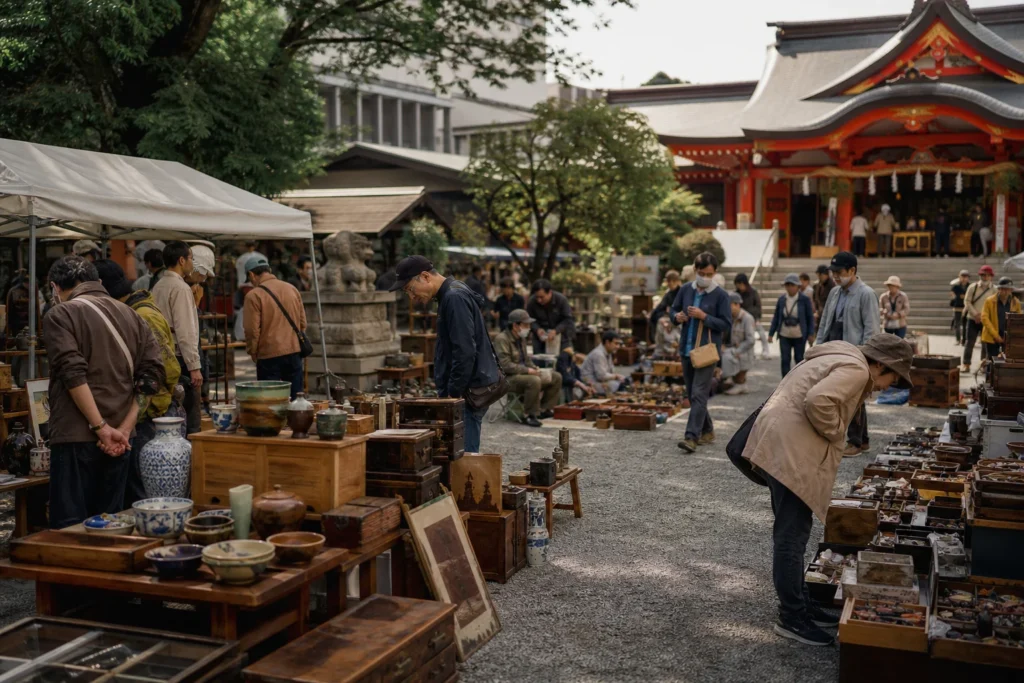

Hanazono-Jinja sits in the middle of Shinjuku, one of Tokyo's most relentlessly busy districts, yet on Sunday mornings the shrine grounds shift into something unexpectedly quiet. Around 25 to 30 stalls spread across the courtyard, offering a compact open-air antique market known as 花園神社青空骨董市. Vendors lay out their wares on mats and tables while the city hums just beyond the torii gates. It is a genuine contrast — and a genuinely good one.
The merchandise runs across a wide sweep of Japanese material culture. Expect old ceramics, lacquerware, vintage textiles, wooden boxes, tea sets, and assorted Edo-era ephemera. Coins, metalwork, and folded lengths of kimono silk appear regularly. The selection changes week to week, which is precisely why some locals return every Sunday. Nothing here is mass-produced or curated for tourists.
The atmosphere stays relaxed throughout the morning. Vendors are engaged and will answer questions willingly, but there is no pressure and no hard sell. Browsers tend to drift slowly between stalls, picking things up, setting them down, occasionally pausing for longer than expected over something they can't quite place. That unhurried quality is part of what makes the market distinctive, particularly in a city that rarely slows down.
The market runs every Sunday from 06:30 to 15:00, closing during certain shrine festivals and on 27 December and 3 January each year. Arriving early gives you first pick of the better pieces. Because the market is fully open-air, clear mornings are the most comfortable time to visit, though a light drizzle rarely stops the stalls from opening. Bring cash — card payments are not common at markets of this type in Japan.
The shrine itself adds genuine atmosphere beyond the stalls. Hanazono-Jinja has deep roots in Shinjuku's history and carries a significance that pre-dates the surrounding entertainment district by centuries. The kitsune statues — stone fox figures associated with Inari shrines — stand quietly among the vendors, lending the scene an odd and appealing mix of the sacred and the commercial. The proximity to Kabukichō, Tokyo's loudest nightlife corridor, makes the Sunday morning calm feel even more pronounced.
Getting here is straightforward. Shinjuku-sanchome Station on subway lines F, M and S sits approximately 270 metres away and serves as the most direct access point. The 新宿一丁目北 bus stop, served by bus route 白61, is a similar distance away. Shinjuku Station — a major rail hub served by numerous JR lines including the JR Chūō Rapid Line and N'EX — is roughly 725 metres away and is a walkable option for those already in the area.
This market suits collectors hunting Japanese ceramics or pre-war domestic objects, and equally suits curious visitors who want a genuine local Sunday ritual rather than a packaged experience. The scale is small, the setting is distinctive, and the finds are real.
Frequently Asked Questions
Q: When does the Hanazono Shrine antique market run, and are there any closures to know about?
A: The market runs every Sunday from 06:30 to 15:00. It closes during certain shrine festivals and on 27 December and 3 January each year. Check the shrine's official page before visiting on or around those dates to confirm the market is on.
Q: What kind of antiques and vintage goods can I expect to find?
A: The roughly 25 to 30 stalls cover a wide range of Japanese material culture — old coins, ceramics, tea sets, lacquerware, vintage kimono silk and textile off-cuts, wooden objects, antique fans, and Edo-period metalwork such as sword guards. The selection rotates weekly, so no two visits are identical.
Q: Is it worth arriving early?
A: Yes. The market opens at 06:30 and morning is the best time to browse before the better pieces are picked over. The unhurried pace suits early arrivals who want time to look carefully rather than rush.
Q: Do I need cash, and is bargaining expected?
A: Bring cash — card payments are uncommon at open-air antique markets in Japan. Vendors are generally engaged and willing to talk about their pieces, but the atmosphere is low-pressure with no hard sell. Quiet, respectful negotiation is part of the culture here.
Q: How do I get to Hanazono Shrine from central Shinjuku?
A: The most direct option is Shinjuku-sanchome Station on subway lines F, M and S, approximately 270 metres from the shrine. Bus stop 新宿一丁目北, served by route 白61, is a similar distance. Shinjuku Station — served by multiple JR lines — is around 725 metres away and is a walkable approach for those already in the area.
Marketplace Highlights








Hilda Cross
7th September 2015 at 22:44My advice is to get to Hanazono-Jinja Shrine early while there are still bargains to be had, but even near closing time there is something for any taste, and at prices well below anything you can find in mainstream stores. My husband bought a century old print of a geisha, and I bought a wood carving.
Chris Soto
30th June 2016 at 16:43You definitely need to sort through the junk, and perhaps nothing left is really ‘antique’, but has cultural significance at least. There are rolled up paintings, scripts, and other memorabilia. There was one couple selling kimonos and yukatas for women and men, and they even dressed a visitor, too. There were also rolls of kimono fabric for sale. Then the bells, masks, sculptures, bracelets and other odds and ends you’d expect at a flea market.
If anything, the prices were slightly lower than other places I visited on my trip, especially when you’re not willing to spend hundreds of USD or tens of thousands of Yen on newer kimonos, and it can go up ten times as much for better quality pieces.
Maggie
31st August 2025 at 12:49I was very disappointed to be deceived by a seller at this flea market. I purchased a fan for 2,000 yen (nearly $20) from a box marked with antiques, only to later discover the exact same item at Daiso for just 100 yen (less than $1). While I believe some sellers here are genuine, this market also seems to be a free-for-all for those who want to take advantage of foreigners. A very shameful and dishonest experience. I would not recommend this market to other tourists.