

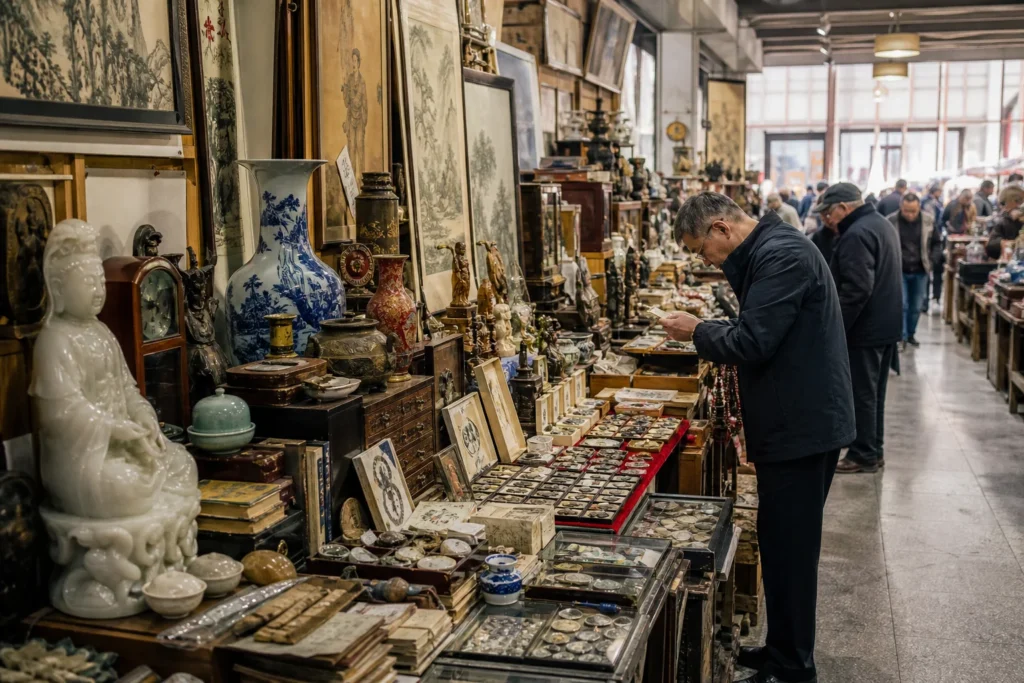

A single floor given over entirely to coins tells you what kind of place Yunzhou Curio City is. Collectors who trade in numismatics come here with purpose, and the building — seven floors in total, open daily from 10:00 to 21:00 — gives them plenty of room to work. But the coin floor is only the beginning. The rest of Yunzhou holds a dense, unpredictable accumulation of objects that rewards patience far more than speed.
Jade carvings occupy one corner of the trade, Cultural Revolution badges and Mao-era pins another. Vintage picture books and historical papers sit beside stacks of old stamps. Faded family photographs and handwritten letters turn up in boxes that have clearly not been sorted in years. Nothing here is curated in any gallery sense, and that roughness is precisely the point. Vendors arrange their stock the way long-term collectors arrange storage — by logic that only becomes visible once you start asking questions.
Weekend visits shift the entire atmosphere. More vendors arrive than the building can hold, and the overflow spreads into surrounding alleys and across any flat surface that will take a folding table or a blanket. Serious collectors arrive early to work through the freshest stock. Casual browsers tend to find the Saturday and Sunday crowd energising rather than chaotic. Prices are rarely posted and rarely fixed. Conversation drives the transaction, and a working knowledge of Mandarin opens negotiations that would otherwise stay closed. Vendors who have traded here for years often attach stories to their stock, and those stories are part of what you are buying.
Yunzhou carries particular weight in Shanghai's contracted antique scene. The Dongtai Road Antique Market was once a favourite rummaging ground for locals and collectors alike, before it was demolished. When that informal trading tier disappeared, Yunzhou absorbed much of the demand. It has since held its ground as one of the city's most consistent destinations for serious curio hunting — neither tourist-facing nor especially easy, but rewarding to anyone willing to engage on its own terms.
The market suits dedicated collectors working through specific categories — coins, stamps, Cultural Revolution memorabilia — as well as curious visitors who want a Shanghai market that feels genuinely lived-in. The coin floor alone makes the detour worthwhile. The six floors around it are a dense, occasionally spectacular bonus.
Getting to Yunzhou is straightforward by subway. Jiashan Road station, served by metro lines 9 and 12, sits approximately 600 m away and makes a reliable arrival point from across the city. Dapuqiao station on line 9 offers a second subway option at around 800 m. For local bus connections, the stop 斜土路瑞金南路 is approximately 200 m away and served by bus lines 89, 205, 733 and 932. All distances are approximate straight-line figures.
Frequently Asked Questions
Q: Is Yunzhou Curio City open every day, and what are the hours?
A: Yunzhou Curio City opens daily from 10:00 to 21:00 across all seven floors. Weekday visits are quieter and easier to browse at a steady pace. Weekends bring significantly more vendors, with overflow spilling into surrounding alleys — a livelier but still manageable experience for most visitors.
Q: What kinds of items can you realistically find here?
A: The range runs from numismatic collections — one entire floor is dedicated to coins — through jade carvings, Cultural Revolution badges and Mao-era pins, vintage picture books, old stamps, historical papers, faded family photographs, and handwritten letters. The stock is ungurated and rummage-style, which means patient browsing turns up more than a quick walk-through will.
Q: Are prices fixed, and does it help to speak Mandarin?
A: Prices here are rarely posted and rarely fixed. Negotiation is how transactions work, and a working knowledge of Mandarin opens conversations that would otherwise stay closed. Many vendors with long histories at the market attach stories to their stock — those exchanges are part of the experience, not just the sale.
Q: When is the best time to visit for the widest selection?
A: Weekends bring the largest number of vendors, including outdoor stalls on surrounding pavements and alleys. Serious collectors tend to arrive early on Saturday and Sunday to work through the freshest stock before it moves. Weekday visits suit anyone who prefers a calmer pace with easier access to vendors.
Q: How do you get to Yunzhou Curio City by public transport?
A: Jiashan Road station, served by metro lines 9 and 12, is approximately 600 m away and is the most convenient subway option. Dapuqiao station on line 9 is a second option at around 800 m. The bus stop 斜土路瑞金南路 is approximately 200 m from the market. Confirm current services before travelling, as routes can change.
Marketplace Highlights








Add a review