

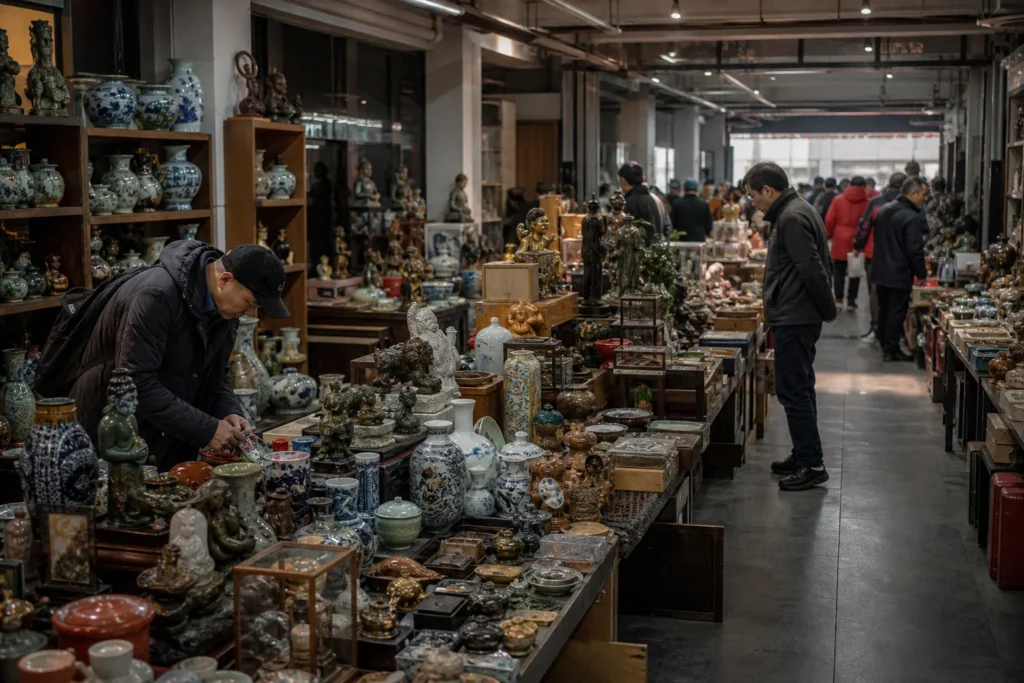

Fuyou Antiques Market sits on Fangbang Zhong Lu in Shanghai's Old City, and it hides its depth well. The entrance gives almost nothing away — a scatter of trinkets, a few plastic goods, street-level clutter that looks much like any other block in the area. Cross the threshold, and the whole character of the place shifts.
The building runs across four floors, and the lower two trade every day of the week. Weekdays run from 9:00 in the morning until 5:00 in the afternoon. Weekends are a different proposition entirely. On Saturdays and Sundays the market opens at 5:00 am and the upper floors come fully alive, joined by street-side stalls that spread out along the pavement and draw in additional vendors from across the city and beyond. The weekend version of Fuyou is busier, louder and substantially more rewarding for serious collectors.
Despite those early opening hours, the market rarely hits its stride before mid-morning. This is not a dawn rush where dedicated buyers hover over half-unpacked crates. Fuyou moves at a more relaxed pace. Arrive after a proper breakfast and you will find stalls fully set up, vendors settled, and the building humming with the sound of movement and negotiation. Each seller occupies a numbered floor space, which gives the market a more ordered feel than the scale of the weekend crowd might suggest.
The inventory is genuinely broad. Porcelain pieces share shelf space with lacquerware, vases, pottery and kitchenware. Qing dynasty coins, calligraphy scrolls, Buddhist statues and paintings appear regularly. Jewellery and decorative artwork fill the spaces in between. Specialist collectors tend to find exactly what they came for. Curious first-timers usually find something they were not expecting — which may be a better outcome still.
Bargaining is central to the experience, and vendors expect it. A working knowledge of Mandarin helps considerably. Visitors without language skills often come with a local contact or hire a translator for the day, which is a worthwhile investment if you plan to buy anything beyond the token.
The Fangbang Road location sits inside Shanghai's Old City, a neighbourhood that rewards wandering in its own right. Fuyou works well as an anchor for a longer morning in this part of Huangpu District, with the surrounding streets offering their own texture before or after a browse.
For public transport, bus lines 64 and 715 stop at 复兴东路光启路, roughly 100 metres from the market — the most convenient option for a direct approach. Xiaonanmen station on subway line 9 sits approximately 800 metres away and connects easily from central Shanghai. Yuyuan Garden station, served by subway lines 10 and 14, is at a similar distance and useful if you plan to combine the visit with nearby sights. Shiliupu Wharf, about 800 metres away, also offers ferry access for those arriving from across the Huangpu River.
Frequently Asked Questions
Q: When is the best time to visit Fuyou Antiques Market?
A: Mid-morning on a weekend is the sweet spot. The market opens as early as 5:00 am on Saturdays and Sundays, but that early hour is mainly for traders. By mid-morning the upper floors are fully open, street-side stalls have spread along the pavement, and vendors are settled and ready to negotiate. Weekday visits (9:00 am–5:00 pm) are quieter and cover the permanent stalls on the first and second floors only.
Q: What kinds of antiques and collectables can you find here?
A: The range is genuinely broad. On the classical side, expect porcelain, lacquerware, vases, pottery, calligraphy scrolls and paintings. Among smaller collectables, Qing dynasty coins, Buddhist statues, jewellery and decorative artwork turn up regularly. Specialist collectors tend to find what they came for; first-timers usually stumble across something unexpected.
Q: Is bargaining expected, and does it help to speak Mandarin?
A: Bargaining is central to the experience and vendors are entirely accustomed to it. A working knowledge of Mandarin makes a real difference — both for negotiating price and for understanding what you are looking at. Visitors without language skills often bring a local contact or hire a translator for the day, which is a worthwhile investment if you plan to buy anything beyond a small souvenir.
Q: How do you get to Fuyou Antiques Market by public transport?
A: Bus lines 64 and 715 stop at 复兴东路光启路, around 100 metres from the market entrance, making them the most direct option. Xiaonanmen station on subway line 9 and Yuyuan Garden station on lines 10 and 14 are each roughly 800 metres away and connect easily from central Shanghai.








Add a review