

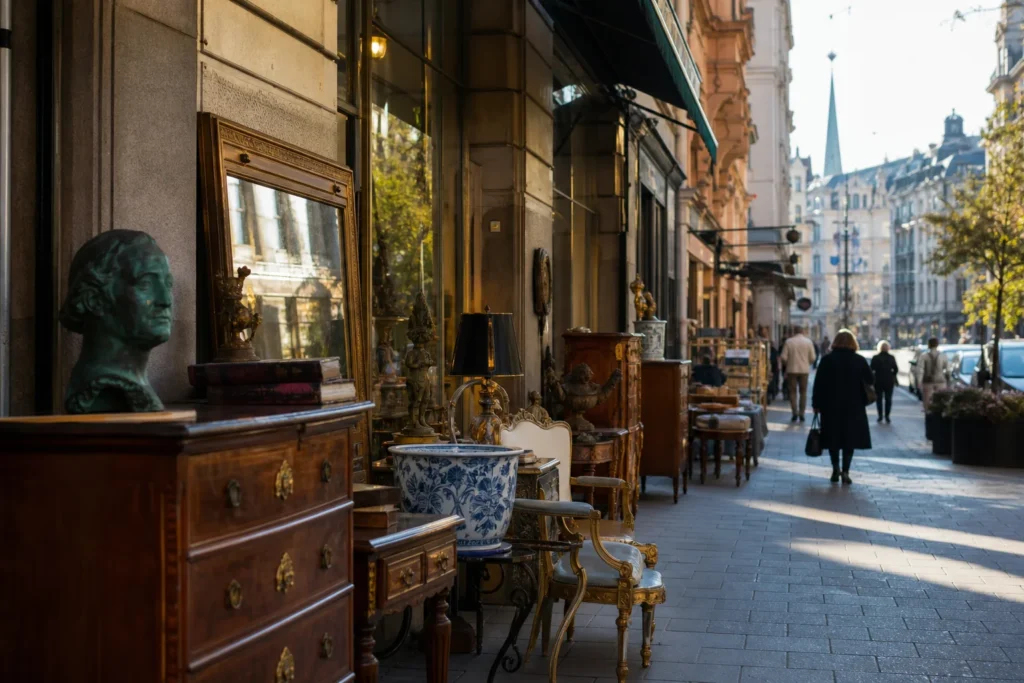

Bukowskis and Stockholm Auction House share a district with some of the finest specialist dealers in Scandinavia. That combination — serious auction infrastructure alongside curated retail — is what sets Östermalm apart. For a collector, being able to preview a significant work in the morning and browse a dealer's private stock in the afternoon is a rare convenience. Few antiques districts anywhere in northern Europe offer that in a single walkable grid.
The four streets at the heart of the quarter — Sibyllegatan, Linnégatan, Kommendörsgatan and Nybrogatan — form a compact loop. Shoppers can cover the full circuit on foot. The layout makes browsing genuinely productive rather than exhausting, and the shops sit close enough together that a detour rarely costs more than a few minutes.
Named dealers give the district its character. Sjöström Antiques and Rehns Antikhandel draw collectors interested in Swedish period furniture, from painted rural pieces to formal city cabinetry. Ostindiska Kompaniet specialises in Oriental objects and ceramics — a strong counterpoint to the Nordic-focused rooms nearby. JP Willborg and L Edelstam round out the mix, with expertise that leans toward decorative objects, silver and antique paintings from both Nordic and broader European sources. The owners and senior staff at these shops carry deep provenance knowledge. Asking questions is genuinely worthwhile; a conversation here often surfaces period context and collecting insight that no object label provides.
The range of stock across the district is broad without feeling scattered. Swedish furniture appears in multiple shops, but so do antique paintings, decorative glassware, ceramics and specialist carpets from Europe and further east. The overall impression is curation — pieces chosen with intention, not gathered for volume.
Both auction houses reward a preview visit even for those not planning to bid. The viewing rooms at Bukowskis and Stockholm Auction House regularly surface pieces that rarely move through normal retail. For a collector researching a specific maker or period, those rooms are worth scheduling separately from the main shopping circuit.
Most antique shops in Östermalm open Monday through Friday, roughly from 09:00 to 18:00, and are closed on weekends. Planning a weekday visit gives access to the full district and to the staff who know it best.
Östermalmstorg station sits approximately 100 metres from the district and serves metro lines 13 and 14 alongside bus lines 54 and 57 — the most direct public transport option from central Stockholm. Bus lines 1 and 67 stop at Nybrogatan, roughly 250 metres away, offering a useful alternative from other parts of the city. Tram line 7 reaches Nybroplan, about 550 metres distant, and works well for visitors approaching from the waterfront direction.
Östermalm suits the experienced collector hunting a specific Swedish period piece, the interior designer sourcing decorative objects, and the curious browser who wants to engage with serious dealers without the noise of a general market. The professional-grade seller mix and the proximity of two major auction houses make this one of the few districts in the region where a single afternoon can genuinely move a collection forward.
Frequently Asked Questions
Q: What days and hours are the antique shops in Östermalm open?
A: Most specialist dealers in the district keep weekday hours, broadly Monday through Friday from around 09:00 to 18:00, and are typically closed on weekends. A weekday visit gives you access to the full circuit and to the staff who know the stock best. Check individual shops before you go, as hours can vary by season.
Q: How do Bukowskis and Stockholm Auction House fit into a browsing visit?
A: Both auction houses are worth building into your itinerary even if you have no intention of bidding. Their viewing rooms regularly surface significant furniture, paintings, silver and ceramics that rarely move through normal retail channels — useful for price reference, period research or simply finding pieces unavailable elsewhere in the district.
Q: How compact is the antiques quarter, and can you cover it on foot?
A: The four core streets — Sibyllegatan, Linnégatan, Kommendörsgatan and Nybrogatan — form a walkable loop that can be covered in an afternoon. The layout makes comparison shopping between specialist dealers genuinely practical, with most shops within a few minutes of each other.
Q: What is the easiest way to reach the district by public transport?
A: Östermalmstorg metro station, on lines 13 and 14, sits around 100 metres from the quarter and is the most direct option from central Stockholm. Bus lines 54 and 57 also stop there. Bus lines 1 and 67 stop at Nybrogatan, roughly 250 metres away, and tram line 7 reaches Nybroplan about 550 metres from the heart of the district.
Q: Is it worth talking to the dealers rather than just browsing the shelves?
A: Very much so. The owners and senior staff at shops such as Sjöström Antiques, Rehns Antikhandel, JP Willborg, L Edelstam and Ostindiska Kompaniet carry provenance knowledge built over decades of handling. A conversation often surfaces period context, maker details and collecting insight that no object label provides — and that kind of depth is part of what makes the district worth the journey.
Marketplace Highlights







Add a review