

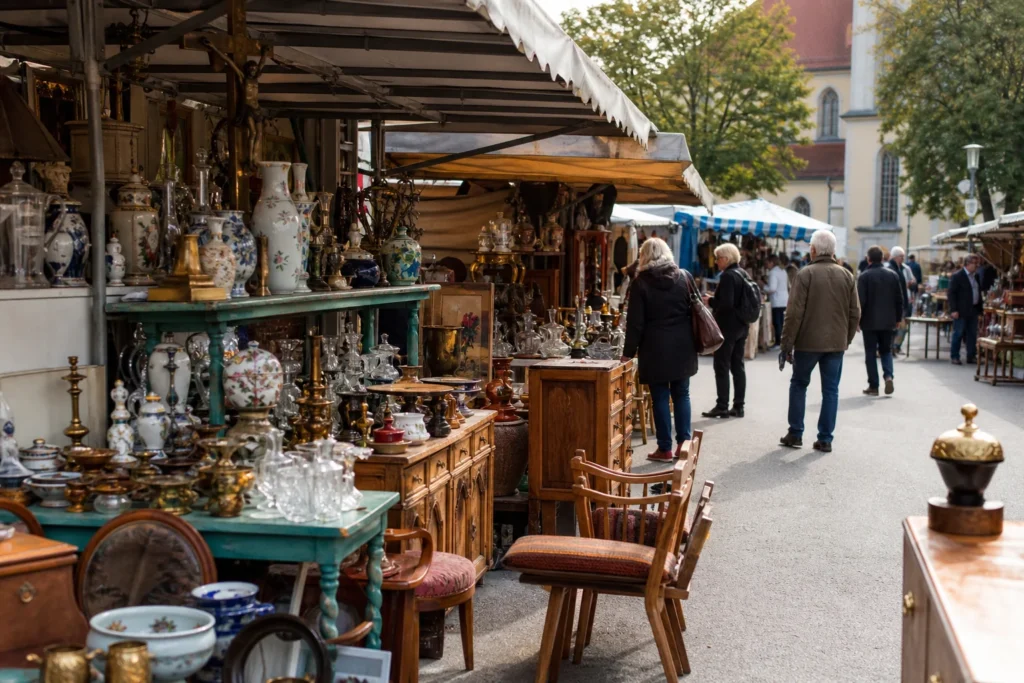

On a Saturday morning at Mariahilfplatz, the Auer Dult announces itself before you reach the square. The smell of grilling fish drifts across the Au neighbourhood, vendors are already setting out stacks of crockery, and early browsers move slowly between tables dense with old books and silverware. This is Munich at its most local — not a tourist market, but a genuine neighbourhood fair with centuries of practice behind it.
The Auer Dult traces its roots to 1796, when the Au district received the right to hold a fair. By 1905 the format settled into three nine-day runs each year, interrupted only by the wartime and immediate post-war years from 1943 to 1946. Today the fair opens on the last Saturday in April and the last Saturday in July, with a third edition starting on the third Saturday in October. Hours run from 10:00 to 20:00 throughout each run.
The antique and flea market section draws the most serious buyers. More than 300 stalls cover the square, and the sheer depth of stock rewards patient browsing. Ceramics and tableware form one of the strongest threads — the Auer Dult is widely said to hold the title of Europe's largest crockery market, and the density of glassware, silverware and domestic pottery makes that claim easy to believe. Rare books, old prints, coins and stamps draw collectors of paper and numismatics. Vintage furniture and decorative objects occupy another corner, alongside kitchen utensils, ornaments and traditional Bavarian beer mugs. Lederhosen, dirndl and folk textiles run through the stalls, mixing regional character into the broader antique offer.
Vendors here tend to know their stock and talk about it readily. That engaged quality sets the Auer Dult apart from more anonymous flea markets. The nine-day run also allows serious buyers to return more than once — fresh stock turns up between visits, and a single pass rarely uncovers everything.
Food and family entertainment keep the fair alive between browsing sessions. Steckerlfisch — whole fish grilled on a stick over open coals — draws a steady queue and remains one of Munich's most distinctive street foods. Barbecued sausages, Bavarian beer and fresh coffee fill out the offer. The fairground side runs alongside: a merry-go-round, puppet shows, horseback riding and circus acts give families with children their own reasons to stay. This dual character — specialist antique fair and working neighbourhood festival — is what lifts the Auer Dult above a purely commercial market.
The Au district location matters. Mariahilfplatz sits in a real Munich neighbourhood, not a repurposed car park or a purpose-built tourist precinct. That grounding shows in the crowd and in the atmosphere, which feels lived-in rather than staged.
Getting there is straightforward. Tram lines 18 and N27 stop directly at Mariahilfplatz, approximately 150 metres from the fair, making them the most direct surface option. Bus lines 52 and 62 serve Schweigerstraße, roughly 100 metres away. For those arriving by subway, Fraunhoferstraße connects to metro lines U1, U2, U7 and U8 at an approximate distance of 740 metres.
For collectors focused on European ceramics, Bavarian folk objects or vintage printed materials, the Auer Dult remains one of the most rewarding recurring fairs in Germany. Its age and consistency give it something most markets cannot replicate: a reputation that keeps serious vendors and serious buyers coming back together, three times a year, on the same square in Munich.
Frequently Asked Questions
Q: When does the Auer Dult take place each year?
A: The fair runs three times a year, each edition lasting nine days. It opens on the last Saturday in April, the last Saturday in July, and the third Saturday in October. Hours are 10:00 to 20:00 throughout each run.
Q: What kind of antiques and collectables can shoppers expect to find?
A: The 300-plus stalls cover a wide range, but ceramics, crockery and glassware are particularly deep — the Auer Dult is widely regarded as the largest crockery market in Europe. Serious collectors also come for rare books, old prints, coins, stamps, vintage furniture, decorative objects, and Bavarian folk items such as lederhosen and dirndl. Vendors tend to know their stock well, which makes browsing more productive than at anonymous flea markets.
Q: Is it worth returning on multiple days during the same nine-day run?
A: Many regulars do exactly that. The sheer volume of stalls means a single visit rarely covers everything, and fresh stock can appear between days. The nine-day format gives collectors time to go back after thinking something over, which suits the pace of serious buying.
Q: How do you get to Mariahilfplatz for the fair?
A: Tram is the most practical option. Check current Munich transport maps for the relevant stop, as the Au neighbourhood is well served from the city centre. Confirm routes before you travel, as services and stop names can change.
Q: Is the Auer Dult suitable for a family visit, or is it mainly for collectors?
A: Both. Alongside the antique stalls, the fair runs a full fairground with a merry-go-round, puppet shows, horseback riding and circus acts aimed squarely at younger visitors. Food stalls serving Steckerlfisch, grilled sausages and Bavarian beer keep everyone fed. The combination of specialist market and neighbourhood festival means families can comfortably spend a full afternoon there without the day revolving entirely around browsing.
Marketplace Highlights








Add a review