

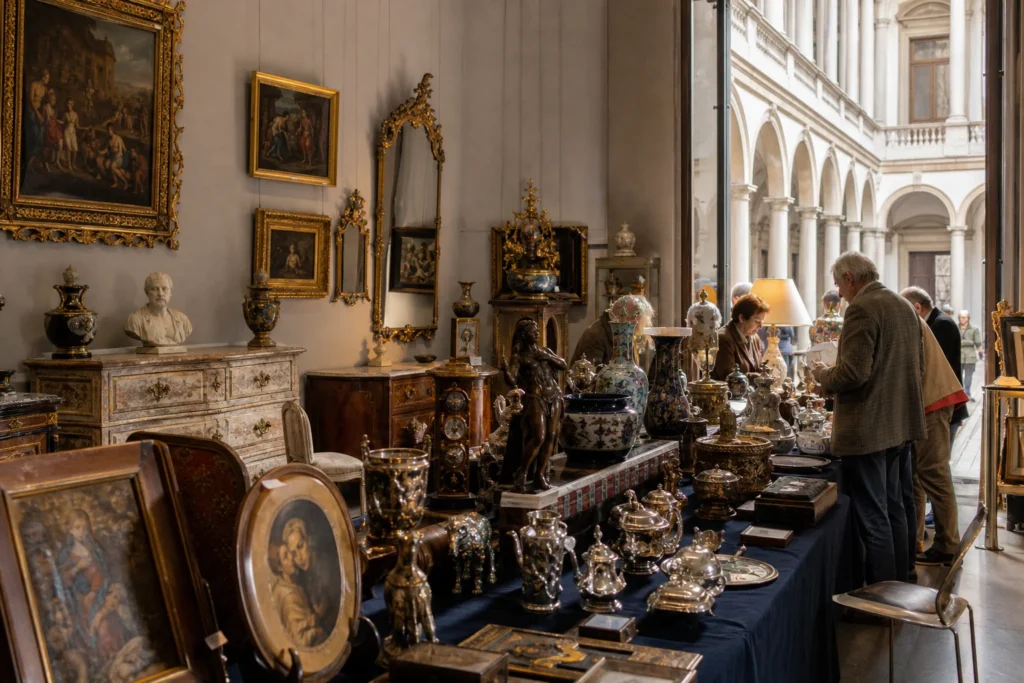

Not every dealer who applies to show at BIAF gets in. The selection committee — drawn from the Florentine museum world — reviews each application for authenticity, provenance, and conservation condition before a single piece crosses the threshold. That rigour is the defining fact of the Biennale Internazionale dell'Antiquariato di Firenze, and it shapes everything a visitor encounters once inside.
BIAF has run since 1959, convening every two years in autumn for a ten-day event. Around seventy-five galleries take part in each edition, arriving from across Italy and internationally. The range is genuine: Old Master paintings and drawings sit alongside Renaissance bronzes, antique ceramics, historic furniture, tapestries, marble and stone sculpture, and fine jewellery. A collector hunting seventeenth-century Dutch cabinet paintings and one searching for Florentine silverware will both find relevant work under the same roof.
The setting amplifies everything. BIAF takes place inside Palazzo Corsini on Lungarno Corsini, a historic building whose rooms provide a context that no purpose-built convention hall can replicate. Exhibitors display vetted, museum-grade objects room by room through the palazzo's interiors. The cumulative effect sits closer to a considered museum visit than a trade fair — except that acquisition is genuinely possible.
Alongside the selling galleries, BIAF builds a cultural programme. Temporary exhibitions run in parallel with the main floor. Art historians and curators lead talks and lectures open to collectors and the public. The opening gala and fireworks mark each edition as a genuine occasion, drawing guests from across the international art world and giving even the first evening its own weight.
BIAF suits serious collectors, museum professionals, decorative arts scholars, and informed cultural travellers who want concentrated quality rather than browsing volume. What distinguishes it from a broader antiques market is not just the subject matter but the density of decision-making behind every object on display. The biennial rhythm adds its own logic: each edition carries the scarcity of something that will not return for two years, and Florence in autumn provides an exceptional backdrop for a fair of this calibre. Check the next edition's exact dates through official BIAF channels before committing to travel arrangements. The event is worth building a trip around.
Getting to Palazzo Corsini on Lungarno Corsini is straightforward. The Vigna Nuova bus stop sits approximately 60 metres away, served by bus lines 6A, 6B, and 11. Tram lines T1 and T2 stop at Alamanni – Stazione Santa Maria Novella, around 640 metres distant. Firenze Santa Maria Novella train station — reached by Frecciarossa, Italo, and regional services including RMFI and RE 18255 — lies approximately 800 metres away, making the fair easily accessible for visitors arriving by rail from Rome, Milan, or Bologna.
Frequently Asked Questions
Q: What makes BIAF different from a general antiques fair?
A: Every dealer must pass a vetting process before a single object is admitted. The selection committee, drawn from the Florentine museum world, reviews each piece for authenticity, provenance, and conservation condition. The result is a floor of museum-grade material where acquisition is genuinely possible — closer in atmosphere to a considered museum visit than a trade fair.
Q: What kinds of objects can a collector expect to find at BIAF?
A: Around seventy-five galleries attend each edition, bringing Old Master paintings and drawings, Renaissance bronzes, marble and stone sculpture, antique ceramics, tapestries, historic furniture, and fine jewellery. Dealers come from across Italy and internationally, so the scope extends well beyond Italian material — collectors of seventeenth-century Northern European painting find relevant work alongside those hunting Italian Renaissance bronzes.
Q: How often does BIAF take place, and roughly when does it run?
A: BIAF is a biennial event, held every two years in autumn for a ten-day run at Palazzo Corsini on Lungarno Corsini in Florence. Confirm the next edition's exact dates through official BIAF channels before committing to travel.
Q: Is there anything to engage with beyond the selling galleries?
A: Yes. Each edition includes temporary exhibitions running alongside the main fair floor, as well as talks and lectures with art historians and curators open to collectors and the public. The opening gala and fireworks draw guests from across the international art world, giving the launch its own occasion.
Q: How easy is Palazzo Corsini to reach by public transport?
A: The Vigna Nuova bus stop is around 60 metres away, served by lines 6A, 6B, and 11. Tram lines T1 and T2 stop at Alamanni – Stazione Santa Maria Novella, roughly 640 metres distant, which is also the city's main train station with connections via Frecciarossa, Italo, and regional services.
Marketplace Highlights








Add a review