

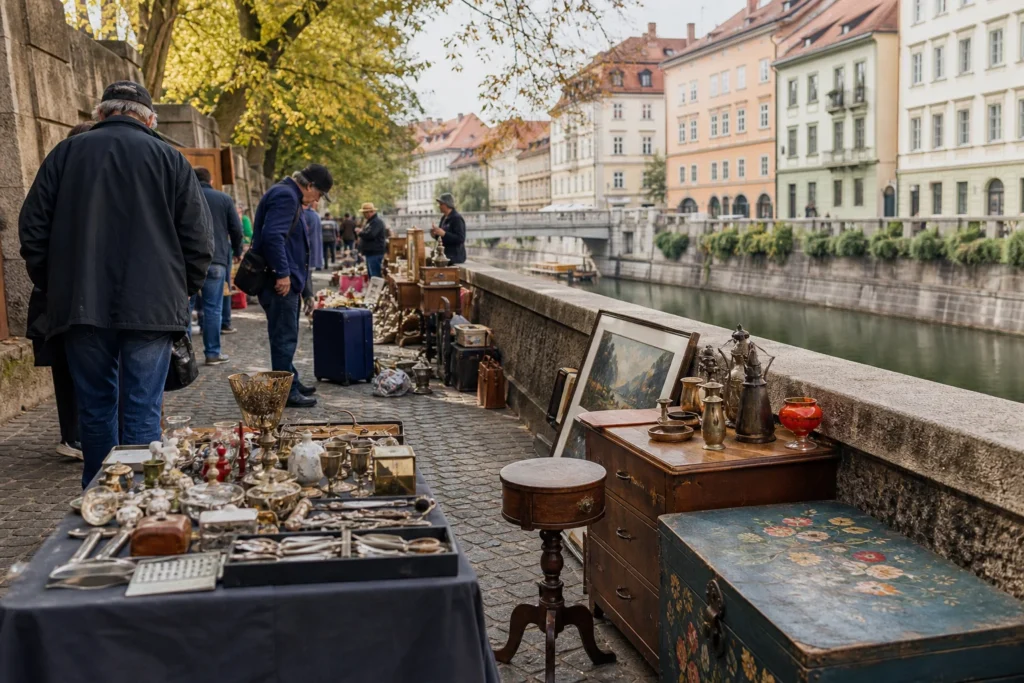

On a Sunday morning along the Breg embankment, the Ljubljanica catches the early light and the stalls are already open. Vendors arrange their tables facing the water, with Ljubljana's old city rooflines and the castle hill filling the view behind them. This is Bolšji Sejem, and it runs every Sunday from 08:00 to 15:00 — unhurried, open-air, and rooted in the kind of browsing that rewards patience over speed.
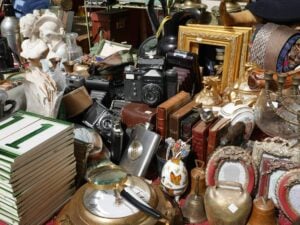
The stock here is portable and personal. Antiques, decorative objects, art pieces, vintage kitchenware and bric-a-brac fill the tables, most of it the kind of thing that fits comfortably in a carry-on. There is no heavy furniture and no secondhand clothing. That focus is a deliberate quality, not a limitation. Travelling collectors can browse seriously without worrying about what they cannot take home.
The most singular category at Bolšji Sejem is Yugoslav-era material. Medals, military badges, leather packs, helmets, wartime documents and books from the socialist period appear regularly across the stalls. The objects themselves do the editorial work — a parade medal next to a military field pack, a worn leather belt beside a stack of propaganda-era publications. For collectors tracking Eastern European militaria, this is a genuine destination rather than a pleasant diversion.
The Habsburg thread runs just as deep. Ljubljana spent centuries inside the Austrian Empire, and that history surfaces clearly in the silverware, painted trunks, glassware, clocks, bronze pieces, crockery and hunting trophies anchoring many of the tables. Collectors who know the flea markets of Vienna or Budapest will recognise the visual language immediately. What makes Bolšji Sejem unusual is the coexistence of these two very different material cultures — Central European Habsburg and Yugoslav socialist — within a single compact market. That layering is specific to Ljubljana's history and gives the market a character that is hard to replicate elsewhere.
The scale stays approachable. Most visitors can walk every stall in roughly half an hour, which leaves the rest of the morning free. The embankment itself invites a coffee after the browsing ends, and the old city is immediately at hand for anyone who wants to extend the day.
Getting to Bolšji Sejem is straightforward by public transport. The Gornji trg bus stop sits approximately 150 metres from the market and serves a wide range of city bus lines including routes 2, 3, 11, 27 and the night bus N3, among others. For a different approach, the Vzpenjača funicular runs to Ljubljana Castle; the Lower Funicular station is approximately 500 metres away and pairs naturally with a post-market visit up to the castle hill.
Frequently Asked Questions
Q: When does Bolšji Sejem run, and how early should I arrive?
A: The market runs every Sunday from 08:00 to 15:00 along the Breg embankment. Arriving early gives you the best selection before serious collectors have moved through the stalls, though the unhurried pace means there is no single rush hour to navigate.
Q: What kind of items will I find here — is it worth visiting as a travelling collector?
A: The stock is deliberately portable: antiques, decorative objects, vintage kitchenware, art pieces and bric-a-brac. There is no heavy furniture and no secondhand clothing. Almost everything fits in a suitcase, which makes it genuinely practical for collectors who need to carry finds home.
Q: What makes Bolšji Sejem distinctive compared to other European antique markets?
A: The combination of Yugoslav-era militaria — medals, badges, leather field packs, helmets, socialist-period books and documents — alongside Habsburg-period silverware, glassware, clocks and painted trunks is hard to find in a single compact market anywhere else. That layering reflects Ljubljana's specific history across two very different empires and political periods.
Q: How do I get there by public transport?
A: The Gornji trg bus stop is approximately 150 metres from the market and is served by several city bus routes including lines 2, 3, 11, 27 and the night bus N3. The Lower Funicular station for the Vzpenjača, which runs up to Ljubljana Castle, is around 500 metres away and pairs well with a post-market visit to the castle hill.
Q: How long does it take to browse the whole market?
A: Most visitors can walk every stall in roughly half an hour. The scale is approachable rather than overwhelming, which leaves the rest of the Sunday morning free for a coffee along the embankment or time in the old city nearby.
Marketplace Highlights







Add a review