

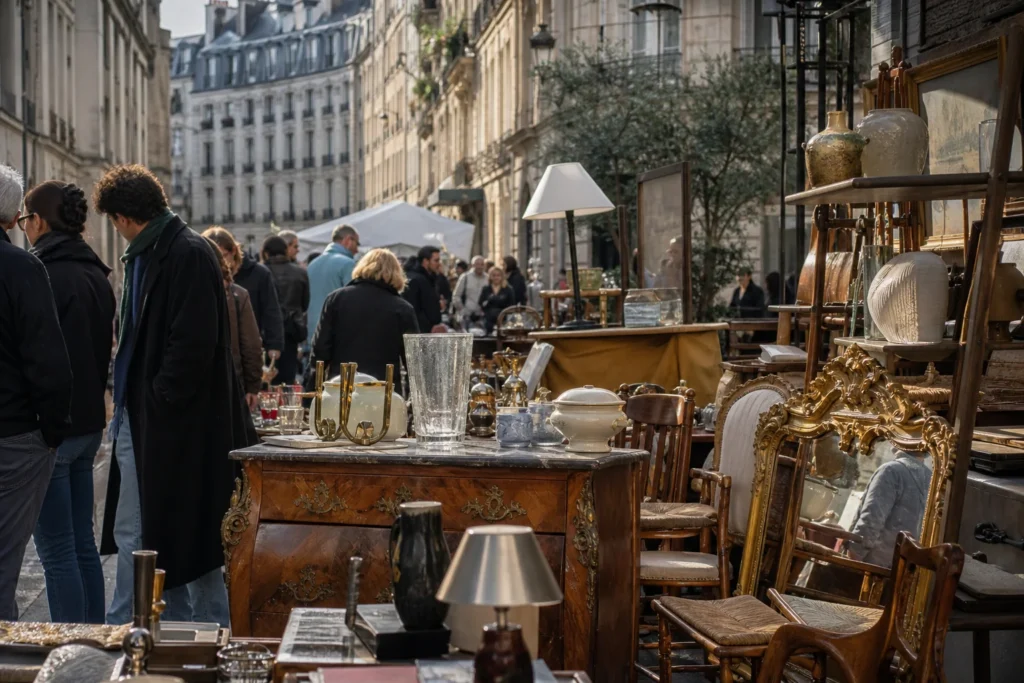

Twice a year, a cluster of streets in the 3rd arrondissement of Paris quietly transforms into one of the city's most rewarding open-air brocantes. Stalls extend along Rue de Bretagne and spill outward into Rue Perrée, Rue Spuller, Boulevard du Temple, and Rue du Temple. The gardens near the local mairie absorb the overflow. The event runs across a long weekend — Friday through Sunday, from six in the morning until six in the evening — with editions timed to spring and autumn.
Two distinct types of seller shape the character of this market. Professional dealers arrive with properly sourced stock: tagged, arranged, and priced to reflect what they know. Private sellers come with something looser — a grandparent's sideboard, a box of unsorted glassware, a lifetime of accumulated domestic objects. That contrast matters practically. Curated stalls reward early arrivals who know what they want. The private seller rows reward patience and a willingness to dig through what at first looks unpromising.
The furniture and decorative objects form the visual backbone of the event. Mid-century pieces sit alongside ornate mirrors, brass table lamps at varying degrees of polish, framed lithographs, and porcelain in patterns that suggest a different era of French domestic life. Dealers who specialise in decorative glassware tend to arrange their tables carefully; the pieces earn their asking prices. Interior designers make up a visible share of Friday's early crowd.
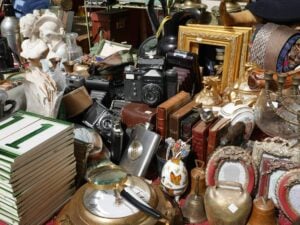
Clothing, vinyl, and smaller finds occupy their own rhythm within the market. Vintage paperbacks stack next to costume jewellery and decorative hardware. A single framed print leans against a crate of records. These stalls suit collectors who browse without a fixed list. Bargaining is natural here, particularly with private sellers later in the day when the opening rush has passed.
Food stalls thread through the lanes and give the whole event a festive texture that softens the more serious collecting energy. Coffee, crêpes, and pâté sandwiches appear throughout. During the autumn edition, roasted chestnuts add their particular scent to the narrower streets — a detail that makes Saturday morning browsing feel genuinely seasonal. The atmosphere lands somewhere between neighbourhood fête and proper antique fair, and neither quality cancels the other.
Sunday carries an additional draw. A children's flea market traditionally forms near the Mairie du 3ème, where younger sellers trade books, toys, and games. It brings a different energy to that corner and gives families a specific reason to plan around the Sunday session rather than arriving only on Saturday.
Pricing reflects the Marais address. Statement furniture and designer-era pieces command serious money from dealers who know their market. Smaller objects — ceramics, hardware, vintage paperbacks, modest jewellery — remain genuinely accessible and suit visitors who want to leave with something real without committing to significant spend.
The market sits within easy reach of several public transport options. Square du Temple bus stop is approximately 150 metres away and serves buses 20, 75, N12 and N23. For the Metro, Filles du Calvaire on line 8 is approximately 350 metres distant and makes a natural primary access point; Temple on line 3 is a reasonable alternative at roughly 400 metres. None of those distances is far from the first stalls on Rue de Bretagne.
The Brocante de la Rue de Bretagne suits visitors who want genuine engagement with French secondhand culture rather than a sanitised retail version of it. The Friday opening offers a real early-arrival edge — the field of dealers is fresh, the best singular pieces are still on the table, and the weekend crowd has not yet arrived. That first morning tends to justify the whole trip.
Frequently Asked Questions
Q: When does the Brocante de la Rue de Bretagne take place?
A: The market runs twice a year, with editions in spring and autumn. Each edition spans a long weekend — Friday through Sunday, roughly 6am to 6pm. Exact dates shift between editions, so check local Paris event listings before planning travel around the market.
Q: Which Metro stations are closest to the market?
A: Filles du Calvaire (line 8) and Temple (line 3) are both within easy walking distance of the main market streets. The Square du Temple bus stop, served by routes 20, 75, N12, and N23, is even closer to the heart of the brocante.
Q: Is there a good time of day to arrive for the best finds?
A: Friday morning and Saturday early are the prime windows. Professional dealers arrive with curated, tagged stock, and the most sought-after furniture and decorative objects tend to go quickly. Later in the day — particularly Sunday — private sellers are more open to bargaining as the opening rush fades.
Q: What kinds of things can you find at this market?
A: The stock covers a wide range: mid-century furniture, ornate mirrors, brass lamps, framed lithographs, decorative glassware, vintage clothing, vinyl records, costume jewellery, and paperbacks. Some stalls are spare and curated; others require patient digging through boxes of unsorted domestic objects.
Q: Is the market suitable for families with children?
A: Sunday is the strongest day for families. A children's flea market traditionally forms near the Mairie du 3ème, where younger sellers trade books, toys, and games. Food stalls serving crêpes, coffee, and sandwiches run throughout the weekend, and during the autumn edition roasted chestnuts add to the atmosphere.
Marketplace Highlights








Add a review