

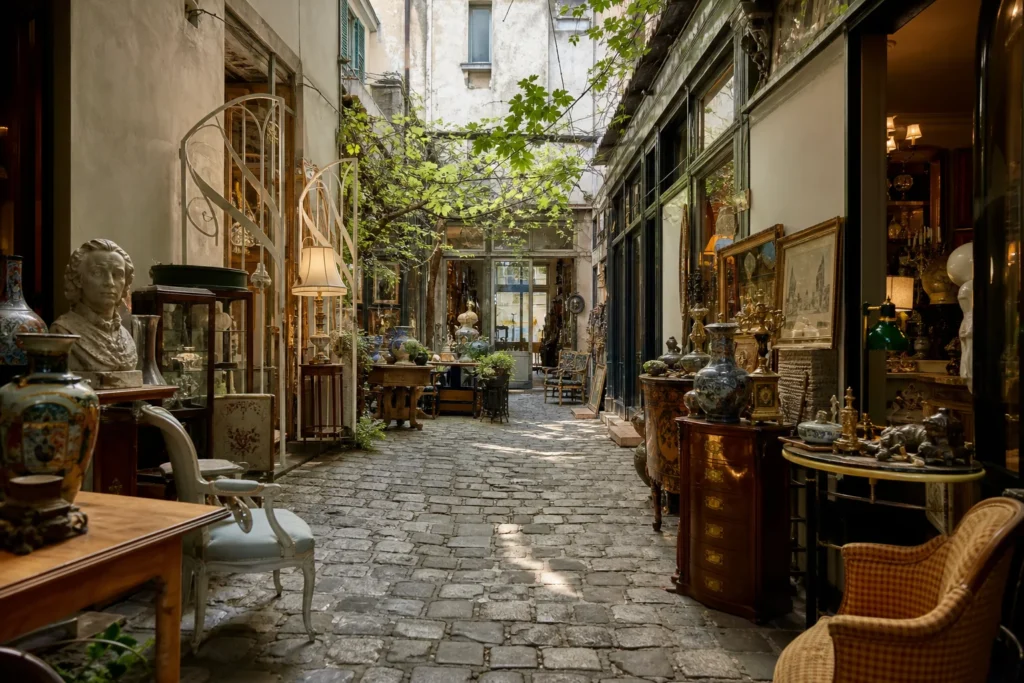

Tucked behind Rue Saint-Paul in the heart of the Marais, Le Village Saint-Paul is easy to miss from the street. Step through one of its narrow archways, though, and a different Paris reveals itself. A succession of connecting courtyards opens up, linked by cobblestone passages, shaded by old trees and softened by climbing vines. Wooden shutters frame upper-floor windows. Iron balcony railings edge above walls draped in creeping greenery. The surrounding 4th arrondissement buzzes with tourists and traffic, but this enclosed village feels genuinely unhurried.
The village draws together around 200 antique dealers across its courtyard network. The range runs wide — furniture and decorative objects from several centuries sit alongside mid-century collectibles, retro pop memorabilia, vintage prints and smaller curiosities. Some dealers focus on a single period or category; others stock an eclectic mix that rewards slow browsing. Either way, the concentration of specialist knowledge here sets it apart from a general flea market. Dealers tend to be genuinely engaged with their stock and willing to talk through provenance, condition or context.
Bargaining is normal and expected. If a piece catches your eye, opening a conversation is both acceptable and often fruitful. These exchanges are part of what makes Le Village Saint-Paul feel different from a transactional browsing experience. The dealers are enthusiasts as much as traders, and a brief exchange frequently turns up details about an object that no label could convey.
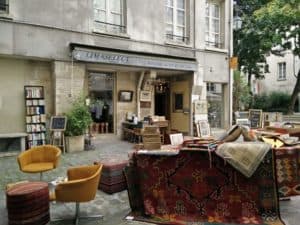
At weekends, the surrounding Marais neighbourhood sometimes hosts informal yard-sale style markets that add a more spontaneous layer to the antique hunting. These gatherings are less formal than the village itself and can vary in size and frequency, but they suit visitors who enjoy the unpredictability of an open-air rummage. The village's courtyard setting handles both modes well — structured browsing on a quiet Tuesday morning or a livelier weekend circuit.
The opening pattern runs through the week, with mornings typically the quietest time to visit. Individual shop hours within the village can vary by dealer, so arriving with a flexible schedule gives the best chance of finding the most doors open.
What gives Le Village Saint-Paul its particular appeal is the combination of accessibility and atmosphere. Saint-Ouen offers volume and spectacle; Puces de Vanves offers Sunday-morning charm. Le Village Saint-Paul offers something rarer: a permanently inhabited antique quarter that feels as though it belongs to the neighbourhood rather than performing for visitors. The architecture earns its own attention even when nothing is for sale.
The village sits close to Metro line 1 at Saint-Paul station, approximately 200 metres away — a straightforward connection from central Paris. The Saint-Paul bus stop, roughly 128 metres from the site, serves bus lines 69, 76, 96, N11 and N16, giving good coverage from multiple directions. Visitors arriving by river can use the Batobus stop at Hôtel-de-Ville, approximately 600 metres away, with the walk from the riverbank adding a pleasant approach through the old streets of the Marais.
Frequently Asked Questions
Q: What kind of antiques and collectibles can I find at Le Village Saint-Paul?
A: The village brings together around 200 dealers covering a wide span — from medieval pieces and 17th-century jewellery through to decorative furniture, vintage prints, mid-century objects, and 1960s–70s pop memorabilia and retro gear. Art galleries and craft boutiques sit alongside the antique dealers, so the mix suits both focused collectors and casual browsers.
Q: Is bargaining acceptable here, or are prices fixed?
A: Bargaining is normal and expected. Dealers are generally knowledgeable enthusiasts who enjoy talking about their stock, so opening a negotiation with a genuine question about a piece is a good approach — the conversation itself often adds to the value of what you find.
Q: How is Le Village Saint-Paul different from Paris's big flea markets like Saint-Ouen?
A: Rather than a weekend-only market, this is a permanently occupied antique quarter built into a series of connecting courtyards in the Marais. The atmosphere is unhurried and neighbourhood-rooted rather than market-spectacle in feel, and the concentration of specialist dealers makes it better suited to deliberate, slow browsing than a large Sunday flea market.
Q: When is the best time to visit, and do all the shops keep the same hours?
A: Mornings tend to be the quietest time to explore. Individual dealer hours vary across the village, so arriving with a flexible schedule — rather than a tight window — gives you the best chance of finding the most shops open. Check ahead if you have a specific dealer in mind.
Q: Are there additional market finds beyond the village itself at weekends?
A: The surrounding Marais neighbourhood can see informal, yard-sale style street markets at weekends that add a more spontaneous layer to the antique hunting. These are less structured than the village and vary in size, but they suit visitors who enjoy an open-air rummage alongside the courtyard browsing.










Add a review