

Region
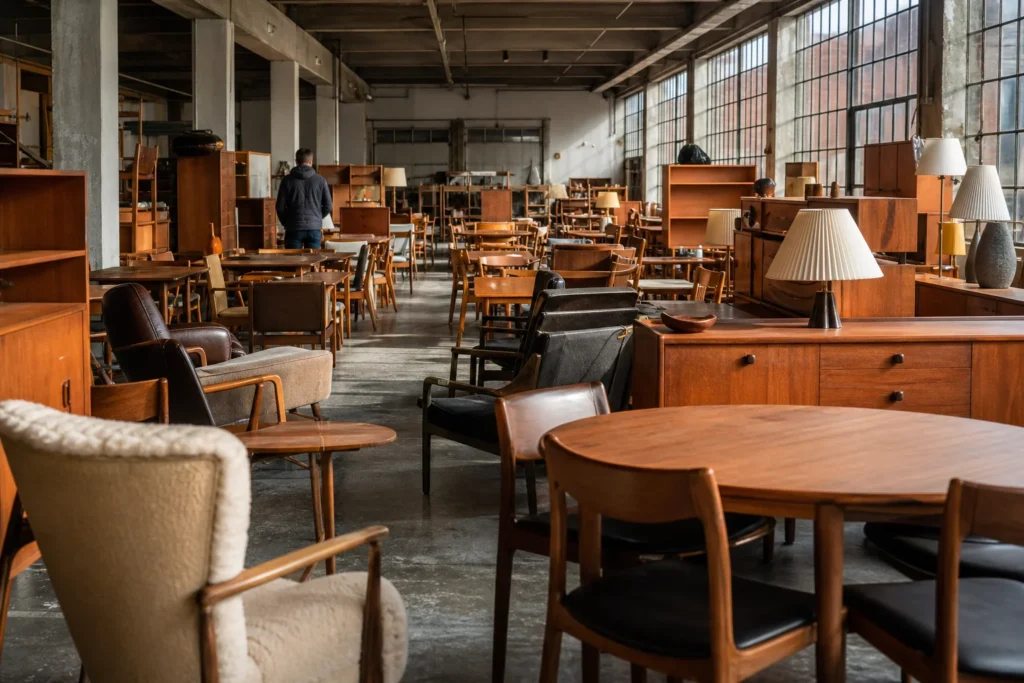
On Refshaleøen — Copenhagen's former naval shipyard island — a 2,500-square-metre warehouse holds one of Scandinavia's most concentrated sources of vintage Danish design furniture. This is Danish Antique & Modern, better known in the trade as B&W Market. The industrial setting and the quality of what sits inside it create an immediate contrast. Owner Jimmy Benjamin Nielsen has spent years building a wholesale operation serious enough to draw international buyers from across Europe, the United States, Australia and Asia.
The collection centres tightly on Danish modernism's golden decades, roughly 1940 to 1980. Seating dominates much of the floor: armchairs, sofas and dining chairs in configurations that reward slow inspection. Tables, desks and storage pieces fill out the broader selection. Teak, oak and rosewood are the materials that recur throughout, and the warehouse preserves the natural patina of each piece rather than refinishing it away. That approach matters to buyers who value authenticity over cosmetic restoration.
The designer names associated with the stock read like a Danish design curriculum. Arne Jacobsen, Børge Mogensen, Kurt Østervig, Henning Jensen, Eric Buch, Erling Torvits and Johannes Andersen are among the figures represented. For collectors and trade buyers who know mid-century Scandinavian furniture, those names immediately explain the warehouse's standing. The breadth of the selection covers multiple eras and schools within the modernist tradition, giving visitors genuine range to work with in a single visit.
B&W Market operates by appointment, and also opens to visitors during its B&W fleamarket weekends. Buyers planning a sourcing trip should factor in the appointment-only model from the start. The warehouse supports the full logistics chain for international buyers: free packing of shipping containers, pick-up and transport arrangements, and on-site storage. These services reduce friction considerably for dealers working across borders, and they position B&W Market as something closer to a trade partner than a conventional antique dealer.
The organised layout across the full warehouse floor gives buyers genuine room to assess proportion, condition and scale. That contrasts sharply with the cramped presentation typical of smaller dealers. Serious buyers tend to move slowly here and often return more than once. The primary audience is trade professionals, but dedicated collectors with a focused interest in Danish mid-century design will find the depth of the collection rewarding well beyond a purely commercial context.
Getting to Refshaleøen is part of the experience. Bus line 2A stops at Refshaleøen approximately 250 metres from the warehouse. Ferry lines 991 and 992 also call at the Refshaleøen stop, roughly 400 metres away — a fitting approach given the harbour island setting. Visitors arriving from central Copenhagen or by regional rail can reach Østerport train station, served by IC4, RE40, RE54 and several S-line services, approximately 1.5 kilometres away.
B&W Market occupies a category of its own among Danish design sources. The appointment model, the export infrastructure and the sheer scale of the collection make it a deliberate destination — one suited to trade buyers and serious collectors who arrive knowing what they are looking for.
Frequently Asked Questions
Q: Do I need an appointment to visit Danish Antique & Modern?
A: Yes, the warehouse operates on an appointment basis. It also opens to walk-in visitors during its B&W fleamarket weekends. Check the organiser's official channels for the current fleamarket schedule before planning a visit.
Q: Is B&W Market primarily a trade operation, or can private collectors visit?
A: The wholesale model and export infrastructure are aimed at trade buyers, but dedicated collectors with a genuine interest in Danish mid-century design are welcome. The depth and range of the collection rewards serious enthusiasts well beyond a purely commercial context.
Q: What era and style of furniture does the warehouse focus on?
A: The collection centres on Danish modernism from roughly 1940 to 1980. Seating — armchairs, sofas, dining chairs — dominates the floor, alongside tables, desks and storage pieces. Teak, oak and rosewood recur throughout, and pieces are kept in their original patina rather than refinished.
Q: Does B&W Market help with international shipping and container logistics?
A: The warehouse supports the full export chain, including free packing of shipping containers, pick-up and transport arrangements, and on-site storage. Confirm current terms directly with the team before committing to a sourcing trip.
Q: How do I get to the warehouse on Refshaleøen?
A: The warehouse sits on Refshaleøen, Copenhagen's former naval shipyard island. Bus line 2A stops approximately 250 metres away, and harbour ferry lines 991 and 992 also call at Refshaleøen. Arriving by public transport is straightforward from the city centre.
Marketplace Highlights









Add a review