

Good Old Goods opens at noon, which suits the place perfectly. A slow-start arrival gives you the right pace for a store this size. The address is Eichenstraße 4 in Alt-Treptow, a corner of Berlin where former industrial yards and riverside paths share space with creative studios and the odd warehouse repurposed for something unexpected.
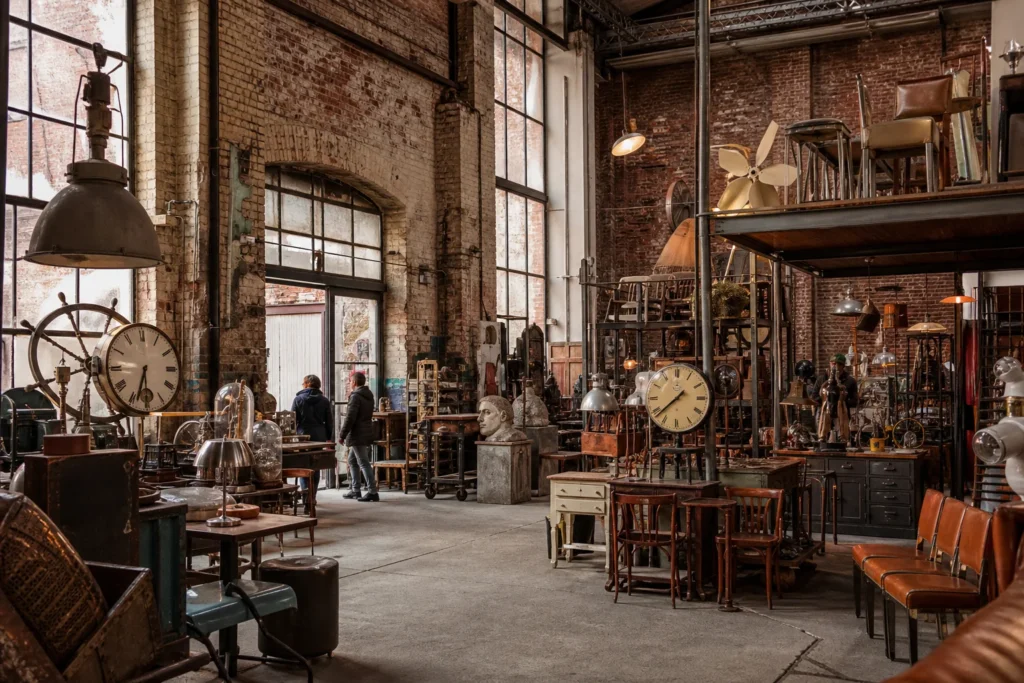
The building itself signals its character before you step inside. A hulking red brick façade carries layers of graffiti and bold signage that read as invitation rather than warning. The exterior sets a tone — raw, deliberate, and not particularly interested in conventional retail presentation. Inside, the ceiling soars and the floor plan spreads wide. The first impression is closer to a gallery or industrial exhibition space than a shop.
Oversized shelving divides the interior into browsable zones without breaking the sense of space. Sculptural light fixtures and artwork anchor the walls, and graffiti continues on several surfaces inside, blurring the line between display and decoration. The most distinctive quality of the layout is restraint. Items sit with enough room around them to register individually. For a store this dense, that is genuinely unusual, and it makes the browsing experience feel unhurried.
The stock leans toward objects with visual weight and material history. Statement furniture, architectural salvage, and industrial clocks occupy the larger floor areas. Towards the back, oversized sculptures — the kind that work equally well indoors or in a garden setting — make an unexpected and quietly impressive appearance. Mirrors, enamelware, kitchenware, faded sports equipment, and retro posters surface in the mid-range zones. The salvage and furniture section is particularly strong for buyers hunting something with genuine age and structural character.
Stock turns over regularly, which rewards repeat visits. A piece that wasn't there last month may appear next week. That rhythm also means the store feels different between visits, which is rare for a fixed-address antique destination of this scale.
Good Old Goods suits collectors hunting statement furniture or architectural pieces, design-conscious buyers looking for one object to anchor a room, and curious visitors who want an afternoon that feels genuinely Berlin rather than curated-for-tourists. It draws design-minded locals, international buyers, and people who wander in from the Spree riverside paths nearby. The store earns its visits through the objects themselves — warehouse scale, gallery-quality display, and an editorial stock list that manages to surprise almost anyone who walks in.
The store runs Wednesday through Sunday, 12:00 to 17:30, and stays closed on Mondays and Tuesdays.
Getting to Eichenstraße 4 is straightforward by public transport. Treptower Park S-Bahn station sits approximately 600 metres away and connects the area to S-Bahn lines S8, S9, S41, S42 and S85. The closest stop is the bus stop at Eichenstraße/Puschkinallee, roughly 250 metres from the entrance. Visitors coming from Friedrichshain or Kreuzberg can use subway lines U1 or U3 to Warschauer Straße station, around 1,000 metres away, or connect via tram line M10 and bus lines 300, 347 and N1 at S+U Warschauer Straße, at a similar distance.
Frequently Asked Questions
Q: When is Good Old Goods open, and what time should I plan to arrive?
A: The store runs Wednesday through Sunday, noon to 17:30, and is closed on Mondays and Tuesdays. Arriving earlier in the afternoon gives you the most unhurried browse — the noon opening suits a slow start, and the space rewards time rather than a quick scan.
Q: What kinds of pieces does Good Old Goods specialise in?
A: The stock leans toward objects with visual weight and material history — statement furniture, architectural salvage, industrial clocks, and large-scale sculptures that work indoors or in a garden. Mid-range finds include mirrors, enamelware, vintage kitchenware, retro posters, and faded sports equipment. It is stronger on substantial, room-anchoring pieces than on small collectables.
Q: Is it worth visiting more than once?
A: Yes. Stock turns over regularly, so pieces that were not there last month may appear on a return visit. The selection feels different between visits, which is unusual for a fixed-address antique destination of this scale.
Q: Where exactly is Good Old Goods located, and is the neighbourhood easy to reach?
A: The address is Eichenstraße 4 in Alt-Treptow, a Berlin neighbourhood where industrial heritage and creative studios sit alongside Spree riverside paths. Check current transport options via BVG before you go, but the area is accessible by S-Bahn and the riverside location makes it a natural stop if you are already exploring that stretch of the city.
Marketplace Highlights








Add a review