

Region
Housing Works started from a conviction that most thrift shops never articulate: that buying secondhand can be a direct act of advocacy. Founded in 1990 by activists with ties to ACT UP, the organisation built its thrift network around the idea that stable housing and health care are inseparable rights. Thirty-plus years later, that founding argument still runs through every rack, shelf and donation bin across its New York City locations.
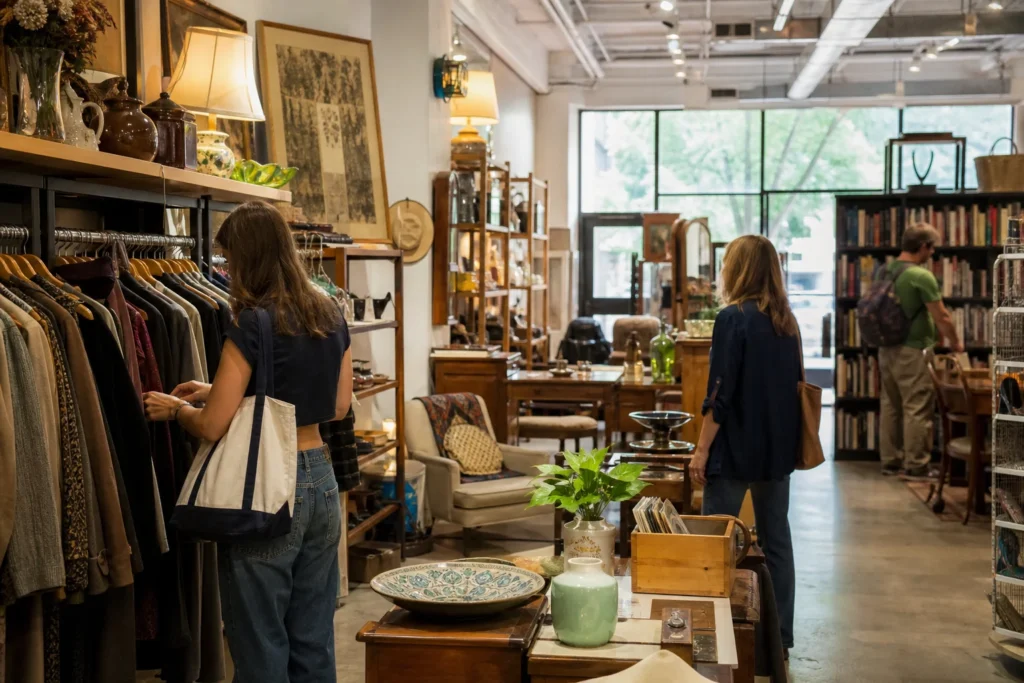
Walk into any Housing Works store and the curation stands out immediately. Clothing is sorted by colour and era, which makes scanning for a particular decade genuinely easy. Books lean in tidy stacks, furniture sits at considered angles, and vintage lighting catches the overhead glare in ways that slow your pace. Housewares, mirrors and textiles fill out a floor plan designed for unhurried browsing rather than quick grabs.
The branches carry distinct personalities shaped by their neighbourhoods. The Upper East Side location tends to lean toward home goods and hardcovers. Chelsea draws strong fashion finds. Brooklyn stores frequently surface mid-century furniture and bold printed textiles. None of the locations feel identical, which gives regular visitors good reason to move across several branches rather than relying on one.
Every sale feeds directly into Housing Works programmes supporting people experiencing homelessness or living with HIV/AIDS. Those programmes cover housing support, job training, health care access and advocacy work. The link between a purchased coat or lamp and that wider effort is direct and documented — a detail that separates this network from most charity retail.
Most branches open Monday through Saturday from 11:00 to 19:00, with Sunday hours running from 12:00 to 17:00. Hours may vary slightly between locations, so checking ahead before a dedicated visit is worth the effort. A weekday morning tends to offer quieter floors and a fresher rotation of stock following weekend donations — a useful window for collectors who prefer space to look properly.
Beyond the thrift stores, Housing Works runs a Bookstore Café in Soho that functions as a cultural venue as much as a shop. Author readings and literary events fill its calendar alongside the shelves. It draws a crowd that may never visit the thrift stores at all, which speaks to the breadth of what the organisation has built. Housing Works also stages Design on a Dime, a fundraising gala where interior designers build entire rooms from donated goods before auctioning them off — an event that sits squarely at the crossroads of charity fundraising and design spectacle.
For visitors to the Upper East Side branch at 1222 Second Avenue, public transport access is straightforward. The M15 bus stops at 2 Av/E 64 St, roughly 60 metres away. The subway station at Lexington Avenue–63rd Street serves the F, M and Q lines at approximately 400 metres, while Lexington Avenue–59th Street — served by the N, R and W trains — sits around 500 metres away. Both subway options connect easily to Midtown and downtown Manhattan.
Housing Works suits collectors who care about the story behind an object as much as the object itself. Stock turns over regularly, and patience tends to surface genuinely unexpected pieces. For anyone already moving through the Upper East Side, Chelsea, or central Brooklyn, a Housing Works stop fits naturally into a longer day of neighbourhood exploration.
Frequently Asked Questions
Q: Does buying at Housing Works actually support the mission, or does money go to general overhead?
A: The connection is direct. Every sale funds Housing Works programmes covering housing support, job training, health care access and advocacy for people experiencing homelessness or living with HIV/AIDS. The funding pipeline between the shopfloor and those services is documented, which is what separates this network from most charity retail.
Q: Are all the Housing Works locations the same, or is it worth visiting more than one?
A: Each branch has its own character shaped by its neighbourhood. Chelsea tends to turn up strong fashion finds, the Upper East Side location leans toward home goods and hardcovers, and Brooklyn stores frequently surface mid-century furniture and bold printed textiles. Regular visitors find it worth moving between several branches rather than relying on one.
Q: When is the best time to visit for a serious browse?
A: A weekday morning tends to offer quieter floors and a fresher stock rotation following weekend donations — a useful window for collectors who prefer space to look properly. Most branches open Monday through Saturday from 11:00 to 19:00, with Sunday hours running from 12:00 to 17:00, though hours can vary slightly by location, so checking ahead before a dedicated trip is worthwhile.
Q: Is the Soho Bookstore Café part of the thrift shop network?
A: It is part of the same organisation but operates as its own space. The Bookstore Café hosts author readings and literary events and functions closer to an independent cultural venue than a charity shop annexe. It draws a crowd that may never visit the thrift stores, which gives a sense of how broadly Housing Works has extended its reach.
Marketplace Highlights










Add a review