

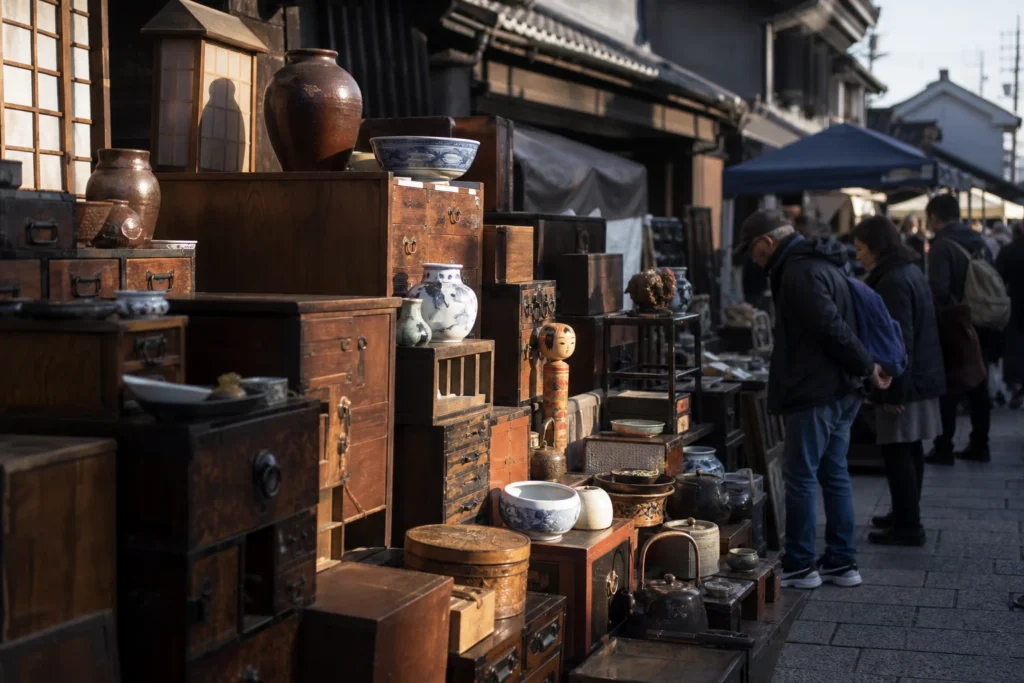

Once a month, on the 28th, the Kawagoe Antique Market opens its gates at five in the morning. That early start is not accidental — serious collectors know that the best pieces move quickly, and the market rewards those who arrive before the crowds thin the selection. By the time most day-trippers reach Kawagoe, the stalls are already humming.
From central Tokyo, the journey takes roughly 80 minutes by train, making this a manageable and genuinely worthwhile day trip. Around 110 stalls set up across the site, which gives the market a scale that goes well beyond the modest monthly fairs common in Japanese cities. This is a market where you can spend several hours without retracing your steps, and still feel you have not seen everything.
The merchandise leans strongly toward Japanese antiques with real collector depth. Antique furniture — tansu chests, low tables, wooden cabinets — sits alongside ceramics, lacquerware and pottery spanning multiple periods. Kimono, obi and textile pieces appear in good numbers, ranging from everyday wear to more formal vintage garments. Dealers here tend to know their stock, and the mix attracts both seasoned collectors and curious visitors making their first serious foray into Japanese antiques. The market has built a following among Tokyo's international community, a reflection of its breadth and reliability.
The setting adds a dimension that a Tokyo flea market simply cannot match. Kawagoe's historic centre preserves a remarkable run of kura-zukuri architecture — the thick-walled clay storehouses built during the Edo period that give the town its nickname of Koedo, or "Little Edo." Wandering the main street between market visits, past indigo-dyed shop curtains and timber facades, makes the round trip feel like more than a shopping excursion. The town earns the journey independently; the market is the reason to choose the 28th.
The market sits in Kubo-cho, close to Kawagoe City Hall. Visitors arriving by bus will find the 川越市役所前 stop within easy reach, served by bus lines 名01 and 名03 at approximately 35 metres from the site. Bus routes 川越06 and 川越08 stop at a second 川越市役所前 stand around 100 metres away. Those preferring rail can travel to Hon-Kawagoe Station on the Seibu Shinjuku Line and walk approximately 15 minutes to the market, or use Kawagoe Station as an alternative rail arrival point with connecting bus options.
The market suits collectors who travel with purpose, Tokyo-based visitors looking for a day trip with genuine cultural weight, and first-time visitors to Japan who want an antique experience set inside a living heritage town rather than a convention hall. Plan around the 28th, set the alarm early, and treat the afternoon in Kawagoe's old town as part of the itinerary rather than an afterthought.
Frequently Asked Questions
Q: When does the Kawagoe Antique Market take place?
A: The market runs on the 28th of each month, opening at 05:00 and running until 16:00. Arriving early is genuinely worthwhile — serious collectors show up at opening, and the better pieces tend to move in the first hours.
Q: How do I get there from Tokyo?
A: The journey from central Tokyo takes approximately 80 minutes by train. The most direct approach is the Seibu Shinjuku Line to Hon-Kawagoe Station, then a roughly 15-minute walk to the market in Kubo-cho near Kawagoe City Hall. Kawagoe Station is an alternative rail arrival point with connecting bus options, including stops at 川越市役所前 (Kawagoe City Hall Mae) within easy reach of the site.
Q: What kinds of antiques can I expect to find?
A: The market leans heavily toward Japanese antiques with real collector depth — tansu chests, low tables, lacquerware, ceramics, and pottery across multiple periods, alongside kimono, obi and vintage textiles. Around 110 stalls set up each month, giving the market a scale where a serious collector can spend several hours without exhausting the selection.
Q: Is this market worth combining with sightseeing in Kawagoe?
A: Very much so. Kawagoe's historic centre preserves kura-zukuri clay-walled warehouse architecture from the Edo period, and the main street independently justifies the trip. Treating the afternoon as a walk through the old town after the market rounds out the day well beyond a standard shopping excursion.
Q: Is this a good market for first-time buyers of Japanese antiques?
A: Yes — the dealer mix includes knowledgeable professionals who know their stock, but the market also draws plenty of curious visitors making their first serious foray into Japanese antiques. The breadth of merchandise and the manageable day-trip distance from Tokyo make it a practical starting point. Check the organizer's official page before you go to confirm the schedule holds for your chosen month.
Marketplace Highlights










Add a review