

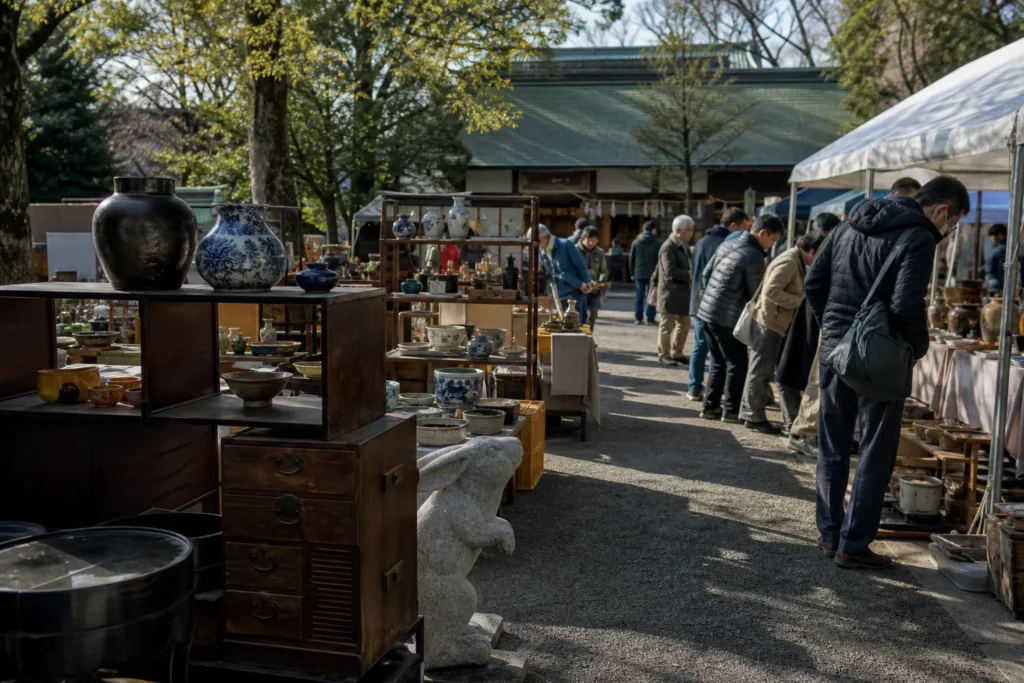

Two stone rabbits guard the entrance to Tsukinomiya Shrine in Urawa, and that detail tells you almost everything you need to know. Where most Japanese shrines post ceramic guardian lions, this one keeps its own symbol — the moon-rabbit of ancient folklore, embodied in the shrine's popular local nickname, Tsuki Jinja. Tsuki means moon, and the belief that a rabbit dwells in the moon runs deep in Japanese tradition. Every fourth Saturday of the month, antique dealers fill Tsukinomiya Park within the shrine grounds, running from early morning at 07:00 through to 15:30. That pairing of setting and schedule gives this market a character no purpose-built antiques hall can match.
Around 150 vendors typically set up across the park, which puts this fair in the same broad tier as well-known Kanto markets like Kawagoe or the Heiwajima Antique Fair. The merchandise leans toward traditional Japanese objects rather than European or generic flea-market goods. Functional folk pieces dominate one end of the range — earthenware and ceramics, tea ceremony sets, wooden furniture, lacquerware, and the kind of everyday utensils that rarely survive in pristine condition but carry genuine age. The decorative and wearable end brings kimonos, obis, and carefully folded bolts of fabric, alongside smaller collector pieces like kokeshi dolls and netsuke. Vendors here tend to know their stock, and patient browsing rewards it.
The shrine setting shapes the atmosphere in ways worth noting. Browsing stalls between wooden shrine structures and stone lanterns feels different from shopping in a car park or community hall. There is a quietness to the place even when it is busy — the kind of atmosphere that comes from a site with genuine religious and historical significance, not a hired venue dressed up for the occasion. Casual visitors and dedicated collectors both seem to absorb it differently, but both come away with something.
Arriving early suits serious hunters. The 07:00 opening gives collectors first choice of the more sought-after folk pieces and textiles, and the market tends to thin naturally toward mid-afternoon before the 15:30 close. A morning arrival also allows time to look around the shrine itself, which rewards a slow circuit even for visitors with no particular interest in antiques.
Tsukinomiya Shrine sits in Urawa, Saitama — a straightforward train journey from central Tokyo rather than a walk from it. Urawa Station is the natural arrival point, approximately 640 metres from the shrine in a straight line. It sits on multiple JR lines, among them the Utsunomiya Line, Tohoku Main Line (JR東北本線), Ueno-Tokyo Line, and rapid services JK and JS, giving direct connections from Ueno and Tokyo stations. For visitors already in the area, the bus stops 県庁通り and 埼玉会館 are each roughly 500 metres away, both served by routes including 浦10, 浦11, and 志01. As always with bus stops, check current local timetables for service details.
This market suits collectors who prioritise depth over volume and want a setting that justifies the journey on its own terms. It is not the largest antique fair in the Kanto region, but the combination of focused folk-object stock, a genuinely distinctive shrine environment, and reliable monthly timing makes it one of the more coherent day-trip options from Tokyo for anyone drawn to traditional Japanese material culture.
Frequently Asked Questions
Q: When does the Tsukinomiya Shrine antique market take place?
A: The market is held on the fourth Saturday of each month, running from 07:00 to 15:30 in Tsukinomiya Park within the shrine grounds.
Q: What kind of antiques and goods are sold here?
A: The market focuses on traditional Japanese objects rather than European or generic flea-market goods. Expect functional folk pieces — ceramics, tea ceremony sets, wooden furniture, lacquerware — alongside wearable and decorative items such as kimonos, obis, fabric bolts, kokeshi dolls, and netsuke. Around 150 vendors typically set up.
Q: Is it worth arriving early?
A: Yes. The 07:00 opening gives collectors first pick of folk pieces and textiles before they move. Arriving in the morning also leaves time to walk the shrine grounds themselves, which are worth a slow circuit.
Q: How do I get to Tsukinomiya Shrine from Tokyo?
A: Take a JR train to Urawa Station in Saitama — direct services run from Ueno and Tokyo stations on multiple JR lines including the Utsunomiya Line, Tohoku Main Line, and Ueno-Tokyo Line. The shrine is approximately 640 metres from the station on foot. Confirm your preferred service on the JR East journey planner before travel.
Q: Why does this shrine have stone rabbits instead of the usual guardian lions?
A: Tsukinomiya's symbol is the moon-rabbit of Japanese folklore — tsuki means moon, and the belief that a rabbit dwells in the moon is deep-rooted in Japanese tradition. The stone rabbit guardians are what give the shrine its local nickname, Tsuki Jinja, and set the whole site apart from a standard shrine market venue.
Marketplace Highlights









Add a review