

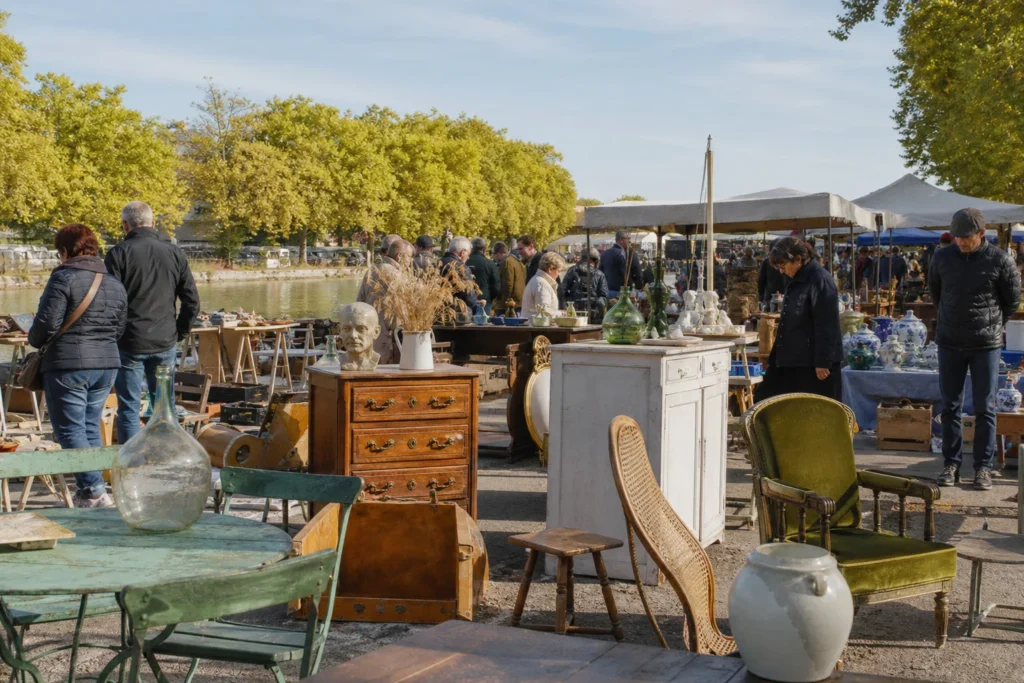

Les Puces du Canal opens three times a week beside the Jonage canal in Villeurbanne, on the eastern fringe of Lyon, and the scene in the early hours is worth arriving for. Dealers pull up before the gates open, unload furniture onto trolleys, and begin arranging their pitches while the light is still thin. By the time the market fills, around 400 vendors have claimed their space across four distinct zones. Claimed as France's second-largest flea market, this is a place that rewards early arrivals and patient browsers in equal measure.
The most formal quarter is Le Hangar, where over a hundred established dealers line up antiques spanning the sixteenth to the twentieth century. Serious furniture hunters come here first. Quality is high and the range genuine — expect carved armoires beside art deco lamps, painted commodes alongside industrial-era metalwork. From there, La halle Louis-la-Brocante — known locally as les tôles — forms the market's working spine. Dealers here organise by speciality, so a focused collector can move efficiently from one category to the next without circling the whole site.
Le village des containers shifts the tone toward design and more recent finds. Old bicycles lean against the units, vintage film posters curl at the edges, and mid-century lamps catch the morning light. This zone suits buyers with a contemporary eye who still want something with a story. L'École closes the loop at the more creative end: upcycled pieces, restored vintage items and one-off interventions by craftspeople who treat old objects as raw material rather than relics.
Thursdays and Saturdays, the market operates on professional days — stallholders only, with no public selling. Thursday runs from 07:00 to 13:00 and Saturday from 07:00 to 12:00. Sunday is the most expansive session: the gates open at 07:00 and the market runs through to 15:00, with members of the public free to set up their own pitch alongside the professionals. That Sunday dynamic gives the market an unpredictable edge — you never quite know who has turned up with what.
Several times a year, Les Puces du Canal hosts the Déballage International des Puces du Canal, a major outdoor event that draws dealers from well beyond the region. Its position on the natural route between the antique fairs of the north and those of Avignon, Montpellier and Béziers has made Villeurbanne a genuinely strategic stop on the French brocante circuit.
After a few hours on your feet, the on-site guinguettes pull their weight. Le Broc' café and L'expo Bar both serve steak-frites and Rhône wine, and the petit mâchon à la Lyonnaise — a savoury snack rooted in Lyon's bouchon tradition — gives the break a distinctly local flavour. Eating at the market, rather than rushing off after the last purchase, is part of how regulars actually use this place.
By bus, the Puces du Canal stop is the most direct option, with lines 7A and 37A serving it approximately 127 metres from the market entrance. The Les Bluets stop, roughly 350 metres away, also connects to line 7A and provides a straightforward alternative approach from another direction. Both stops are served in both directions, making it easy to plan a return trip once the bags are full.
Les Puces du Canal suits committed collectors, antique professionals and anyone who wants to spend a proper morning inside one of France's most visited and well-organised flea markets. The scale is real, the zones are genuinely different from one another, and the Lyonnaise character — from the canal-side setting to the midday mâchon — gives the whole experience a regional texture that the bigger Paris markets rarely match.
Frequently Asked Questions
Q: Which days can ordinary visitors browse and buy at Les Puces du Canal?
A: All three market days are open to visitors as buyers. Thursday (07:00–13:00) and Saturday (07:00–12:00) are reserved for professional stallholders trading among themselves, so the atmosphere is focused and trade-oriented. Sunday (07:00–15:00) is the most expansive session, with members of the public also free to set up their own pitch alongside the regular dealers.
Q: What kinds of things can I realistically find here?
A: The range is broad. Le Hangar concentrates on antiques from the sixteenth to the twentieth century — furniture, art deco pieces, painted commodes, metalwork. La halle Louis-la-Brocante organises dealers by speciality, which suits focused collectors. Le village des containers leans toward vintage design: old bicycles, lamps, posters. L'École is the place for upcycled and restored objects with a more contemporary craft edge.
Q: Is it worth arriving early?
A: Yes. Dealers begin unloading and arranging their pitches before the gates open, and the best pieces in the serious antiques zones tend to move early. The market draws around 400 vendors, so there is plenty to see at any hour, but early arrivals have the advantage — especially on Thursday and Saturday when the professional trade is most active.
Q: Can I eat at the market, or should I plan to leave for lunch?
A: There are on-site guinguettes, including Le Broc' café and L'expo Bar, both of which serve steak-frites, Rhône wine and the savoury petit mâchon à la Lyonnaise. Staying to eat at the market is part of the experience and keeps the morning self-contained. Check current opening arrangements with each venue before your visit.
Q: Where exactly is Les Puces du Canal, and is it easy to reach from central Lyon?
A: The market is beside the Jonage canal in Villeurbanne, on the eastern edge of the Lyon conurbation. Villeurbanne is served by Lyon's tram and metro network. Confirm the most convenient stop and any parking options via official local transport information before you travel.
Marketplace Highlights








Add a review