

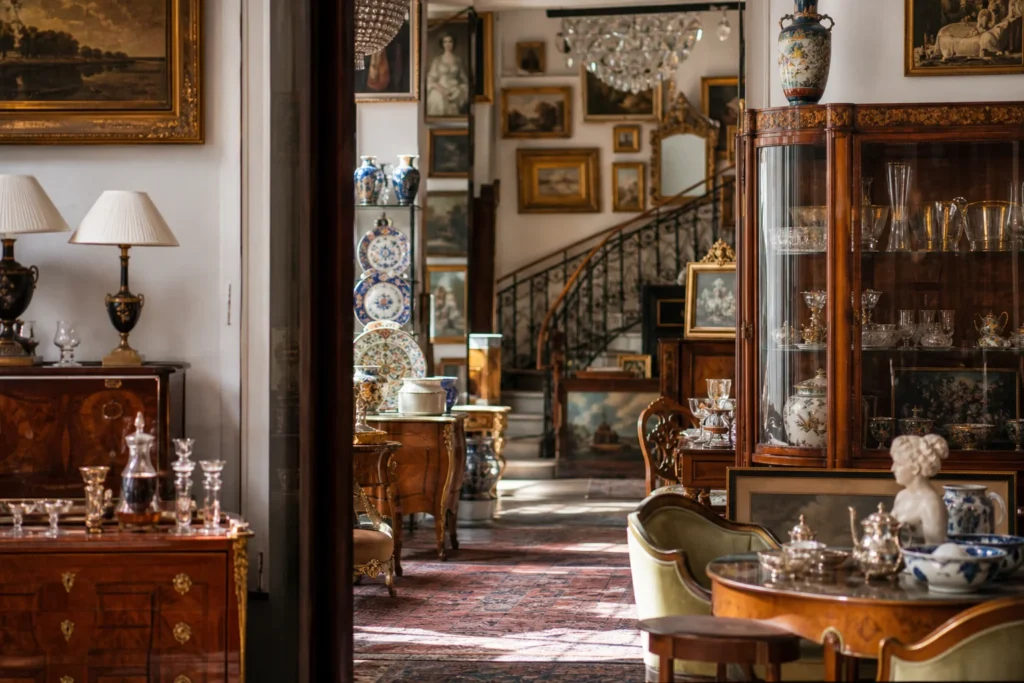

Pandrossou Street runs through one of Athens' oldest trading quarters, a narrow lane connecting the Monastiraki flea market district to the edges of the Roman Agora. Most of the dealers here operate from compact, cluttered shopfronts. Martino's Antique and Fine Art Gallery is something else entirely. The gallery occupies a four-floor building at number 50, and the scale alone signals a different category of operation. Founded in 1885, it has been part of this street and this neighbourhood for well over a century, outlasting fashions, market shifts and the changing appetites of collectors across several generations.
Walking in from the street noise of Monastiraki, the shift in atmosphere is immediate. The gallery feels closer to a private collection than a retail space. Pieces are presented with care and context, not arranged as overflow stock waiting for someone to make an offer. That curatorial instinct runs throughout the building and sets Martino's apart from the market traders just a short walk away.
The collection covers serious ground. Decorative arts form one strong thread: ceramics, glassware, silverware and embroideries sourced from across Europe and beyond. Carpets and furniture anchor the larger spaces, particularly on the upper floors where the natural light is better and the rooms have more breathing room. The fine art register sits alongside these — paintings, photography and sculpture grouped in ways that give certain rooms a genuine gallery quality, the kind that photographs rarely capture. Clocks occupy their own quiet corner. Jewellery adds another layer. The range rewards browsing in a way that a focused list never quite conveys.
Four floors takes real time to cover. First-time visitors regularly underestimate a thorough visit. The upper levels especially reward patience; larger furniture pieces spread across those rooms, and the light makes the collection feel different from the busier ground floor. Specialist collectors hunting Greek silverware or a specific period of furniture will find knowledgeable ground here. Curious first-timers wanting something more considered than a market browse will find Martino's shifts their sense of what Athens antique hunting can offer.
The gallery opens at 10:00 every day it trades. Monday, Wednesday and Saturday it closes at 15:00. Tuesday through Friday it stays open until 18:00. Sunday it is closed entirely. Saturday's early close is worth noting for anyone combining a visit with the Monastiraki flea market, which also draws crowds on Saturday mornings. Arriving by midday on a Saturday leaves time for both.
Getting here is straightforward. Monastiraki Metro station, served by lines M1 and M3, sits approximately 50 metres away — essentially at the gallery's doorstep. Bus routes 025 and 026 stop at the MONASTIRAKI bus stop roughly 90 metres away for visitors arriving by surface transport. Thiseio Metro station on line M1 is around 500 metres distant and works well as an alternative for those walking through the broader neighbourhood before or after a visit.
Martino's holds a particular position in Athenian cultural life. It operates where serious antique collecting and fine art dealing overlap, a combination that is genuinely rare. For anyone building a thorough picture of what Athens offers serious buyers, or simply wanting to spend an afternoon in a space that takes objects seriously, Pandrossou Street at number 50 is worth the detour.
Frequently Asked Questions
Q: How many floors does Martino's cover, and how long should I set aside for a visit?
A: The gallery spans four floors, and a thorough visit takes longer than most first-timers expect. The upper floors in particular reward patience — larger furniture pieces spread through those rooms, and the natural light there gives the collection a different quality to the busier ground floor. Budget generously if you want to cover the whole building.
Q: What kinds of antiques and art does Martino's carry?
A: The collection moves across a wide range: decorative arts including ceramics, glassware, silverware and embroideries; carpets and furniture concentrated on the upper floors; paintings, photography and sculpture grouped to give certain rooms a genuine gallery feel; clocks in their own quiet corner; and jewellery throughout. Pieces are presented with care rather than arranged as market overflow, which makes browsing feel closer to moving through a private collection.
Q: What are the opening hours, and is there anything to watch out for on Saturdays?
A: The gallery opens at 10:00 daily except Sunday, when it is closed. Monday, Wednesday and Saturday it closes at 15:00; Tuesday through Friday it stays open until 18:00. Saturday's early close is worth bearing in mind if you plan to combine a visit with the Monastiraki flea market — arriving by midday on a Saturday gives you time for both. Confirm current hours on the gallery's official page before you go.
Q: How do I get to Martino's by public transport?
A: Monastiraki Metro station, served by lines M1 and M3, is approximately 50 metres from the gallery — essentially at the door. Bus routes 025 and 026 stop at the nearby Monastiraki bus stop, around 90 metres away. Access is about as straightforward as Athens gets.
Q: Is Martino's better suited to serious collectors or casual browsers?
A: Both find it worthwhile, but for different reasons. Specialist collectors hunting Greek silverware, period furniture or works on paper will find knowledgeable, curated ground. Casual visitors who want something more considered than a market browse tend to find that Martino's raises their sense of what Athens antique hunting can offer — the gallery-quality presentation does a lot of the work.
Marketplace Highlights








Add a review