

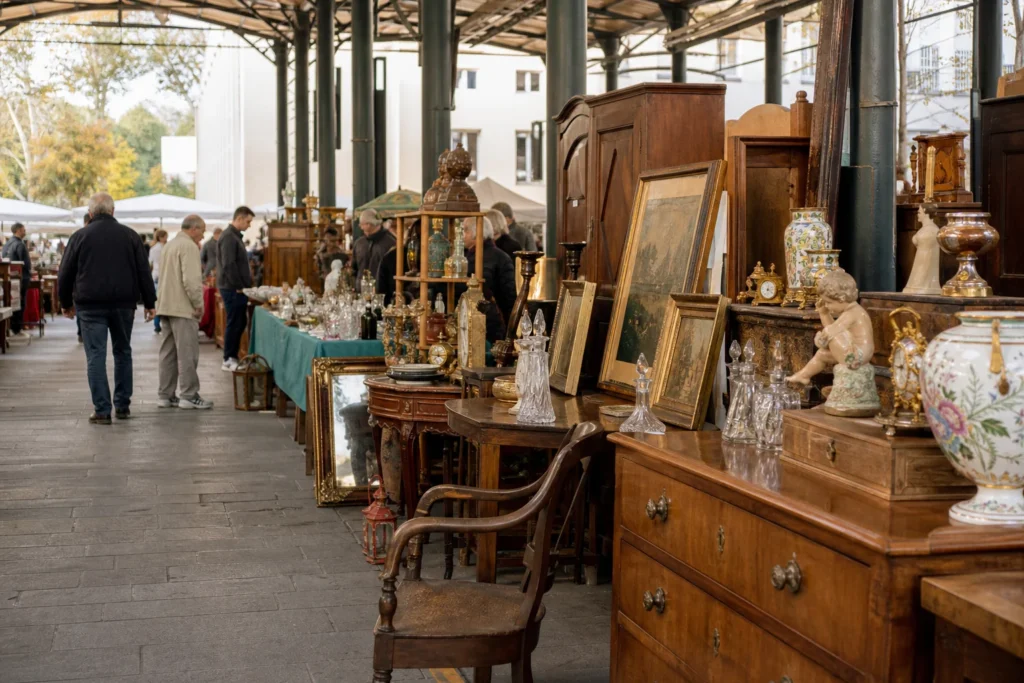

On the third or fourth Sunday of the month, from February through December, a particular kind of Florence reveals itself in Largo Pietro Annigoni. The crowds thin, the pace drops, and the covered stalls of the Mercatino di Piazza dei Ciompi open their doors from nine in the morning until six in the evening. The square sits at a calm remove from the city's famous piazzas. It draws a different kind of visitor — one who arrives looking for something specific, and often leaves with something unexpected.
The market's stock divides broadly into two registers, and the contrast between them is part of its personality. On one side sits the refined: ornate Florentine frames, leather-bound books, porcelain figurines, Persian rugs folded and stacked against stall walls, and sepia film posters in various states of preservation. On the other, a more chaotic category — rural tools, mechanical cogs, wrought-iron candleholders, and bric-à-brac that resists easy description. Vinyl record crates surface regularly too. Neither register dominates. They coexist stall by stall, which keeps serious collectors alert and casual browsers entertained in equal measure.
Vendors here tend to know their stock in real depth. Strike up a conversation about the grain on an old wooden chest or the origin of a decorative tile and many will offer something more than a price — a brief, unscripted account of where the piece came from or what period it represents. That kind of exchange gives the market a communal texture that purely transactional markets rarely achieve. Florentines negotiate quietly over lamps. Students work through crates of records. Older visitors pause at objects that carry personal memory. Newcomers slot in naturally without feeling conspicuous.
Smaller objects often reward the closest attention. A clock face stripped of its hands, a silver spoon with a worn hallmark, a cracked locket — these carry a quieter, more concentrated sense of history than larger furniture pieces. Walking the full circuit takes under an hour at a steady pace, though the market suits lingering far better than efficiency. The covered stalls offer genuine shelter from summer heat and cooler-season wind, which makes Ciompi a comfortable visit across most of the year. Bringing small bills is practical habit at any Italian street market. An extra bag helps — finds here are often bulkier than expected.
The Agnolo bus stop sits approximately 140 metres from the market and serves bus lines 14, 23 N, C2 and C3, making it the most convenient public transport access point. Bus lines C2 and C3 also stop at Malborghetto and Piazza Annigoni, both within roughly 160–200 metres. Visitors based in the historic centre can reach Largo Pietro Annigoni on foot, as the market occupies a walkable position on the eastern edge of the old city.
Ciompi suits collectors hunting Italian decorative antiques and mid-century European ephemera, as well as vintage textile buyers and anyone new to Florentine markets who wants neighbourhood character over tourist spectacle. The scale is human, the atmosphere is unhurried, and the depth of stock across decades and categories makes it genuinely worth a Sunday morning.
Frequently Asked Questions
Q: What kind of stock does the Mercatino di Piazza dei Ciompi typically carry?
A: The market spans two broad registers that coexist stall by stall. On the refined side: ornate Florentine frames, leather-bound books, Persian rugs, porcelain figurines and sepia film posters. Alongside those you'll find rural tools, wrought-iron candleholders, mechanical cogs, vinyl record crates and general bric-à-brac. Smaller objects — a silver spoon with a worn hallmark, a cracked locket, a clock face stripped of its hands — often carry the most concentrated sense of history.
Q: When does the market take place?
A: The market runs on a Sunday each month, from February through December, with stalls open from morning until early evening. Check the Comune di Firenze market listings or the organiser's official page before you go to confirm the exact Sunday and current hours for your visit.
Q: How long does it take to walk the market, and is it worth arriving early?
A: The full circuit at Largo Pietro Annigoni takes under an hour at a steady pace, but the market suits lingering far better than efficiency. The covered stalls provide genuine shelter from summer heat and cooler-season wind, so there is no strong pressure of weather to move quickly. Arriving with time to spare rewards a slower approach.
Q: How do I reach the market by public transport?
A: The Agnolo bus stop, served by lines 14, 23 N, C2 and C3, sits approximately 140 metres from the market and is the most convenient access point. Bus lines C2 and C3 also stop at Malborghetto and Piazza Annigoni, both within roughly 160–200 metres. Visitors staying in the historic centre can reach Largo Pietro Annigoni on foot.
Q: Any practical tips for buying at Ciompi?
A: Bring small bills — useful habit at any Italian street market. Pack an extra bag, as finds here are often bulkier than expected. Vendors tend to know their stock in real depth, so asking about a piece's origin or period often prompts a genuine conversation rather than just a price.
Marketplace Highlights









Add a review