

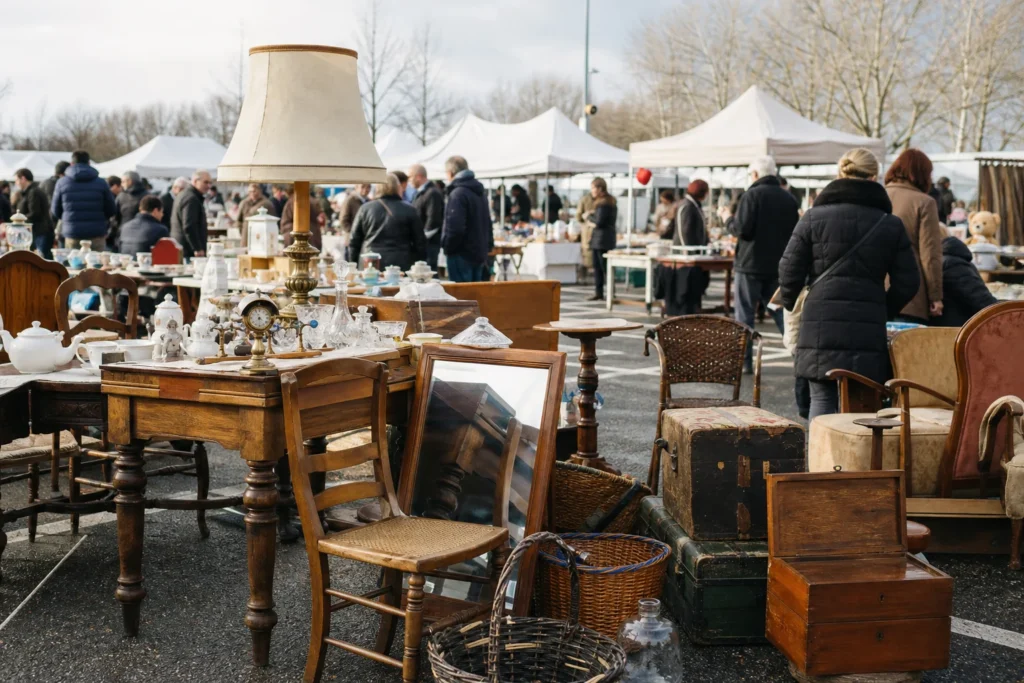

Kölner Stadtflohmarkt is permanently closed. The market is retained as an editorial archive of the venue and its distinctive character.
Cologne has long cultivated a flea market culture rooted in its neighbourhoods. Almost every district once ran its own weekend market, each with its own regulars, rhythms and flavour. The Kölner Stadtflohmarkt was one of the more established fixtures in that landscape — a Saturday institution that drew early risers to the Unicenter car park in the Sülz district, week after week.
The market opened around six in the morning, when the light was still thin over the Unicenter lot and sellers were setting out their tables. By early afternoon it was done. That short, concentrated window gave the market its particular energy — unhurried enough for conversation, but purposeful enough to reward those who arrived first.
What set the Kölner Stadtflohmarkt apart was its private-seller character. Stalls were run by individuals clearing out homes and attics, not by professional dealers with priced and polished stock. That distinction mattered. It meant inventory was genuinely unpredictable — a household dispersal one week, a lifetime's collection of ephemera the next. Sellers sometimes hadn't fully reckoned with what they were offering, and that uncertainty worked in a sharp-eyed buyer's favour.
The market enforced a strict ban on new goods. This wasn't just a rule — it was a commitment that shaped everything on offer. Every item had a prior life somewhere. Among the stalls, a careful browser might turn up decorative household pieces: bone china, crockery, tarnished silver plate. Printed ephemera appeared too — old photographs, illustrated periodicals, paintings, memorabilia with provenance only the seller could hint at. Vintage clothing, jewellery and small decorative trinkets rounded out what felt less like a retail spread and more like a series of personal archives made briefly public.
The Sülz district gave the market a neighbourhood warmth that larger, more commercial events rarely achieved. Conversations at stalls tended to linger. The market cafes offered a place to pause, carry a coffee between rows and slow down the morning. For regulars, the social rhythm was as much a draw as any individual find.
Among Cologne's many district markets — including the better-known Trödel an der Kölner Galopprennbahn with its more frequent schedule — the Stadtflohmarkt held its own ground through consistency and character. It ran every Saturday of the year, public holidays aside, and that weekly reliability built loyalty among both sellers and hunters over time.
The record of the Kölner Stadtflohmarkt remains a useful document of what a neighbourhood flea market could be at its best: privately run, authentically sourced, grounded in a single community, and shaped by the peculiar pleasure of not quite knowing what the next table might hold.
Frequently Asked Questions
Q: What kind of sellers traded at the Kölner Stadtflohmarkt?
A: The market was run exclusively by private individuals — people clearing out homes and attics — rather than professional dealers. That meant inventory was genuinely unpredictable, with household dispersals and personal collections appearing week to week rather than curated, priced-up stock.
Q: Were new goods allowed at the market?
A: No. The Kölner Stadtflohmarkt enforced a strict ban on new goods. Every item on sale had a prior life, which is what made it worthwhile for buyers hunting authentic secondhand finds rather than repackaged merchandise.
Q: What kinds of items typically turned up at the stalls?
A: Buyers could expect decorative household pieces such as porcelain, crockery and silver plate alongside printed ephemera — old photographs, illustrated periodicals and paintings. Vintage clothing, jewellery and small trinkets also featured regularly, the overall feel being closer to a series of personal archives made briefly public than a conventional market spread.
Q: Where in Cologne was the market held?
A: The Kölner Stadtflohmarkt was held at the Unicenter car park in Cologne's Sülz district, close to the University of Cologne campus. The neighbourhood setting gave the market a quieter, more community-oriented character than larger commercial events in the city.
Q: Is the Kölner Stadtflohmarkt still running?
A: The market is permanently closed. This record is kept as an editorial archive of the venue and its character as part of Cologne's district flea market history.
Marketplace Highlights







Sonja Ehrmann
20th August 2015 at 03:23The Kölner Stadtflohmarkt is a great place to sell your stuff you don’t need anymore. Throughout all year this place is open and offers a big variety eg. furniture, kitchen, toys, clothes and even more. I sold here several times and it was always big fun and a big success. Most people who came by were friendly and up to a chat. Of course sometimes people try to even pay nothing and think they can get everything for free or do not even try to negotiate. But hey, this is a flea market!
If you want to get the good stuff you need to come early right at the start as professional buyers try to pick the raisins. It is always fun to come here as a visitor as you also see ridiculous stuff sometimes. So if you have time at a Saturday, take your bike and ride to the Unicenter.
Julia Sacher
5th June 2016 at 21:00Klein, aber fein. Der Trödel findet wirklich bei jedem Wetter statt und ist super zu erreichen. Dass er so häufig ist macht den großen Pluspunkt aus. Hier ist man schnell drübergelaufen, aber für nen kleinen Besuch am Samstagmorgen lohnt es sich doch immer.